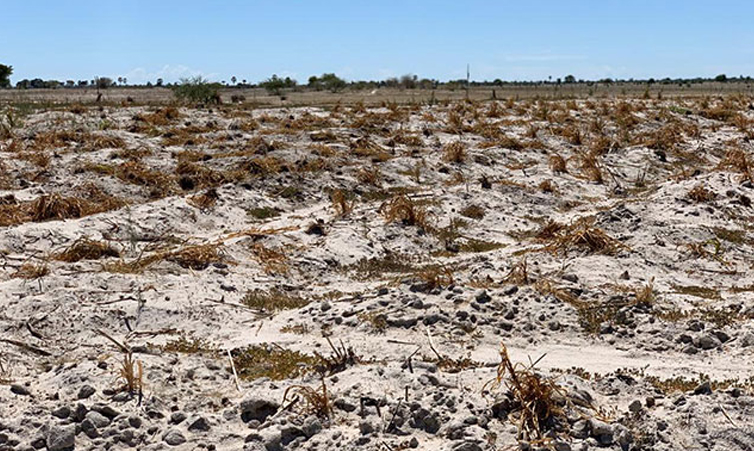
Land degradation and a lack of nutrients in the soil has been cited as some of the major problems contributing to poor food production in the Omusati region.
This was revealed at a one-day community meeting held at Omiyongo village in the Omusati region, which the Drylands Sustainable Landscapes Impact Project (DSL-IP) has chosen as the centre for a farmers field school (FFS), one of the activities the project plans to establish in the country.
The meeting was attended by residents of Omiyongo village, as well as people from surrounding village such as Amukulungu, Uukulu and Omalyadhila.
Participants were divided into five groups and asked to identify important tree species in their area and what major environmental challenges they face.
Selma Mateus (62) told the meeting that the land in their area is dry and degraded, while they also face water scarcity, soil erosion and a lack of grazing land.
“There is also the problem of goats dying after eating plastic bags while there is a plant locally known as ‘okayanga’ killing lots of goats after eating it,” Mateus says.
She says some of the most important tree species for their livelihoods include aloe vera, jackalberry, mopane, bird plum and palm trees.
Kritofina Kalilo from Uukulu village says sand and clay are important for their livelihoods because they use them to build and make clay pots.
Sacky Matthew from Omalyadhila village says that when floodwater fills the floodplains in their area, it brings fish and snails for domestic consumption.
However, Matthew says there is a plant locally known as ‘etope’, which degrades the soil in their area.
Also at Omiyongo village, an earth dam will be rehabilitated under the project and will be integrated into the FFS.
This is according to Isak Kaholongo, who is the project implementation officer in north-central Namibia.
The FFS will educate farmers in the Outapi, Onesi and Tsandi constituencies on how to attend to their local environmental challenges.
Once enlarged and deepened, the earth dam will be able to hold flood and rainwater for a longer period and the water will be used for human and animal consumption.
The three constituencies fall within the Kunene-Cuvelai Landscape of the Mopane-Miombo of northern Namibia under the DSL-IP, which is jointly implemented by the Ministry of Agriculture, Fisheries, Water and Land Reform and the Ministry of Environment, Forestry and Tourism, and funded by the Global Environment Facility through the Food and Agriculture Organisation.