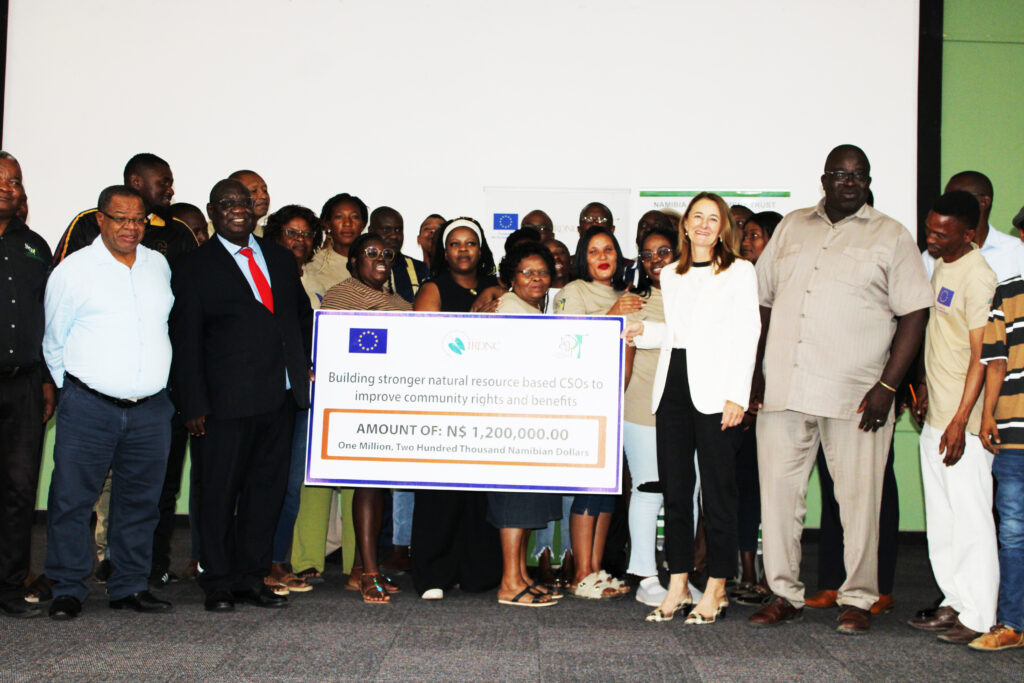
A Total of 15 civil society organisations have received N$1.2 million in grants to strengthen community rights and advocacy regarding land, wildlife, and natural resource management.
The grants were awarded in Windhoek on Tuesday under an initiative implemented by Integrated Rural Development and Nature Conservation (IRDNC) in partnership with the Namibia Development Trust (NDT), with funding support from the European Union.
The beneficiaries are the National Conservancies and Community Forests Alliance, the Nama Traditional Leaders Association, the Namibia Rural Women’s Assembly ||Kharas, the Namibia Rural Women’s Assembly Hardap, the Kunene Regional Communal Conservancy Association, the Family Tree Movement Foundation, the Omaheke Regional Conservancy and Community Forest Association, the Southern Kunene Conservancy Association and the Southern Natural Resources Management Association.
Other beneficiaries are the Erongo Communal Conservancy and Community Forest Association, the Kavango East and West Regional Conservancy and Community Forest Association, the Otjozondjupa Western Conservancy and Community Forest Association, the North Central Conservancy and Community Forest Regional Association, the Namibia Non-State Actors and Civil Society Network, and the Zambezi Communal Conservancy and Community Forest Association.
Speaking at the ceremony, IRDNC executive director John Kasaona said communal conservancies and community forests have shown communities can manage natural resources and benefit from them, but their rights face growing pressure from mining, green hydrogen and oil and gas exploration.
“Too often, decisions that affect people’s land, water, wildlife and cultural heritage are made without their voices being heard,” he said, adding the grants would enable communities and their organisations to participate in decisions affecting their livelihoods.
The beneficiaries will focus on issues including mining, forestry, sand mining, green hydrogen, wildlife management and the participation of women and young people in decision-making.
Kasaona said the project would also strengthen awareness of the Extractive Industries Transparency Initiative) as Namibia expands its extractive industries.
“We want every organisation here to be equipped to ask the right questions and to hold both government and industry accountable to national and international standards,” he said.
NDT board chairperson Sam Gaiseb said the funding should be viewed as a catalyst for grassroots transformation rather than simply financial assistance.
“By equipping our natural resource-based civil society organisations, we’re empowering them to drive targeted advocacy actions and campaigns,” he said.
Gaiseb urged beneficiaries to manage the funds transparently and ensure they produce tangible benefits for rural communities.
Kunene Regional Communal Conservancy Association chairperson Sam Katupa said the association would focus on the land bill, wildlife management and “unprofessional mining activities” in the Kunene region.
He said communities are not opposed to mining but want it conducted responsibly.
Namibia Non-State Actors and Civil Society Network chairperson Stallin Maharero said the network would focus on corruption, transparency and accountability, including advocating for Namibia to join the transparency initiative.
National Alliance for Conservancies and Community Forests chairperson Thomas Muronga raised concerns about proposed changes to communal land boards, saying the removal of conservancy representatives could weaken their voice in decisions affecting the land they manage.
Southern Kunene Conservancy Association chairperson Charlotte !Ganes said her organisation would focus on helping communities coexist with wildlife, prevent human-wildlife conflict, and secure greater benefits from natural resources.
NDT chief executive Ronny Dempers highlighted the importance of partnerships in advancing community rights, saying people go further when they work together.