



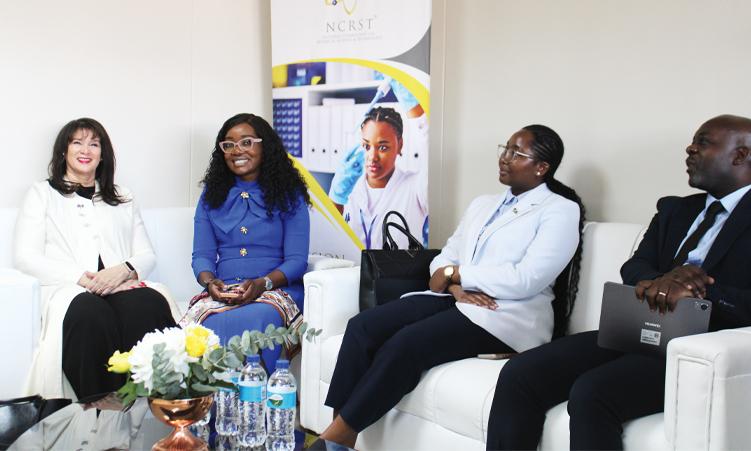
Namibia has officially launched the National Artificial Intelligence Institute to boost research, local innovation, youth skills development, and digital public service transformation.
Minister of information and communication technology Emma Theofelus officially launched the institute in Windhoek on Wednesday.
She said the institute forms part of Namibia’s broader digital transformation agenda.
“The institute creates a dedicated national platform through which capabilities can be developed around artificial intelligence, data, innovation and practical applications,” she said.
The institute comprises a software development centre, datasets centre, artificial intelligence (AI) innovation centre, and research and development centre.
National Commission on Research, Science and Technology (NCRST) chief executive Anicia Peters at the launch said Namibia could not afford to remain merely a consumer of AI developed elsewhere.
“We must develop the national capabilities to understand AI, adapt it to our circumstances and increasingly develop our own solutions,” she said.
Peters said the institute would bring together the government, academia, industry and other stakeholders to strengthen national AI capabilities.
The National AI Strategy was developed through a process involving 215 local AI experts and stakeholders, with support from the United Nations Educational, Scientific and Cultural Organisation, the United Nations Development Programme and the Konrad-Adenauer-Stiftung,” she said.
She said the strategy has reached the synthesis and national validation stage before being considered by the minister and ultimately submitted to the Cabinet.
Peters said the institute would focus on AI research linked to national priorities such as water, energy, food security, health and education.
She said it would also support the development of AI-enabled applications, particularly for e-government and public services, while providing young Namibians with opportunities to gain practical experience by working on national development challenges.
“We do not want training to exist separately from implementation. Where possible, learning must happen through building,” Peters said.
The institute will also focus on developing and managing quality Namibian datasets, which Peters described as fundamental to developing AI systems that understand the country’s context.
“If our AI systems are to understand Namibia, they must increasingly be trained and tested using data that represents Namibia,” she said.
Theofelus said the institute could also support the government in using technology to improve public services.
“Citizens should experience digital transformation through services that are easier to access, more responsive and more efficient,” she said.
“We should be able to bring a public-sector challenge to this institute, work with the relevant expertise, test a solution and determine whether that solution can be responsibly deployed at scale,” Theofelus said.
The minister said Namibia needed to develop local expertise instead of relying exclusively on external sources for AI solutions.
“Our companies should not have to look exclusively outside Namibia for expertise and solutions. We need to grow an ecosystem in which some of that capability is available locally,” she said.
Deputy executive director of higher education, training, research and innovation Lisho Mundia on Wednesday said the institute would strengthen Namibia’s research, science, technology and innovation system.
“Research undertaken at our universities and research institutions must increasingly contribute to national priorities, industrial development and the improvement of the lives of our people,” he said.
He said research should not end with publications but should progress towards practical outcomes, including prototypes, products, services and enterprises.
Mundia said the institute would also provide opportunities for students, researchers, innovators and industry partners to develop and test ideas.
The institute is expected to work with the government, universities, research institutions, industry and young people to strengthen Namibia’s AI and innovation ecosystem.
Peters said responsible AI would be the overarching principle guiding the institute.