




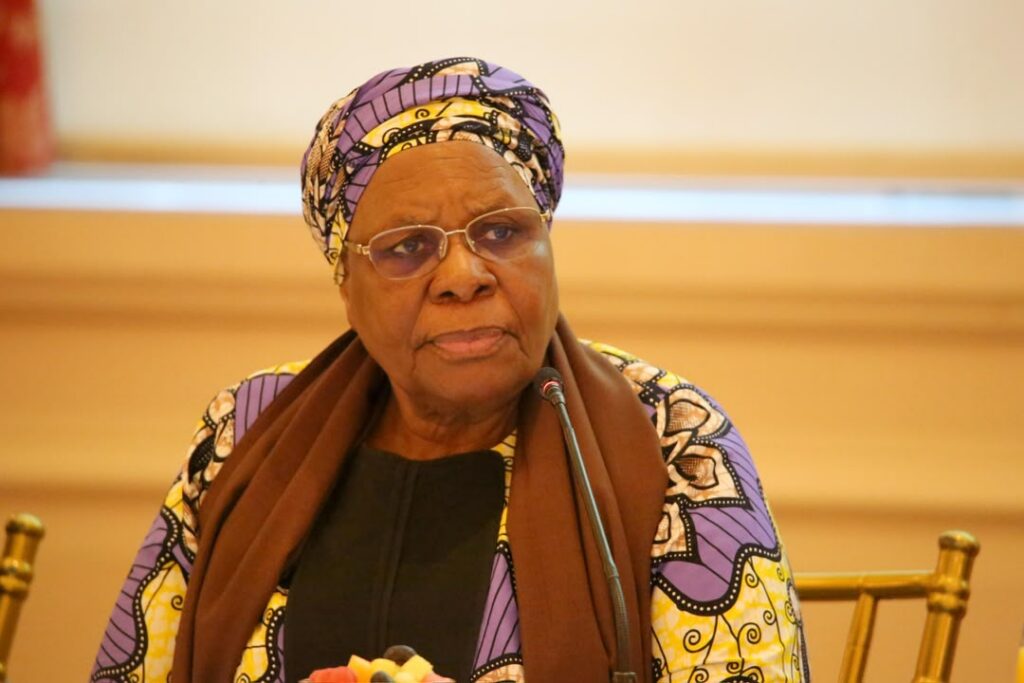
Remarks by H.E. Dr. Netumbo Nandi-Ndaitwah, President of the Republic of Namibia
New York City, 21 September 2026.
Ms. Kendra Gaither, President of the U.S.-Africa Business Center;
Ladies and Gentlemen,
Good morning.
New York is a city that stays with you. Each visit brings back memories of earlier journeys, important conversations and the unmistakable energy of a city where the world meets.
It is a pleasure to join you for this Executive Breakfast and for what I hope to be forward-looking conversation between Namibia and the United States business community.
I thank the U.S. Chamber of Commerce and the U.S.-Africa Business Center for bringing us together. I am pleased that Namibian business leaders are also with us, to engage their American counterparts, build networks, explore commercial partnerships, exchange expertise and identify opportunities for investment and market access.
Namibia’s Economic Transformation
Namibia is a relatively small economy, but our strategic value extends far beyond the size of our domestic market. Located on the Atlantic coast, Namibia is well positioned to serve as a logistics and trade gateway into the SADC region, with access to a market of approximately 400 million consumers. Through our ports, transport corridors and expanding infrastructure, we are positioning Namibia as a logistics, energy, minerals and investment hub connecting global markets with Southern Africa.
We are also committed to the opportunities presented by the African Continental Free Trade Area, AfCFTA. Hence, our ambition is to enable businesses investing in Namibia to use our country as a platform to reach a much larger African market. That matters to U.S. companies seeking to diversify supply chains, establish a presence in Africa and reach emerging markets across the continent.
Strategic Areas of Opportunity
The opportunities are significant and ready for serious engagement.
• In oil and gas, Namibia is entering an important new phase following significant offshore discoveries. The opportunity extends beyond exploration and production to services, logistics, technology, skills development and the wider industrial value chains that can grow around the sector.
• In energy, Namibia has enormous renewable energy and green-hydrogen potential. We intend to develop these resources responsibly and use them to drive industrialisation, value addition and economic diversification.
Critical Minerals
Another area of strategic importance is critical minerals. Namibia has significant reserves and resources of minerals essential to energy security, advanced manufacturing and the global energy transition. These include uranium, lithium, rare earth elements, copper, cobalt, graphite, manganese, tantalum and tin.
For the United States, Namibia offers more than mineral resources. We offer the opportunity to build secure, transparent and resilient critical-mineral supply chains with a trusted partner.
Our objective is clear. We will not remain exporters of raw natural resources and importers of value-added products. We seek investment in local processing, refining, technology, skills and downstream industries so that our resources create jobs, grow Namibian businesses and advance industrialisation.
This is a strong opportunity for U.S. companies to partner with Namibia across the value chain, from exploration and extraction to processing, logistics and manufacturing.
Trans-Kalahari Railway Line Project and Walvis Bay as a Logistics Hub
The feasibility study for the railway linking Namibia and Botswana has been completed, bringing this strategic project closer to implementation. The tender for its development and construction is expected to be issued soon.
This is a significant opportunity for investors and companies with expertise in rail infrastructure, engineering, construction, logistics, financing and related services.
• It is a modern economic corridor connecting Namibia’s Atlantic ports with Botswana and the wider SADC region, and facilitating the movement of minerals, agricultural products, manufactured goods and other commodities.
• The Trans-Kalahari Railway can become a platform through which Namibia, Botswana, the United States and other partners build commercially viable infrastructure and regional value chains.
Tourism, Sport and the Creative Economy
Tourism remains an important pillar of Namibia’s economy, with opportunities in hospitality, conservation, aviation and tourism infrastructure. Sport and the creative industries also hold growing potential.
American expertise, investment, technology and global networks can make a meaningful difference in these sectors.
We seek partnerships that bring technology, innovation, skills, market access and opportunities for Namibian enterprises and our young people.
That is the value of this Roundtable.
Let us use today’s engagement for an open and candid conversation. I want to hear from you:
• What do you see in Namibia?
• Where are the strongest opportunities?
• What barriers do you face?
And what can we do together to unlock greater investment and commercial cooperation?
I encourage our Namibian business leaders to use this platform fully: build networks, explore partnerships and establish relationships that continue well beyond today’s breakfast.
We invite American businesses to invest in Namibia, partner with Namibian enterprises, participate in our infrastructure development, support our industrialisation and unlock opportunities across our economy and the wider African market.
I thank the U.S.-Africa Business Center at the U.S. Chamber of Commerce for hosting us. I look forward to our conversation and, more importantly, to the partnerships that will follow.
Thank you.