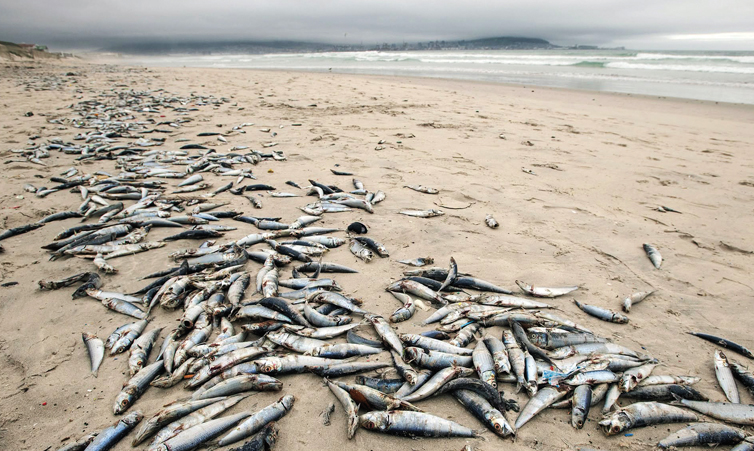
Mass Pilchard washouts are currently a major concern along the South African and Namibian coastlines.
What started as isolated events near Cape Town last month quickly developed into widespread mass strandings along South Africa’s Western Cape coast, reaching as far as Gqeberha in the Eastern Cape and even far north to Langstrand, Walvis Bay, Swakopmund and Henties Bay.
Scientists have detected sardine herpesvirus (PHV) in both live and dead fish in South Africa.
However, it is still unclear whether the virus is causing the deaths or simply making fish more vulnerable to other environmental stressors such as harmful algal blooms, low-oxygen areas or warmer sea temperatures.
Testing of samples from Namibia is still underway. The Benguela ecosystem stretches from South Africa’s west coast to southern Angola, so a link between the events is possible.
Namibia’s fisheries department is working with its South African counterpart to share samples and investigate a possible connection.
Until more information is available, Namibians are urged not to collect or eat washed-up fish as they could pose a health risk.
FOOD CONCERNS
Another concern is the delay in test results. Many coastal communities have limited access to food, making the washed-up fish an important source of nutrition.
While people are advised not to eat them until results are available, some are already drying the fish while waiting.
Namibia’s fishing ministry spokesperson, Romeo Muyunda, reported that the number of dead fish found is “not a lot”.
However, fewer fish washing up in Namibia does not necessarily mean fewer fish have died.
Strandings may have gone unrecorded along the remote Skeleton Coast or further north in Angola, while dead fish offshore can sink, making the true scale of the die-off difficult to determine.
Despite the low numbers found on our shores so far, experts are increasingly concerned about the possible impact on the Benguela Current ecosystem.
Sardines have already declined sharply after decades of overfishing, yet remain an important part of the marine food web.
Further losses could have a serious ecological and economic impact.
VULNERABILITIES
In South Africa and Namibia, African penguins are especially affected as their main prey is anchovy and sardine.
Today, only about 1% of their original population remains because food shortages and other factors make them especially vulnerable to additional shocks.
BirdLife South Africa has already reported poorer penguin conditions on Dyer Island and at Stony Point.
Mass sardine die-offs in Australia in 1995 and 1998 were linked to PHV. A 2001 study found that sardine spawning biomass dropped by 75% after the first die-off and another 70% after the second.
The outbreaks were linked to untreated frozen sardines imported to feed farmed tuna.
South African fish showed a 99.7% genetic match to the Australian virus, but this does not prove how it reached southern Africa.
Still, imported frozen sardines are currently considered the most likely pathway.
Following the outbreak, a moratorium on the sardine fishery has been debated in South Africa.
It prompted authorities to restrict catches to 25% of the remaining quota until the results of a new hydroacoustic survey in October/November – which will assess sardine numbers – are available.
CONSEQUENCES
In Namibia, no similar actions have been taken so far.
Instead, the government successfully auctioned 3 500 metric tonnes of pilchard on 4 September.
Even though the scale of the washouts appears smaller here, the impact on sardine stocks still needs to be assessed.
Continuing business as usual without knowing the full impact could cause lasting damage to the marine ecosystem, with consequences for the fishing industry and coastal communities.
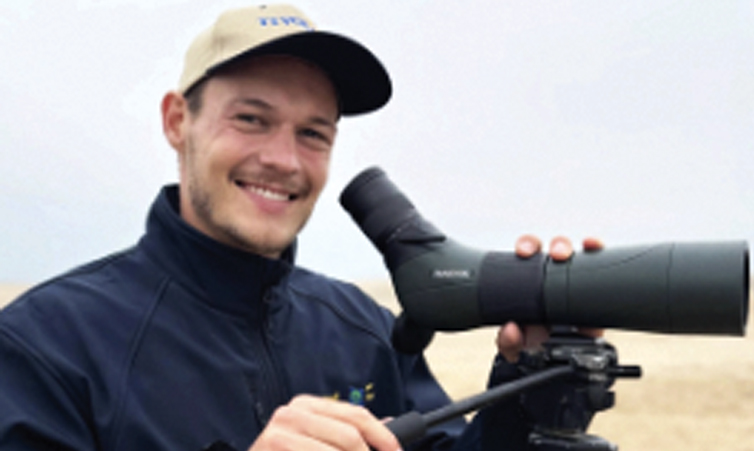
– Damian Schreiber is a marine conservation communications, field and research officer at Ocean Conservation Namibia; he is involved in seal rescues, education outreach, and beach clean-ups. He holds a master’s in ecology and society from the University for Peace (Costa Rica).