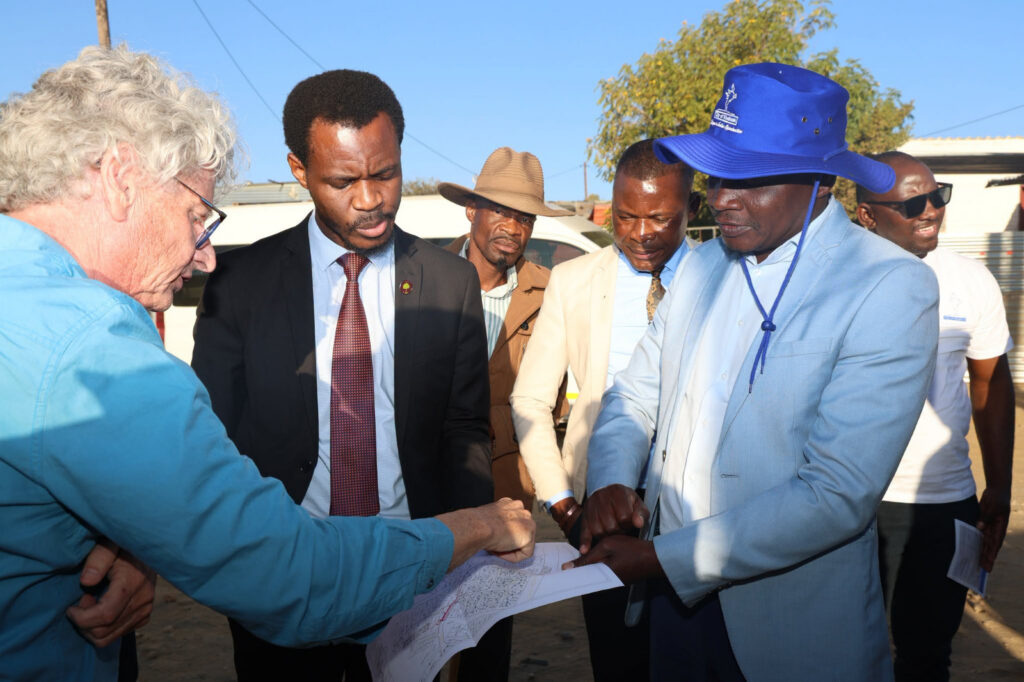
The City of Windhoek’s electrification programme targeting 1 298 households across informal settlements is making steady progress, with work at several sites nearing completion as the municipality moves to expand access to essential services.
The city leadership, led by chief executive Moses Matyayi and councillors, visited various project sites including Mix Settlement on Friday to assess the progress made since the programme was launched in April this year.
Matyayi says the visit aimed to update residents on the implementation of council resolutions and demonstrate the municipality’s commitment to improving living conditions in informal settlements.
“We just wanted to update the residents of Windhoek on the activities the council is busy with and on the projects that were commissioned,” he said during the visit to Mix Settlement, north of the capital.
“Here in Mix Settlement, we launched the electrification process earlier this year, and we are pleased to see that there is progress.”
According to Matyayi, the Mix Settlement project, which will connect 267 households to the city’s grid, is about 80% complete.
“There is just the connection to the power lines that still needs to be completed. We are quite happy with the current progress of this project,” he said, adding that the development, valued at over N$6 million, also includes overhead power lines and street lighting.
The delegation inspected electrification projects in the Tobias Hainyeko constituency, where 491 households are earmarked for electricity connections. A further 260 households will be connected in the Moses ||Garoëb constituency, while 280 households in the Otjomuise area are set to benefit from the programme.
Councillor Ivan Skrywer, who was part of the visiting delegation, says the site inspections demonstrated the council’s commitment to ensuring projects approved for communities are implemented.
“The site visit is for us to acquaint ourselves with the progress of council decisions. This is a success story. We have young graduate engineers spearheading the work under the supervision of senior engineers, and the project is progressing well,” he says.
“When we say we are a caring city, this is what we mean. When we say we are restoring our people’s dignity, this is indeed what we mean,” he adds.
One of the beneficiaries, Maxi Geises, has welcomed the project, saying she had lived in Okahandja Park since she was an infant without access to electricity. She says she moved with her mother to Okahandja Park when she was nine months old. Today she is 29.
“It was a struggle because we had to use candlelight, and later we depended on solar power. Now it will really improve our lives because children will have enough light to study, and we can live more comfortably in our own home,” she says.
– Nampa