






• N$250 million to N$350 million likely lost • “Now we have nothing left”
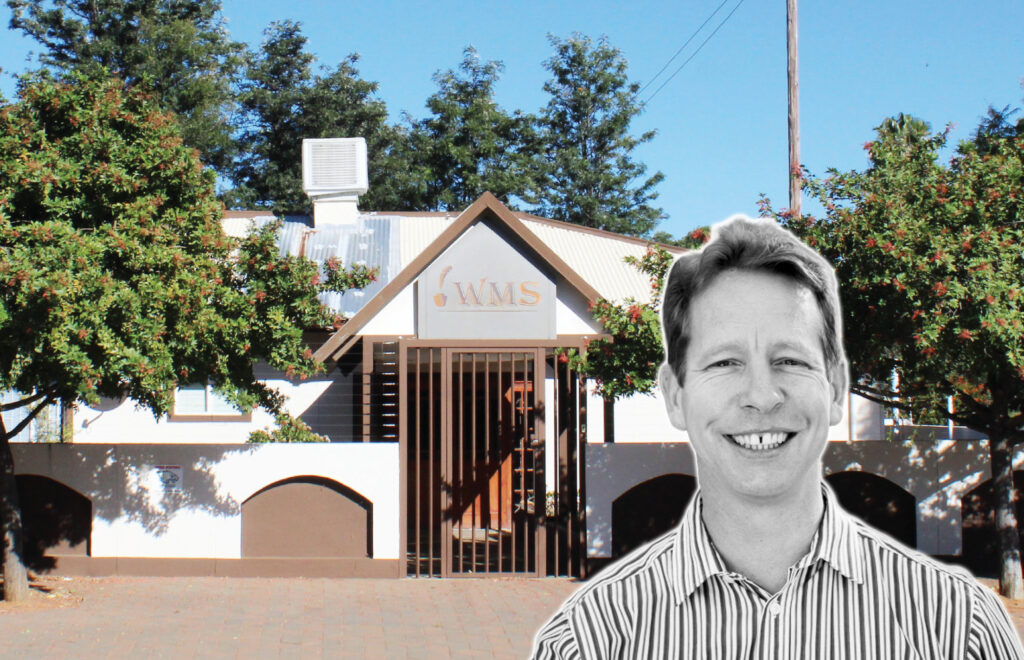
At least N$250 million belonging to Namibian pensioners and families has been lost after a Windhoek financial advisory firm risked their savings on foreign investments.
After losing money overseas, Wealth Management Solutions (WMS) owner Hanjo Schlabitz allegedly paid out clients from other people’s accounts to hide the losses and keep his firm afloat.
Investors say they were not kept informed of WMS’ deepening financial woes and kept paying into a failing firm.
A total of 87 people and two organisations have come forward to recover what they can, but the liquidator estimates the total losses are likely to reach N$350 million.
Wealth Management Solutions has for years advertised itself as a go-to financial advisory that expands people’s wealth.
Many of its clients were elderly people who had trusted the firm for years. Some had started investing 20 years ago with Schlabitz’s father, who founded the firm and built its name in the tight-knit German-Namibian community.
Others include non-profit organisations that are now at risk of retrenching their employees.
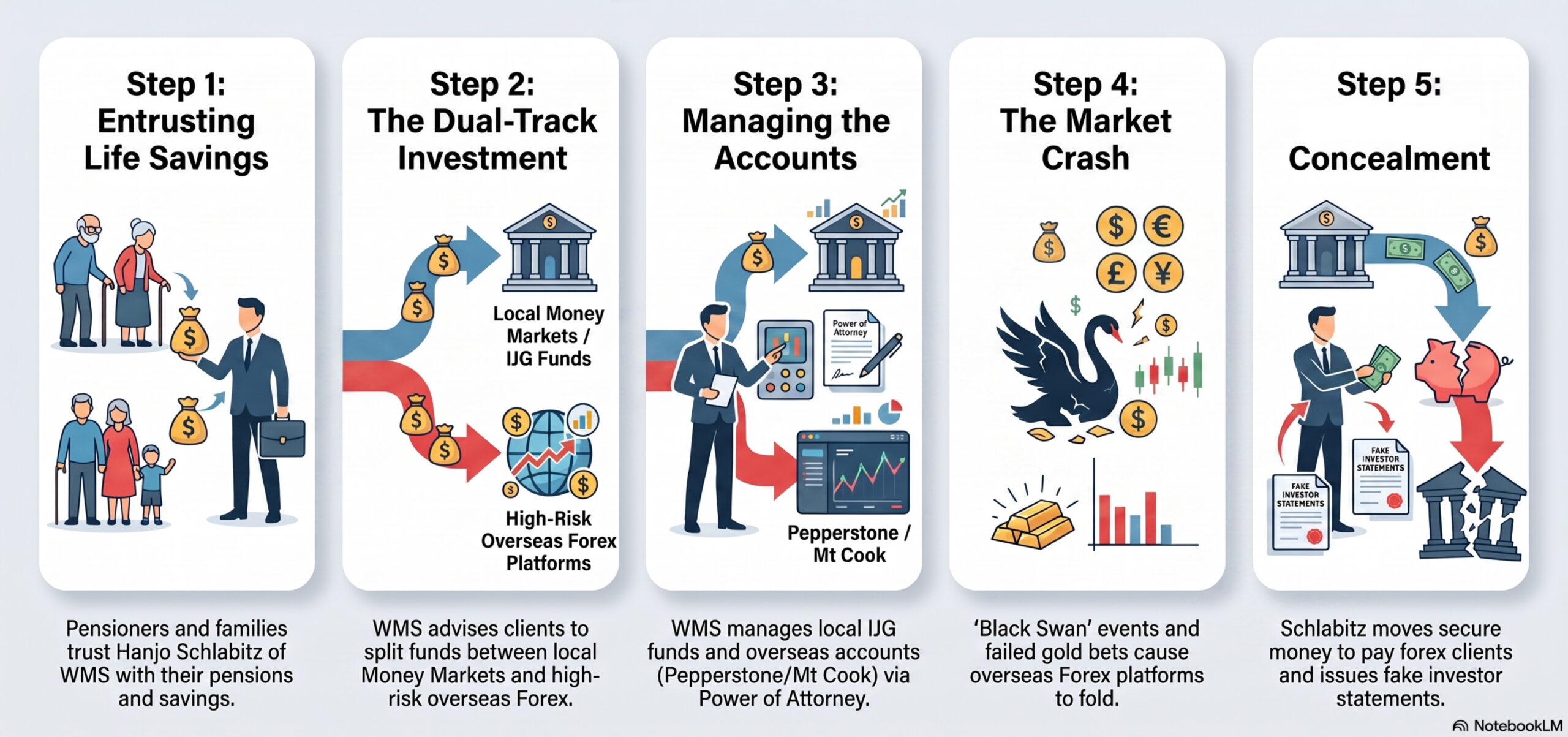
Schlabitz invested savings and pensions on their behalf. Part of it went into local investment companies.
The rest was invested abroad and placed on digital trading platforms called Pepperstone and Mt Cook that bet on the rise and fall of currencies and commodity prices.
Schlabitz promised clients they would earn around 7% a year in the money market fund and up to 20% on their investment in foreign exchange, according to investors The Namibian has spoken to.
But the money invested overseas disappeared this year after one of the trading platforms – Mt Cook – collapsed.
Schlabitz could not be reached for comment via phone, text message or email.
The Namibian recently visited his offices, which were closed.
LIQUIDATOR CONFIRMS
Schlabitz’s Wealth Management Solutions applied for voluntary liquidation on 21 April, a month after it lost a large sum of money in foreign exchange trading.
Wiam Schickerling was subsequently appointed as the liquidator to shut down the company and try to recover creditors’ funds.
Schickerling believes the final amount owed to creditors is likely to total about N$350 million. He urges outstanding creditors to submit their claims with his office.
“Roughly 70% of creditors have filed claims. I think the total [of claims] is going to go to N$300 or N$350 million,” Schicklerling has told The Namibian.
Crucial to the claims of improper use of investors’ funds are statements by the liquidator and the minutes and transcripts of a creditors’ meeting held on 3 June.
Schickerling says Schlabitz confirmed directly that he withdrew funds from money market clients to pay off other clients.
The money market account in question is held by IJG Securities.
The amount in the IJG account should be N$47.7 million, according to the statements investors received.
The amount in the account after transfers by Schlabitz is N$17.3 million.
“He had already suffered losses from 2023. After 2023, some clients requested the repayment of their investments.
He then withdrew money from the money market,” the liquidator says.
Schlabitz paid out at least two clients with the money, hoping to make up his losses at a later date.
Although this began in 2023, Schlabitz continued to accept new clients through 2026.
“Most of these clients are old people who started investing with his father.
Some 90% of them lost their entire pensions.
One couple testified he [Schlabitz] requested them to move all of their pension to Mt Cook in February.
They lost everything,” Schickerling says.
Currently, a total of 118 claims have been lodged against WMS, most of them people who have invested their life savings and pensions with Schlabitz.
Just N$18 million remains in WMS, including the money market and moveable goods, according to the liquidator’s preliminary investigations.
“He lost most of his money last September.
I think he felt bad that he lost most of his clients’ money, so he issued fake statements,” Schickerling says.
PENSION PLANS RUINED
The Namibian spoke to 17 of the alleged victims over the past month.
One of them is a woman (63) who deposited nearly N$400 000 with Schlabitz and planned to use the funds to retire in two and a half years. She declined to be named.
“It feels like someone punched me in the gut. I feel humiliated because Schlabitz has been doing business with my family for years. He knows we trusted him,” she said.
She deposited her savings into the money market account after checking what the returns were. They were good, but in line with other investments: nothing raised red flags.
“The statements were saying my money was growing. According to deposits and interests, the amount seemed to be correct,” she said.
Her daughter had been doing business with Schlabitz for years and recommended him to her mother when her pension matured.
“I told her it’s zero risk. Usually it was very secure. But he [said in the meeting that he] forged some of the statements and it’s really bad for us,” her daughter said.
She specifically recommended a low-risk investment because she did not want her mother to gamble with her pension savings.
“I’m very disappointed because [Schlabitz] took IJG money to pay out higher risk clients who lost their money,” she said.
In March, The Namibian reported that WMS placed funds with IJG Securities, a Namibian stockbroker, which says the funds it has in WMS’ name are safe.
“If he had not used other clients’ funds from his IJG pool account, all would have been fine. Mt Cook [one of the products offered to clients] collapsed, we lost money and finished. It’s such a mess because he dabbled with money he was not allowed to touch and he admitted to that during the first meeting,” another of the clients said.
Another pensioner (71) who had over N$400 000 in savings in Schlabitz’s company said: “A week earlier [before receiving the news] I had called [WMS] to ask for N$30 000 to be put on my account. That’s what I have [of my pension] now.
“I have no idea what I’m going to do. Maybe my son can help me.”
N$16 MILLION GONE
A client who invested over N$16 million in WMS told The Namibian this week she feels misled.
“I said never, ever [put my money into] anything high-risk. He always said it was safe,” the client said.
She became concerned about keeping investments overseas due to the war in the Middle East, but Schlabitz just told her he could not log into the trading system.
In March, she gave Schlabitz funds to invest in the Namibian money market account. In April, she requested some of the money to be paid out to her for an expense, only to be ignored by WMS.
She reached out to IJG and Pepperstone to find out about the money she believed was invested in her name, only for both to tell her they had no record of her as a client.
Then she received the news about the liquidation.
“He misled me until the last minute. I gave all my investments, all my savings to him. Now we have nothing left,” she said.
“He knew all my dreams. And it was cut, just like that,” she said.
She said she put her savings and that of her children into investments as a safeguard for their future. She invested in several different products and spoke clearly to Schlabitz about her needs and her risk appetite, she said.
“It’s unbearable what he did,” she said.
“The bubble burst for us,” her partner said. “You realise you’ve got your wallet and what’s in it and nothing else.”
Another client said he was careful to request that Schlabitz put his N$10 million in investments into different investment products. He split his savings into IJG, Pepperstone, and Mt Cook.
“I told him I want three investments. If one thing is gone, then I still have the other two,” he said.
Although Mt Cook folded, Schlabitz should have had money left. Instead, the money from the money market account has disappeared, allegedly to pay out other Mt Cook investors.
IJG has in the past distanced itself from Schlabitz’s WMS.
16 YEARS’ SAVINGS GONE
A younger client who declined to be named said she began investing with WMS because her family had trusted the company for years and invested over N$5 million through Schlabitz.
“The products that were sold to my family directly seemed like fail-safe options. For me personally, I was just with the money market so I didn’t think my money would have gone somewhere [when I found out about Mt Cook],” she said.
She was shocked to learn at the creditors meeting that her money had been used to pay out other clients.
“Most of the people were well above retirement age, and it’s not fair to them,” she said.
“As a professional financial adviser he should have kept the accounts separate. I feel it’s completely irresponsible to use other people’s investments to cover up,” she said.
She said her father had been asked to move more money into Pepperstone earlier this year by Schlabitz, and felt lucky that her father had refused.
“I am not optimistic I will get even half of my money back. My family has similar sentiments,” she said.
Another client lost the N$150 000 in savings he had in the name of his wife and child.
“That’s 16 years of savings. I don’t have any other investments. I’ll have to work at least 10 years to [save that money again],” he said.
He added that he, however, holds no grudge against Schlabitz.
People invested in high-risk forex trading would have accepted the risk before they invested and should have been told honestly the money was gone.
“My opinion is that the company went a bit south on overseas investment. Unfortunately, Schlabitz overreacted and gave some of our local investors’ money to [those who lost it overseas],” he said.
Even though he has lost all his savings, he said he still has his business, unlike others.
One client said he believes he was given adequate information by Schlabitz about the potential risks involved.
He is only disappointed that Schlabitz was not honest about the state of his investment and began making up statements to cover himself.
WHAT REALLY HAPPENED?
The collapse of the firm began in March this year, when a fall in gold prices wiped out all the money that Schlabitz had invested in a trading platform called Mt Cook.
Schlabitz offered his clients access to two international trading platforms: Pepperstone and Mt Cook.
These are trading platforms where people buy and sell currencies or commodities, essentially betting on whether prices would go up or down.
Schlabitz was the trader, but the accounts are in the name of clients and they put money directly onto the trading platforms.
Pepperstone and Mt Cook provided financial statements about individual trading accounts. Schlabitz, with a power of attorney, received those statements and shortened them to be easier to understand.
On 23 March, an abnormally large number of traders on Mt Cook were invested in the price of gold, betting that the price would go up. But the price fell and Mt Cook, which had so many traders borrowing money to bet on the price of gold, was unable to pay its debt and folded.
The WMS clients invested in Mt Cook lost all their money and WMS was forced to go into liquidation.
Prior to this, there were issues with the other forex trading platform, Pepperstone, as well. Since 2023, it has similarly experienced highly unpredictable changes in commodity prices that likely led WMS clients to lose money.
According to creditors’ lawyers, Schlabitz did not inform his clients of any losses and continued to provide the shortened statements showing they still had funds.
According to transcripts of the creditors meeting, Schlabitz described the statements as “misstated”.
POISONED CHALICE
Financial experts who spoke to The Namibian explained that financial advisers have a responsibility to explain the riskiness of overseas investments to their clients.
Forex trading has genuine appeal for Namibians with savings. The country’s own financial market is tiny, whereas forex is the largest financial market in the world.
“On paper, it sounds like an attractive way to access global markets from a small economy like ours,” economist Almandro Jansen says.
With algorithmic trading platforms like Mt Cook, it is even possible to make money without understanding forex trading.
But people who are encouraged by financial advisers to look at forex should understand how the algorithm trades, what the strategy is, and have seen real audited results.
“They should know whether their money is sitting in a segregated account that belongs to them, or whether it’s pooled somewhere the manager can dip into,” Jansen says.
Some of Schlabitz’s clients believe they had individual accounts with Pepperstone and Mt Cook, while others believe it is a segregated account.
“If a client signed up without clear answers to those questions, they were either not properly informed, or actively misled. Either way, that’s a problem that sits with the adviser,” Jansen says, adding that regulation is also “messy”.
The Namibia Financial Institutions Supervisory Authority (Namfisa) is responsible for licensing and supervising financial advisers in Namibia.
Namfisa, however, has limited control over the overseas platforms Namibians invest in.
“When fraud happens at the adviser level, the client is left chasing someone in a gap between jurisdictions. The offshore platform says talk to your local adviser. Namfisa says the platform is foreign. And the client is the one with an empty account,” Jansen says.
Financial analyst Eric van Zyl says financial advisers and anyone managing wealth have a responsibility to check how much risk their clients are willing to take on.
“If it’s a very wealthy individual and they have a high risk appetite and the wealth manager allocates 5% of their portfolio into high-risk products, it might be right for some people,” he says.
But objectively, people who are close to retirement should not be encouraged to put funds into something as high-risk as currency trading.
“Objectively, somebody who is nearing retirement needs lower risk investments if they are not wealthy. Someone who is 60 to 70 doesn’t have time to make up losses,” he says.
He says his experience in similarly volatile environments as forex leads him to view it as highly risky. Even banks with dedicated teams lose money in these markets.
Namfisa did not respond to questions about their regulatory practices or whether they were following WMS’ activities by the time of going to print.

Key takeaways
“It feels like someone punched me in the gut” – A pensioner (63) who trusted Schlabitz with nearly N$400 000 of her retirement savings.
The liquidator estimates total losses will reach around N$350 million, with just N$17 million left against 118 claims.
Schlabitz admits that he used ‘safe’ clients’ savings to pay for foreign investments.
A client who invested over N$16 million in WMS says she feels misled.
WHO IS HANJO SCHLABITZ?
Schlabitz has worked at Wealth Management Solutions since 2008.
He took over the firm from his father, Wolfgang Schlabitz, who in 2016 died in a freak accident on his farm.
The younger Schlabitz is in his late 40s and is described by his clients as confident and competent.
He is a chartered accountant, certified financial planner, and registered as a member of the Institute of Chartered Accountants in Namibia.

Schlabitz was the chairperson of Hope for Life Foundation, a non-profit organisation overseeing projects such as JoyHouse Children’s Village.
He was removed from this position once concerns about his firm were made public, but his wife remains on the board.
Schlabitz was also the vice president for finance on the Namibian Gymnastics Federation’s executive committee and a member of the Deutsche Höhere Privatschule board.
He no longer holds these positions.
Q&A with Simonis Storm economist Almandro Jansen on forex
What is forex?
Forex is just currency trading.
You’re essentially betting that one currency will strengthen against another.
So if you think the US dollar is going to rise against the euro, you buy dollars and sell euros, and if you’re right, you make money on the difference.
What is a ‘high-risk’ investment in this case?
Think about a money market account at Bank Windhoek.
You put money in, it earns interest, it’s in Namibia dollars, the Bank of Namibia is watching over the institution, and barring something truly catastrophic, you’re getting your money back.
That’s low risk.
Not exciting, but safe.
Forex is a completely different animal.
Most platforms let you trade on leverage, meaning you can control a position worth 10 or 20 times what you actually deposited.
That’s great when markets move in your favour and brutal when they don’t.
A small adverse move can wipe out your entire account before you’ve even had time to react.
Who regulates this?
At the Namibian end, Namfisa is responsible for licensing and supervising anyone giving investment advice or managing client funds locally.
The Financial Intelligence Centre also plays a role around suspicious financial flows.
On the platform side, Pepperstone is actually a fairly well-regulated broker; it holds licences in Australia, the United Kingdom, and Europe. Mt Cook is a different story and has attracted scrutiny.
But here’s the structural problem: The foreign regulator cares about the platform operating properly, not about what a Namibian adviser told a Namibian client before the money ever arrived on the platform.
And Namfisa has authority over the local adviser, but limited reach once the money has crossed a border.
*This article was produced by The Namibian’s Investigative Unit. If you know of wrongdoing that should be exposed, securely write to us at: investigations@namibian.com.na