



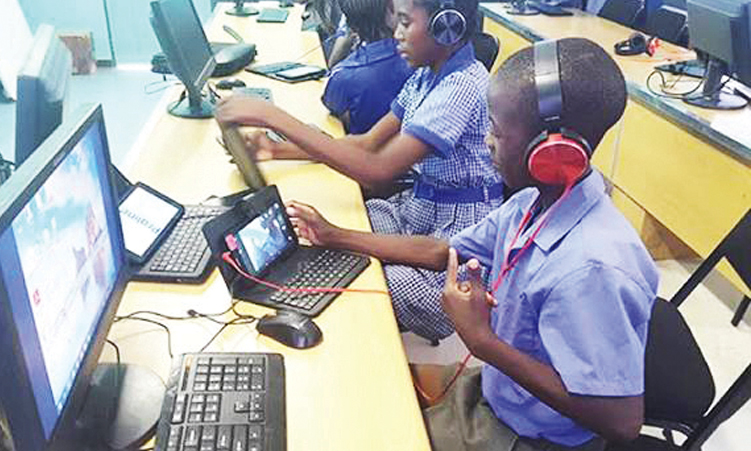
||Kharas governor Dawid Gertze says the newly established artificial intelligence (AI) tutoring laboratories at Angra Pequena Senior Secondary School bridge the gap between classroom learning and the frontier of modern industry.
Gertze says the AI laboratory will equip pupils with computational thinking, problem-solving and digital fluency required to compete globally.
He made the remarks at the launch of two AI laboratories at Lüderitz last week.
“This AI tutoring programme is a human capital engine built to redefine teaching. As our regional educational results continue their upward trajectory, this facility provides the momentum to push our schools to unprecedented heights,” Gertze says.
BW Kudu, an off-shore oil and gas company, and the Namibian Ports Authority (Namport), injected N$1.5 million into the AI- tutoring laboratory – which runs on the Yyeni AI learning platform, with connectivity provided by Telecom Namibia.
Yyeni AI is a Namibian educational technology company that developed the AI tutoring programme.
The initiative seeks to develop a scalable blueprint for AI-assisted learning in Namibia’s public education system by integrating AI tutoring with traditional teacher-led instruction.
Yyeni chief executive Vitalis Haupindi says the platform is an AI-assisted learning approach.
Haupindi says the tutoring laboratories blend classroom instruction with software, where staff have shifted toward guiding pupils individually as the system adapts material for them across subjects.
He says the technology can produce adaptive programmes to analyse pupils’ work and adjust difficulty or offer hints instantly, while reducing teachers’ workload by providing them with tools that help draft lesson plans, create quizzes, and write feedback more efficiently.
AI in education can also spot attendance issues or learning gaps, allowing schools to offer help sooner, while translation and speech-to-text features support multilingual pupils, as well as those with disabilities.
“The AI-powered tutoring programme was not introduced to replace teachers. It is about what the pupil is not understanding.
And then giving them correction lessons over and over until the pupil understands without the teacher marking many papers.
“So, that is only possible through AI; it was impossible a few years ago,” Haupindi says. BW Kudu general manager Manfriedt Muundjua says one of the greatest fears in introducing AI is the loss of jobs. Muundjua says the idea is to improve learning outcomes and to support teachers.
“I think that is one of the fears. But this enables us to work alongside teachers and provide access to education. So, I saw it was practical, measurable and scalable.
“Let us try to join forces and make impactful contributions to our community because the future belongs to our pupils,” Muundjua says.
Namport marketing specialist Cecil Kamupingene says the company is proud to contribute to initiatives that empower young people and advance digital innovation.
“Whether connecting industries from around the world or helping to shape the future of AI in education, our goal is to enable progress through reliable and predictable service provision,” Kamupingene says.
Pupils have welcomed the school’s AI tutoring programme, saying it has boosted their critical thinking and performance.
Annacleta Salvadore says she started as a scared pupil but is today confident because the AI tutoring made her better.
“I think it is beneficial in the way it is structured because it forces you to answer test or questions papers basically before you actually start the content, which makes it easier for you to grasp the information after you get corrections,” Salvadore says.
Yyeni plans to extend its AI tutoring programme to schools in all 14 regions by 2030.