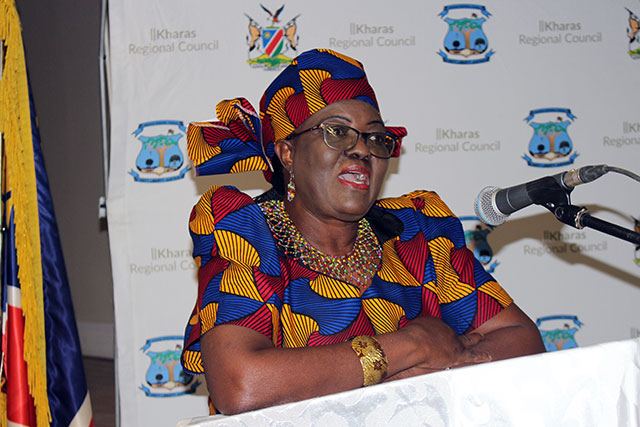
//KARAS governor Lucia Basson has called for commitment and transparency in public funds management from government agencies in the region, amid economic hardships currently prevailing in the country.
“Last year in my state of the region address, I indicated that accountability on public funds is non-negotiable, as far as I am concerned.
“Therefore, every government institution must account for every dollar spent during this economic hardship where our public revenue is not doing well,” said Basson when she delivered her state of the region address at Keetmanshoop yesterday.
This, the governor warned, does not mean people must not account when the economy recovers.
“My stance remains the same. Remember, this is a year of reckoning, and we shall reckon with those who refuse to account,” she warned further.
The governor called for transparency at all material times, saying the public needs to know how and for what purpose government money was utilised, while reminding all public servants to strictly comply with the conditions of funds disbursement in accordance with government treasury regulations.
“As civil servants and politicians, we must be able to justify our actions,” she stressed.
Basson directed all local authorities and regional councils to convene community meetings periodically to communicate council resolutions on projects, and to address residents’ complaints.
“Information on all government activities being implemented must be made available to the public,” she emphasised.
Saying the land question remains a vexing, complex and sensitive matter, Basson acknowledged that the willing buyer, willing seller principle the government adopted after independence has not produced the desired results.
Government had only bought land valued at more than N$14 million in 2016 under the land redistribution programme.
The governor implored unemployed youth and women to apply for mining rights, saying people can also transform the regional economy through small-scale mining.
She said the Noordoewer slate mining and processing facility, which has produced about 9 000 square metres of slate tiles since it started operations in mid-2015, has provided jobs for 13 people.
The governor also revealed that 7 288 citizens in the region currently receive social grants, as were 8 061 children.
According to Basson, the rate of neonatal deaths had decreased to 10 out of 1 000 live births during the year under review, compared to 12 out of 1 000 live births the previous year.
Furthermore, 391 babies born to HIV positive mothers were tested for HIV during the reporting year, compared to 224 and 225 during the 2016/17 and 2015/16 fiscal years.
Thirteen babies were also confirmed HIV positive, and all were referred for antiretroviral therapy services during the reporting year.
The governor admitted that administrative delays of non-payments hampered the eradication of bucket toilets in the region, but was quick to add that there was progress in completing toilet constructions, which were initially set for September 2017.
The region, Basson noted, has continued to move forward in economic development, highlighting the opening of the Keetmanshoop furniture manufacturing plant; the Keetmanshoop garment manufacturing plant; and a fully-fledged bakery at the Kosis settlement as some of the transformational economic activities completed in the region.
Plans are also afoot to establish a poultry farm at Witputz, as well as a fully fledged vocational training centre at Keetmanshoop.