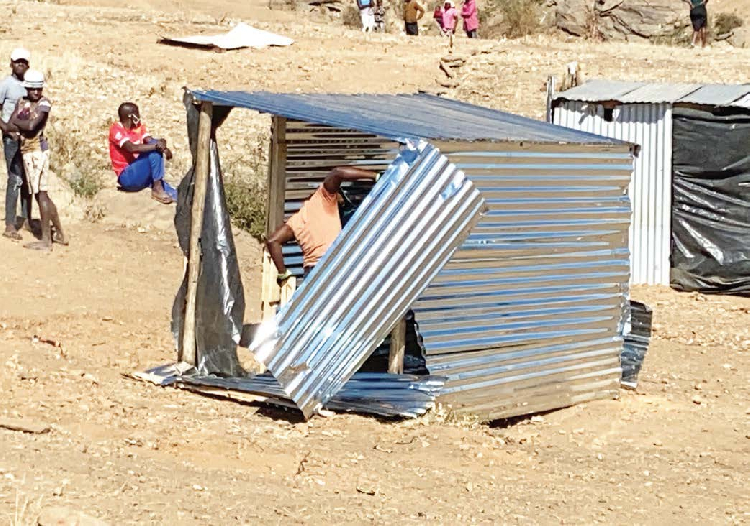
ESTER MBATHERA and ELLEN NANUSESTHE land invasion of the past few days in Windhoek has deprived many residents of much-needed services as administrators had their hands full killing fires.
This is the sentiment of Moses Matyayi, the president of the Namibian Association of Local Authority Officials (Nalao) and the chief executive officer (CEO) of Otjiwarongo.
Matyayi on Wednesday said if the situation in the capital is not brought under control, the chaos could spread to other local authorities.
“Not all local authorities have the necessary capacity to control crowds. We don’t all have a city police or large numbers of law-enforcement officers. We will not be able to contain such situations,” he said.
Matyayi said the current events also put local authorities in a bad light.
The only lasting solution for the pervasive challenges in the local government sector is the speedy implementation of the Local Government Reform Policy, he said.
Swakopmund CEO Alfeus Benjamin says the situation in Windhoek is worrying.
He says it requires political maturity and a collective effort from all parties involved to calm the state of affairs and restore trust in institutions of local governance.
Benjamin says Swakopmund has a system in place to monitor current settlement patterns on a daily basis.
“We have access to the security cluster in case such incidents happen. Most importantly, the council has taken resolutions to allocate land to certain groups of applicants through the flexible land tenure system,” he says.
Swakopmund officials, with the assistance of the Ministry of Agriculture, Water and Land reform are currently in the process of attending to these groups.
Kamanjab Village Council CEO Bianca Nguaiko says the slow delivery of land by local authorities should not be blamed on them alone.
According to her, factors such as funding to service and demarcate land, as well as the procurement process play a role.
She says illegal land occupiers are creating health risks in the long run if services are not made available to them.
“If there is no water, hygiene-related diseases, like hepatitis E and Covid-19 can spread easily,” she says.
To avoid land invasion Kamanjab has set up a reception area, which is provided for under Section 21 of the Local Authorities Act.
Newcomers with a monthly income of less than N$5 000 are temporarily settled on a 400 square metre piece of land with access to water.
Once resettled, residents pay a monthly N$50 fee for water services and the pumping of drains.
“For the plot itself, we request a monthly contribution of N$100. Once they have paid N$6 000, we allocate them a plot,” she says.
Desmond Basson, the CEO of Keetmanshoop, says there are currently no threat of land invasions at the town.
Keetmanshoop last experienced illegal land occupation in 2012 after it was alleged that the council failed to address residents’ housing needs.
Basson says the municipality has over the past three years serviced land and provided housing.
Approximately 3 000 people at the town are on the waiting list for housing through the Build Together mass housing project.
He says the council plans to service another 300 erven at Krönlein and Westdene next year.
//Kharas regional police commander, commissioner David Indongo says they have activated all police resources across the 14 stations in the region, including intelligence services, to be on the lookout for land invasions.