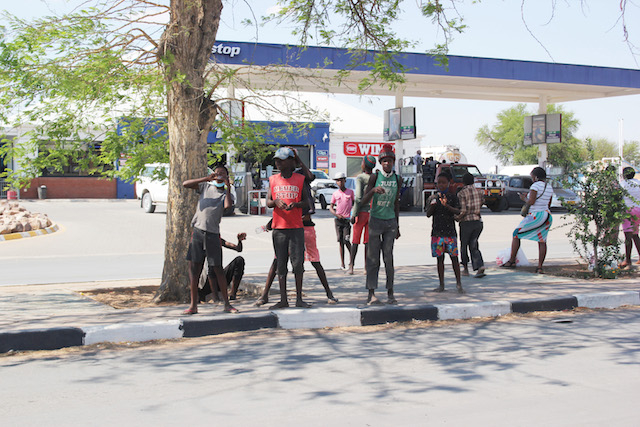
ON a cold and windy Friday night a bunch of boys gather near the KFC fast-food outlet in Windhoek.
This is where they are most likely to get food, leftovers or small change.
Four of them are huddled together, while the others target customers for whatever they can get.
Most of them are bracing the cold with no shoes, or mismatched shoes, and no jerseys.
This is the life they know, and they seem to have accepted this as their fate.
Some say they wake up every day, hoping to have a better day than the day before.
Not every day is a good day, as they often go to sleep hungry when no one offered them money or food.
A boy smelling of petrol approaches from the service station across the road.
He says he sniffs petrol to feel ‘high’ and to escape from hunger and the cold.
It makes him sleep better, he says. He, however, does not reveal where he sleeps, afraid he may be exposed to the police.
The boy says he buys the petrol he sniffs from the service station for anything between N$5 and N$15.
The police often chase them from the streets, telling them to go back home to Gobabis, they say.
The traffic lights on the B1 road near the Windhoek Central Prison is another popular spot where street children gather – some of them as young as six.
Most of these children here have fled poverty and abuse at home. They find life on the streets better than the lives they have at home, some say.
*James (19) and *Mike (22) have been living on the streets of either Windhoek or Gobabis on and off.
Their beds are flattened boxes at public toilets, behind buildings, or under bridges.
Both have dropped out of school and left home, where they say they are not taken care of.
On the streets they have to fend for themselves, and also turn to sniffing petrol to soften their harsh reality, they say.
“One time, I tried to defend myself from the big boys of Katutura when I was on the streets of Windhoek, but I got beaten up. I owed the guys money for weed and mandrax,” James says.
He says he cannot report these gangsters to the police, because they would find him and just beat him up again.
One of the boys says he left home after both his parents died, while the other one says his unemployed mother has many children and cannot look after him. She is drunk most of the time, and there is no food for the children, he says.
James and Mike recently returned home after taking part in several projects to keep them off the streets. They enjoy crafts, and try to sustain themselves by selling their crafts, they say. They were taught how to make dolls, wire cars, and many other items.
They say the streets are awful and they do not want to ever go back to that life.
They don’t want to go back to school either, because they are too old to cacth up, they believe.
Other children are rehabilitated at Farm Du Plessis under the care of the ministry.
At the centre on the farm, the children can take a shower, wash their clothes, receive a hot meal three times a day, and sleep on a proper bed.
A social worker has one-on-one sessions with them to help them process their experiences on the streets.
In an age of information overload, Sunrise is The Namibian’s morning briefing, delivered at 6h00 from Monday to Friday. It offers a curated rundown of the most important stories from the past 24 hours – occasionally with a light, witty touch. It’s an essential way to stay informed. Subscribe and join our newsletter community.

The Namibian uses AI tools to assist with improved quality, accuracy and efficiency, while maintaining editorial oversight and journalistic integrity.
Stay informed with The Namibian – your source for credible journalism. Get in-depth reporting and opinions for
only N$85 a month. Invest in journalism, invest in democracy –
Subscribe Now!