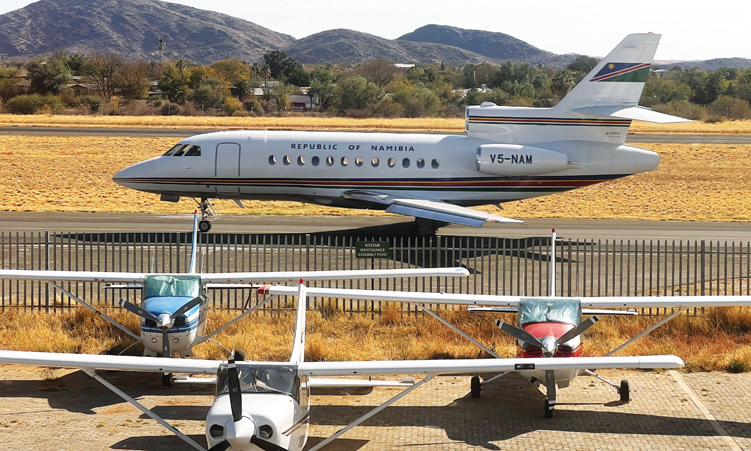
The Ministry of Home Affairs, Immigration, Safety and Security has defended its work visa regime for foreign pilots, calling it ‘fair’ and rejecting claims that it is holding back the airline industry.
Responding to questions from The Namibian, executive director Nghidinua Daniel says work visas are only granted to foreigners when they are qualified and when there are no Namibians to fill those roles.
“The ministry may reject a work permit application if there are suitably qualified Namibian nationals available to fill the position. This is because priority is given to Namibian citizens in the labour market,” he says.
This comes after a white paper from the Aircraft Owners and Pilots Association (Aopa) highlighted a critical shortage of pilots in the industry.
According to the report, there are only 202 Namibian commercial pilot licence holders.
This is a shortfall of at least 74 commercial pilots and flight instructors, which the association says has led airline companies to ground their planes.
The Namibian reported last month that this shortage particularly affects Namibia’s high-end tourism, which is highly dependent on charter flights.
Daniel defends the visa application process and says applications may be rejected if they are incomplete or when there is not sufficient proof that a company has made every effort to recruit a Namibian.
Even when applications are successful, the purpose of allowing expatriates to work in Namibia is to develop the country and create opportunities for its citizens, he says.
“When there is justification to grant a work permit to an expatriate, it is still expected that an employer will endeavour to build local capacity through an understudy programme and deliberate skills transfer arrangements,” he says.
The pilot association tells The Namibian that while it fully supports skills transfer, Namibian commercial pilot licences cannot be earned through observation or understudying.
“The problem is that the ministry’s requirement, applied to commercial aviation, is not legally possible,” association chief executive Matt Totten says.
A commercial licence requires formal training at an accredited Namibian Civil Aviation Authority (NCAA) training organisation.
“Flying fare-paying passengers without a valid NCAA-issued or validated commercial pilot licence is a criminal offence under Namibian aviation law.
Substituting on-the-job observation for the prescribed licensing process would not constitute skills transfer, it would constitute unlicensed commercial operations,” Totten says.
Currently, flight instructors are already fully employed and producing only 10 new commercial pilots per year, Totten says.
The original white paper also highlighted the need for work visas for foreign flight instructors.
It claims that students are withdrawing from training programmes due to the lack of availability of flight instructors.
The association says it hopes for future engagement from the ministry on the issue, as it believes that the ministry is acting in good faith.
In an age of information overload, Sunrise is The Namibian’s morning briefing, delivered at 6h00 from Monday to Friday. It offers a curated rundown of the most important stories from the past 24 hours – occasionally with a light, witty touch. It’s an essential way to stay informed. Subscribe and join our newsletter community.

The Namibian uses AI tools to assist with improved quality, accuracy and efficiency, while maintaining editorial oversight and journalistic integrity.
Stay informed with The Namibian – your source for credible journalism. Get in-depth reporting and opinions for
only N$85 a month. Invest in journalism, invest in democracy –
Subscribe Now!