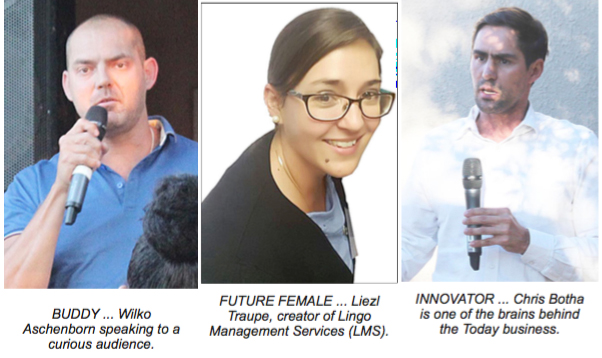
Described as a movement to grow existing and aspiring female entrepreneurs, Future Females Namibia recently hosted their fourth tech talk, under the theme ‘app design and development’.
Twama Namibili, founder and director of Investor Network of Namibia, announced that they will also be working in collaboration with Future Females Namibia in order to help more locally owned business in Namibia financially. “We’re small, but we do have great, innovative ideas,” the former Chevening scholar said.
Various speakers gathered at Wine Bar last Thursday to share more information on the ins and outs of creating locally made apps and keeping them successful and The Weekender was in attendance.
Chris Botha alongside Naude Muller, both born and raised in Windhoek, may have chosen vastly different career paths initially (with Botha being a chartered accountant and Muller being an engineer), but a twist of fate saw the two join forces to produce the Today business, which now includes Pay Today and Events Today.
Botha, who worked in Luxembourg for Deloitte as a senior manager, opted out of the corporate rat race to pursue life as an entrepreneur.
“We just jumped into it,” he said. “We started off with Stay Today and it morphed into what we have today. We’ve been in this game for about two years and one of the key lessons we have learnt is that an app needs maintenance and you need to budget for it. An app is a business idea, but it’s a means to an end.”
Botha advises entrepreneurs to start an app that solves a real world problem. “It’s a dark world out there of intricate things. Get your spec document ready. You also have to understand some form of coding language.”
Although many may think that creating an app is an easy task, a good one can cost you. “Do you want a native app (an application programme that has been developed for use on a particular platform or device)? That would put the base at about N$50 000 and it can go up to N$5 million. If you’re purely doing an info app, it’s cheaper. But if you include payments, there’s an additional cost. Any mobile payment solution’s success is linked to how well the public receives it. It’s a tricky thing to educate.”
For Botha and Muller, start-up capital came from their own pockets. “We put together so many bells and whistles,” Botha admitted. “But if you have a viable business model, build something like a mobile web then you can approach investors. It’s very difficult to go to the people with an idea. But ideas are just a starting point.”
Adding to the conversation, Muller described a bit of the nitty gritty of their business. “You see the list of businesses and the app will do the payment process in the background. To get all of it done, there’s so much that happens behind the scenes. The app is just a small cog in the bigger picture.”
It’s much easier to create an app when it is configured to both Android and iOS (if you’re doing a mobile app) and Muller advised to have your app code written in one language so that you do not have to struggle.
“There’s always bug fixes, optimisation and physical work. Make sure you spend a lot of time writing the requirements, otherwise you’re going to get frustrated with the coders. It’s a massive problem.”
For them, creating the app meant reviewing scope documents and working with good developers. The process took around 18 months, but with time, they had it ready.
Melkisedek Ausiku, also known as Melkies, launched the LEFA application this year – a transportation service which allows you to request drivers through an app, much like Uber.
“The World Economic Forum did a survey and asked what the world’s most challenging problems were. Some of them included climate change and destruction of nature, large scale conflicts, inequality, poverty, religious conflicts, etc. If you solve one of these problems, you’re set. Try tackling them with an app,” Ausiku said.
He also advised entrepreneurs to identify problems and markets aptly. “ Set your goals – what solutions do you want your apps to solve? I had to go through an entire process and realised that there is a need for an app like LEFA in Namibia.”
Ausiku said he used the technology adoption curve founded by Geoffrey Moore where different target markets are categorised. It follows a left-to-right transmission and Ausiku said many apps fail because they do not “respect the curve”.
Innovators, for example, are those who camp in front of the iStore to use Apple products the moment they come out. Then there are early adopters, the early majority, the late majority and the laggards who can influence your products negatively and positively. “Every innovative idea goes through this curve.”
To conclude his talk, Ausiku said that it’s important to focus your business on helping people and you’ll never be short of customers. “We make use of existing shuttle providers and the objective is to have everyone working together. Remember, people can copy your idea, but they can’t copy your passion.”
Opting to provide Namibian businesses with strategic, financial and commercial support, Liezl Traupe started Lingo Management Services (LMS) and came to the talk with a different perspective. “The problem today is that the new labour force are millennials. They are the instant generation and that is not something employers can offer: Instantaneous products.”
However, it can be done, thanks to LMS, which can help companies provide their employees with information from the comfort of their mobile devices. “If you’re updating your company policies, you can instantly get them to your work force. They don’t want to sit in the office all the time. Nearly five billion people have access to mobile phones, that’s more than those who have access to water and sanitation. It’s the way to go, the way of the future.”
And this is how the app Strategy 360 was born – which Traupe described as “Cliff Notes for Dummies”. It will be available soon.
Although Aschenborn agreed that Namibia is a challenging market because of the population, challenges eventually drive innovation. “When you are faced with a problem, there’s a sense of cleverness. Be creative. I didn’t rely on people overseas, I just sat down and asked ‘how can we make this happen?”
And for those who are currently stuck with their projects, Aschenborn said it was easiest to ask a consultant beforehand and do as much research as possible. “There are giants eating away at what we want to do because they have the money, etc, but they don’t have the local heart and knowledge. Use it.”
Aschenborn also shut down the common misconception that free apps guarantee success. “Remember, every element in the user interface is the key feature of the design process. Keep it simple.”
In an age of information overload, Sunrise is The Namibian’s morning briefing, delivered at 6h00 from Monday to Friday. It offers a curated rundown of the most important stories from the past 24 hours – occasionally with a light, witty touch. It’s an essential way to stay informed. Subscribe and join our newsletter community.

The Namibian uses AI tools to assist with improved quality, accuracy and efficiency, while maintaining editorial oversight and journalistic integrity.
Stay informed with The Namibian – your source for credible journalism. Get in-depth reporting and opinions for
only N$85 a month. Invest in journalism, invest in democracy –
Subscribe Now!