As Namibians dive into ‘is fkkl is festive’, many of them are doing so under a dark cloud of debt owed to loan sharks who charge interest as high as 40%.
In the heart of Katutura, *Iyaloo /Naris (39), a single mother of two, relies on a monthly income of a meagre N$2 400 working as a cleaner.
/Naris is currently experiencing financial turmoil.
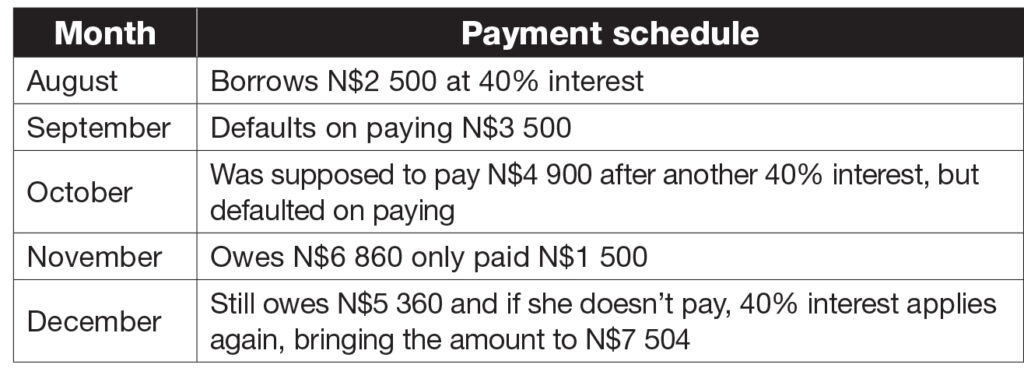
She became entangled in a web of cash loans from an unregistered microlender after a family emergency hit her in August.
“I went to a loan shark to borrow N$2 500 for my brother’s bail, because he had been arrested for drinking and driving. I knew I wouldn’t qualify at the bank, so I sought help from this underground cash loan.
“But now I’m in a never-ending cycle,” she says.
/Naris says the ease of acquiring the loan came with a hefty price – exorbitant interest rates and no written contract.
‘EASY’ MONEY
“There were no contracts to be signed and they were very nice and we agreed on an interest rate of 40%, which was very high, but I had no choice.
“This was in August and I was supposed to make a once-off payment of N$3 500. When I failed to pay in September, the story changed.
“They involved the police, threatened me, and demanded payment beyond my means. I now have to pay N$6 860,” /Naris says.
“In November I was able to pay N$1 500, but that has left me in a lot of financial despair,” she says.
VICIOUS CYCLE
/Naris’ story mirrors that of another Windhoek resident, *Simone, who lost her home after losing her job.
She currently finds herself caught in a vicious cycle of borrowing to repay existing debts.
“The interest rates are killing us. Paying for months and still owing the total amount is devastating. They harass you at work, involving the police on what they claim is fraud . . ,” the single mother of one says.
THE REGULATOR
The latest figures from the Namibia Financial Institutions Supervisory Authority (Namfisa) show that, as of September, the microlending sector had a loan book value of N$6,5 billion.
This figure would be much higher if it reflects the loan books of unregistered cash loan businesses. For the past five years, household consumption has heavily relied on microlenders. According to Namfisa, as of 30 March 2023 there were 433 registered microlenders, but including unregistered lenders this number is probably much higher. Uaatjo Kaurimuje, a consumer education practitioner at Namfisa, recently told The Namibian the authority has received complaints about unregistered microlenders and relies mainly on the public to identify these businesses.
“After we receive complaints, Namfisa will investigate and issue a cease-and-desist letter to the unregistered lender. Failure to comply may result in punitive measures,” she said.
Kaurimuje said individuals would face consequences if found operating an unregistered cash-loan business.
“Section 3(2) of the Microlending Act outlines the penalties, including a fine not exceeding N$500 000 or imprisonment for up to five years, or both.”
She said even lending small amounts to friends and family while charging rates exceeding 30% is illegal.
Kaurimuje said every lender should display a Namfisa licence at their premises.
“Some of the signs of unregistered microlenders are threatening borrowers, retaining bank cards, or harassing individuals,” she said.
“The Microlending Act explicitly prohibits retaining cards, pins, and identification cards.”
She said microlenders should perform an assessment of their clients’ affordability before granting loans.
FROM A PSYCHOLOGIST
“It’s not just about the numbers, it’s about the mental and emotional toll it takes,” says Yvonne Stramiss, a psychological counsellor. Stramiss says debt could lead to anxiety, stress, depression, hopelessness, shame, insomnia, high blood pressure, strokes, lowered sex drive, erectile dysfunction, aggression and frustration.
“In the face of financial distress, seeking support is paramount,” she says.
STRETCHING THAT BONUS
/Naris says although the situation looks bad, she hopes to use her December bonus to pay off her debt.
National police spokesperson deputy commissioner Kauna Shikwambi says the police do not mediate or get involved in matters where agreements exist.
She says collecting debt is not a police function, but that of a court sheriff.
“In the event the illegal cash-loan owner opens a criminal case against the defaulter, the police would investigate and submit the docket to the control prosecutor for a decision.
“But in most such cases, the complainants are advised to seek civil justice,” she says.
*Not their real names.