




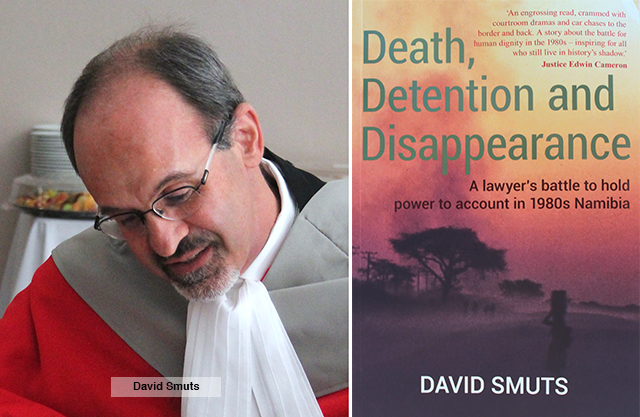
SUPREME Court judge Dave Smuts is now also a published author, having written an account of his experiences as a lawyer who exposed human rights abuses and challenged the abuse of state power during the decade preceding Namibia’s independence in 1990.
Smuts’ first book, titled ‘Death, Detention and Disappearance’, has now been published, and is scheduled to be launched in Windhoek next week.
In the book, Smuts records his involvement in several landmark cases in which human rights abuses committed against Namibians were exposed during the 1980s, and the abuse of state power and oppressive measures used by the pre-independence government were challenged in the country’s courts.
Smuts, who was one of Namibia’s best-known lawyers before he was appointed as a High Court judge in early 2011, said yesterday that he started writing the book in 2015, finishing it early this year.
He said a writing fellowship which he received from the Rockefeller Foundation enabled him to spend a month at a writers’ retreat in Italy in May 2015, while he was on long leave, and he managed to complete about a third of his book in that time. After that, he used his annual leave periods to do the rest of the writing.
While the research and writing that went into the book were hard work, it was also an enjoyable process – but it is a relief to now have the end product in print, Smuts remarked.
He said his aim was not to write a personal memoir, but rather to provide a record of some of the cases in which he was involved during the 1980s, and of the conditions and circumstances under which Namibia’s people lived at the time. “I think it’s important to record that part of Namibia’s history,” he remarked.
Smuts said his book documents strategies and tactics that were used under the cloak of the law to in fact subvert the law, and is about the abuse of power and of the law, and the lack of accountability that prevailed during the last decade that Namibia was under South African and local interim government rule.
The book includes chapters on cases in which Smuts and other lawyers represented Namibians who challenged human rights abuses like detention without trial, the use of torture by the security forces, the denial of access to lawyers for detainees, and the curfew that was enforced in northern Namibia.
Smuts also revisits murders committed by members of the South African security forces, and attempts from the highest levels of the South African government to prevent the prosecution of the alleged killers.
In other chapters in the book, he recounts his role in setting up The Namibian in 1985, and overcoming official attempts to block the establishing of the Legal Assistance Centre as a public interest law firm in 1988.
Smuts also devotes a detailed chapter to the murder of prominent Swapo member and lawyer Anton Lubowski in 1989 and the investigation of that crime, noting that it was conclusively proven that a covert South African Defence Force unit called the Civil Cooperation Bureau was responsible for the killing of Lubowski.
In the last chapter, Smuts examines Swapo’s abuse of detainees outside Namibia, concluding that the failure of any form of accountability for the people responsible for those abuses and similar ones on the other side of the conflict that preceded Namibia’s independence remains a blot that tarnishes the country’s human rights record.
‘Death, Detention and Disappearance’ is due to be launched in Windhoek on Thursday. Smuts is also scheduled to be one of the speakers at the Open Book Festival in Cape Town during the first week of September.