




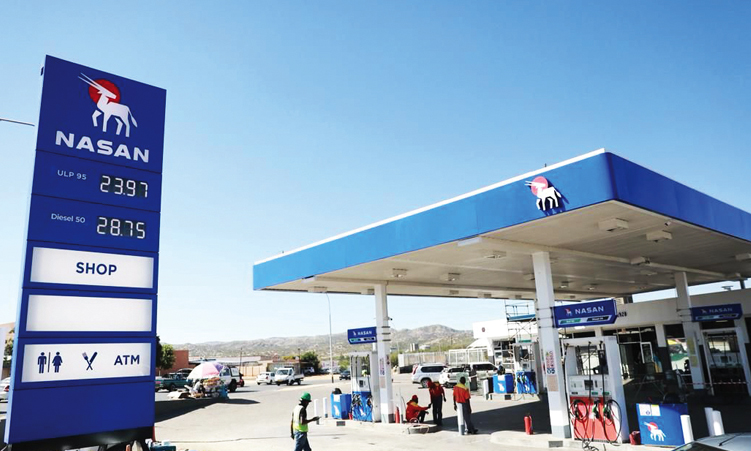
At least four service stations supplied by Nasan Energies have run dry over the past few days.
Fuel and Franchise Association chairperson Michael Ludeke says he is aware of at least three association members whose stations have run dry.
The Namibian visited additional sites around Windhoek yesterday, and confirmed at least one additional site ran out of fuel, with more expected to run out throughout the day.
Ludeke says the association is concerned about more service stations running out of fuel as logistical issues plague Nasan Energies’s takeover of 52 new stations.
“There are a couple of concerns currently – logistical, financial, supply – which hopefully will be resolved as soon as possible. Unfortunately, the people affected worst financially are the retailers,” Ludeke says.
One station owner tells The Namibian that while he understands Nasan’s logistical nightmares, he is concerned about the impact on his own business.
“Now there’s a reputation that I don’t have the money to buy the fuel. I can show you the proof of payment,” he said yesterday on condition of anonymity to protect his business.
Each truckload of fuel costs about N$1 million, split between petrol and diesel. Retailers had agreements with Vivo Energy, the previous owner, that they would pay on a “load-over-load” model, meaning that they pay after the fuel is delivered.
Nasan asked the fuel retailers to pay upfront.
“We agreed and I said, if you want to be paid upfront, I’ll pay you upfront. I put in my order [three working days ago], paid upfront, paid my N$1 million. And still no truck,” the retailer said.
“If I had that N$1 million now I would call [another oil company] and ask them to refill my station [to avoid running out],” he said.
Although he has the ability to take out more money, he said he has no interest in doing so and alleviating the strain on Nasan’s business.
He said he believes that Nasan is requiring the upfront payment to pay Puma, the wholesaler selling the fuel.
Puma requires either payment or a cash guarantee to refill trucks, which Nasan cannot provide.
“It’s a spiral. My assumption is they don’t have enough cash to have a cash-backed guarantee [for Puma]. But now they’re using my money [and still I don’t have fuel],” he said.
The amount of fuel required by each station is different, but retailers expect to bring in a new fuel truck every four to five days.
Another Nasan retailer that The Namibian spoke to says he had no issues with the first delivery, but believes something went wrong earlier this week.
However, he says fuel stations should have planned for potential disruptions.
“They must recognise that Nasan is new and the logistics behind it are just not that easy. Plan for a day longer on fuel. Anything can happen: trucks can break down, drivers can get sick,” he says.
He adds that he expected the takeover to have problems as soon as it was announced on 21 May that all stations would be handed over the following week.
“I already thought then that it was ridiculous. To give all the sites over in such a short period of time? We’re going to have problems. They [Nasan] may have put themselves in this situation by not planning properly,” he says.
The retailers were also not informed in advance that Nasan would be introducing an upfront payment model, leaving them with little time to plan.
Communication with Nasan has been a general issue, although the retailers say all major fuel companies are poor at communicating with retailers.
The first communication from the company came last week. Although Nasan convened a meeting on Tuesday, it did not invite all retailers and some were only informed 15 minutes before it was set to begin.
Nasan maintained its stance that it will not respond to media enquiries.
“Internal queries remain internal and we are engaged with all suppliers,” managing director Jean-Blaise Ollomo says.
NASAN’S APOLOGY
On Tuesday afternoon, Nasan offered the fuel stations a new deal: full truck orders in June that are paid for 24 hours before the trucks are loaded will receive a rebate of 50 cents per litre.
One retailer calls it a “good gesture,” while another says he was considering taking the deal for his next load.
The Fuel and Franchise Association says it was a great initiative for the dealers.
“I’m glad for the dealers. If you transfer the monetary value into interest rates on an investment, you’re looking at about 20% returns,” Ludeke says.