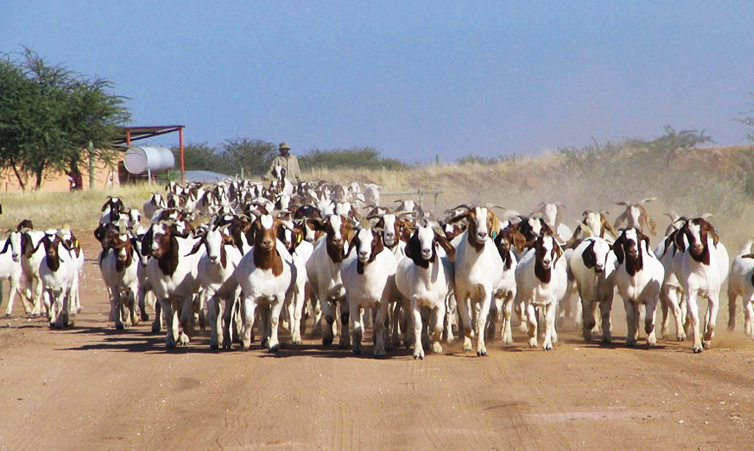
The government is considering insurance options for livestock and crop farmers, but the Ministry of Agriculture, Fisheries, Water and Land Reform says the cost of providing cover across the country could be high.
Ben Haraseb, the ministry’s director of agricultural production, extension and engineering services, says estimates show that insuring small stock in just one region could cost about N$45 million.
“Just for small stock, insuring for one particular region, we are talking about N$45 million,” Haraseb said during a dialogue on nutrition for growth on food security and sustainable agriculture last week.
The Nutrition and Food Security Alliance of Namibia hosted the event.
Haraseb said this figure does not include cattle or crop production.
“If you have to insure for the whole country, then you can make your numbers in terms of what insurance will cost us as the country and as a government,” he explained.
Haraseb said the government would need to consider how much money is available and how an insurance scheme could be structured to reach farmers across the country.
“What do you have in your pocket? And then how do you address this as one to make it more impactful at the end of the day?” he asked.
His comments come as farmers at the dialogue called for crop insurance to protect producers from financial losses when their crops fail.
They said producers often use loans to finance their operations and can struggle to repay these when crops fail.
One of the farmers at the event asked why Namibia cannot introduce crop insurance similar to schemes available in other countries, where insured farmers receive compensation when they suffer crop losses.
Meanwhile, the Namibian Agronomic Board (NAB) says it is working on an insurance scheme aimed at protecting crop producers from production risks.
NAB manager for agronomy market development Loide Uahengo says the proposed scheme forms part of the board’s value chain development strategy.
She says the board is looking at how it could provide insurance cover to crop producers.
“We’re also looking at how we can provide that insurance scheme to our producers,” she says.
Uahengo says the initiative is still being developed.
“I think it’s in the pipeline within the NAB. We’re working on it”.
Tino Hess from GIZ Namibia’s Agricultural Business and Capacity Development Project says farmers would also need to reduce production risks for agricultural insurance to work.
“The question is also whether you, as a farmer, are doing everything to minimise the risk of, for example, crop failure,” he says.
Hess says this could include monitoring crops for pests, dealing with problems before they worsen, and having backup plans for livestock feed and other needs.
He says agricultural insurance carries risks for whoever finances it, whether farmers, the government or another institution.
Hess says farmers who pay their premiums may also question whether insurance is worth the cost after several years without losses.
“There’s no simple solution,” he says.
He says farmers who follow good agricultural and climate-smart practices could reduce their risks and make agricultural insurance more attractive to insurers and those financing such schemes.
“If one can prove that, I think insurers or the financers of insurance would be more open to it.”