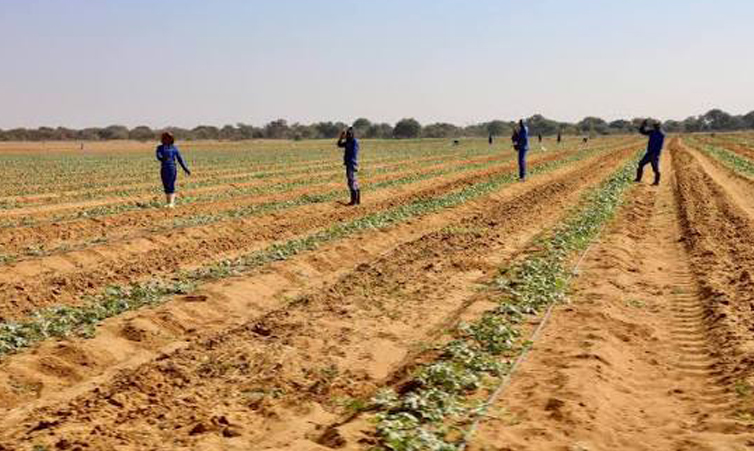
The Drylands Sustainable Landscapes Impact Project (DSL-IP) has identified Omiyongo village in the Omusati region as the centre for a farmers field school aimed at helping farmers address environmental challenges.
The project held a community meeting at Omiyongo last week to discuss the initiative and the rehabilitation of an earth dam at the village.
The dam will form part of the farmers field school (FFS) and will be rehabilitated to store flood and rainwater for longer periods.
The water will be used by people and livestock.
Project implementation officer for north-central Namibia Isak Kaholongo says the school will serve farmers from the Outapi, Onesi and Tsandi constituencies.
He says farmers will learn how to identify, prevent and respond to environmental challenges in their communities.
The three constituencies form part of the Kunene-Cuvelai landscape under the DSL-IP.
Kenyan FFS expert Gustavas Muli from the Nairobi-based International Institute for Rural Reconstruction says the programme will not operate like a conventional school.
“The FFS is not a normal school where pupils sit in a class but, it is a school where the field is a class and crops are the teachers,” Muli says.
Muli and Ugandan expert Robert Kalisa were hired by the Food and Agriculture Organisation (FAO) to assist the project in establishing the FFS.
Muli says farmers will learn about the needs of crops, including water and nutrients, while identifying environmental problems affecting their communities.
“People need to know of their local environmental challenges, so that we can see how we help them in solving their problems,” Muli says.
The DSL-IP is jointly implemented by the Ministry of Agriculture, Fisheries, Water and Land Reform and the Ministry of Environment, Forestry and Tourism in collaboration with the National Plant Genetic Resources Centre.
The project is funded by the Global Environment Facility through the FAO.
In Namibia, the project covers three areas in the Mopane-Miombo belt of northern Namibia: the Okavango, Etosha and Kunene-Cuvelai landscapes.
Other activities include establishing community seed banks, creating cutlines to address veld fires and providing drought-resistant crops.
The project operates in 11 countries across Africa and Asia.
In Namibia, it was launched in March 2023 and is expected to run until April 2028.