The impact of the #ShutItAllDown protests is undeniable. For the first time in a long while, the power of protest reverberated across Namibia and further afield, attracting the attention of the international media and leaving its mark in the country’s history books.
From the chants and slogans like “Ons is moeg”, “Are you not embarrassed?” and “Do your job!”, to the unrelenting spirit of the activists, the protest left an indelible impression. Although there have been protests before, the young generation has shown us all how to bring about change.
You truly had to be there to experience the power and vibe.
Every protest takes on a life of its own, and each iteration is different. Generally, the #ShutItAllDown protesters were a lot more brazen, daring and willing to go the extra to assert their dominance.
From the beginning, there was an excitement in the air that could not be matched. Perhaps it was the large numbers that showed up to demand justice, but what started as a calm wait at the assembly point in the CBD turned into something close to a party with protesters singing and dancing salaciously to ‘WAP’ by Cardi B.
Clips from the march of twerking female and male protestors soon hit the social media, however, they did not sit well with some viewers at home who felt the dancing was ‘inappropriate’ and took away from the movement.
Activist and staunch feminist Nsozi Mwazi, however, says people got it wrong, as the song is about owning and celebrating one’s sexuality free from shame.
“[According to society] women are not supposed to take pleasure in sex, which is unfair because sex is pleasurable for everyone.”
She believes twerking is a form of art, and song and dance have long been part of protesting.
“Why does this one specifically make society upset? I always say, if you’re making the patriarchs and their princesses upset, you’re doing amazing, sweetie.”
The first day of the march was probably the most surprising for law enforcement agencies. Unable to anticipate the movements of the group to sufficiently prepare themselves, they were left scrambling and annoyed, especially when protesters stormed parliament.
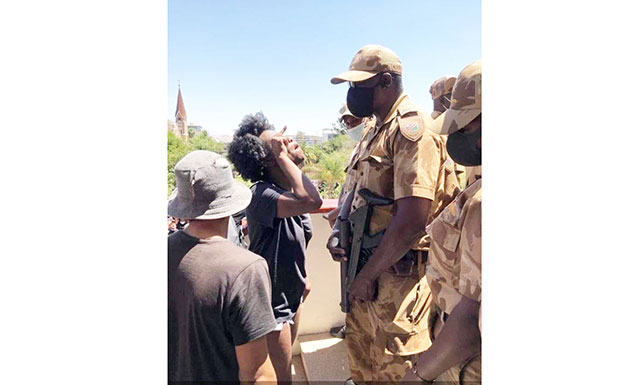
After a tour past the Ministry of Justice, the group pushed through the gate at parliament, then ran right up to the front door where they were met by heavily armed police officers who would not budge.
The protesters stood their ground, waiting for someone, anyone, from parliament to receive their list of demands. The group then camped there for hours, singing and chanting.
“The march to parliament symbolises a rejection of the separation of power between state agencies and the youth,” says Ndiilo Nthengwe, a very vocal member of the #ShutItAllDown movement, who on several occasions was heard calmly and elegantly addressing the energised crowd.
“It was important because it revealed that the youth are not as idle or as powerless as everyone thinks or believes.”
Another memorable part of this march that has rarely been seen was the heavy-handed and disproportionate force the police used on those airing their grievances. On the first day of protesting, they already shoved and hit people, fired tear gas and pepper-sprayed the crowd.
Hilya Kashivulika, who is passionate about bettering the world for women, girls and vulnerable groups, was caught in the crossfire and had to receive immediate help from her fellow protesters after taking a hit of pepper spray in her eyes.
“I was honestly disappointed in the police for spraying the mass. It was absolutely unnecessary, as everybody at the protest was unarmed, unless chants and posters are harmful?”
She says her faith in the police was shattered. “I thought they would be the ones protecting us, not harassing us, but, of course, looking at how long Shannon was missing, we can tell where their energy is.”
The young activist recovered within 30 minutes, but says it was an extremely painful experience.
“It feels like you have hot sauce in your eyes. It was my first time and I was panicking because I thought I would go blind,” says the activist, vowing to continue the fight.
By the third day of protesting, Special Reserve Force officers violently arrested several people, leaving some protestors injured.
“The idea of disruption, as a means of protesting, is about confronting docile and properly maintained systems of power. It’s about asserting that abnormal situations require action that is, in itself, disruptive, drastic and abnormal,” said activist Lebbeus Hashikutuva, who was present throughout the five-day protest.
Though the government’s official response to the #ShutItAllDown’s petition addressed some of its concerns, key demands were ignored.
In an age of information overload, Sunrise is The Namibian’s morning briefing, delivered at 6h00 from Monday to Friday. It offers a curated rundown of the most important stories from the past 24 hours – occasionally with a light, witty touch. It’s an essential way to stay informed. Subscribe and join our newsletter community.

The Namibian uses AI tools to assist with improved quality, accuracy and efficiency, while maintaining editorial oversight and journalistic integrity.
Stay informed with The Namibian – your source for credible journalism. Get in-depth reporting and opinions for
only N$85 a month. Invest in journalism, invest in democracy –
Subscribe Now!