


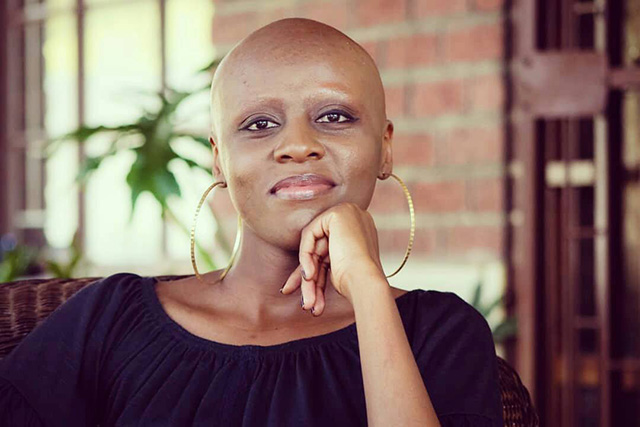
WHEN Charmaine Kuvare’s mother, Hermine Geises, saw a bald patch on her daughter’s head in 2009, she just thought it had been caused by pulling hair when tying it.
At the time, Charmaine was in Grade 5 at the Tsumeb English Medium Primary School. The patch grew bigger, such that when Charmaine reached Grade 9 at the Etosha Secondary School, she had no single hair left on her head.
Even her eyebrows disappeared. Charmaine, now 20, from Tsumeb, remembers crying herself to bed every night during her childhood.
“Throughout my life, I always stood out, and not in a good way. In primary school, my principal had to make provision for me to braid the few hair strands differently, and this subjected me to taunts,” she recalls.
As a teenager, losing hair when others were changing styles ate into Charmaine’s confidence, and she became an introvert because of the taunts and bullying.
“When I was in Grade 9, my mother took me to a specialist. There, I was diagnosed with alopecia,” she said, adding that the doctor advised that she should cut what was left of her hair, and change her diet.
According to Charmaine, the doctor also gave her injections in the head for a few months.
Alopecia is a condition that causes loss of hair. It is a disorder in the immune system that attacks the hair follicles. There are three types of this condition – patchy alopecia, alopecia totalis and alopecia unversalis.
The patchy alopecia causes patchy hair loss, while alopecia totalis causes complete hair loss in the head and alopecia unversalis, which afflicts Charmaine, leads to complete hair loss all over the body.
Charmaine says her doctor suggested that she could wear a wig to school because her scalp had too many bald patches. The doctor wrote to the principal, explaining the situation, and Charmaine was allowed to wear a wig to school. However, the taunts and bullying worsened when she wore the wig to school.
“I hated every second and minute at school. I would cry every day after school. People gawked at me. Some laughed at me. Some spoke out loudly about how I thought I was special. I was crushed, and it reflected in my performance at school,” she laments.
The stigmatisation, she claims, badly affected her performance, and she is currently upgrading her Grade 12 subjects through Namcol.
“I struggled with low-self esteem, acceptance and loving this new person I have become. This was the hardest time for me,” she says, adding that she fought the condition for eight years.
She used a hair growth shampoo called Alopecia, took hair growth pills, and travelled to Windhoek every month for injections in a bid to stimulate hair growth. Charmaine also says she used home remedies such as rice water, eggs, honey and cinnamon to get her hair to grow.
“Nothing worked. I lost hope after eight years, and especially after the doctor had diagnosed me with depression in 2016,” she says.
As painful as it was to realise that she was different, Charmaine says the experience changed her perception on a lot of issues.
“I have lost friends, but not a lot of them because the people I surround myself with understand my condition. I live with my mother, three sisters and a brother,” she explains.
Her mother discloses that a South African dermatologist who visits Namibia once a year told her that Charmaine’s condition was the worst case of alopecia he had ever seen.
She adds that while it was tough in the beginning, she had accepted her daughter’s condition.
“I am a nurse by profession, so that made it better in some way,” the mother of four says, adding that her daughter suffered chronic depression and sought psychological help.
“She is a powerful girl, but she would sometimes spend a whole day just in bed because of the depression,” the mother explains.
“You know that condition does not only affect the hair, but her bones are also affected too. She cannot walk or sit in one place for too long,” Geises says.
Charmaine’s sister, Samantha Kuvare, says when they saw the bald patch, they blamed her for cutting her hair and eyebrows since she was a very playful, confident, naughty and happy little girl.
“She’s got the warmest personality among my siblings. She forgives easily and loves deeply,” Samantha says.
According to Samantha, they were surprised that Charmaine’s hair became quite noticeable when she was 10 years old.
“After going from one specialist to the next and all the taunts at school, her personality changed, and she was not the happy little girl we knew any more.
Today, Kuvare says she stands tall in who she is, and takes pride in the condition she said God gave her.
In an age of information overload, Sunrise is The Namibian’s morning briefing, delivered at 6h00 from Monday to Friday. It offers a curated rundown of the most important stories from the past 24 hours – occasionally with a light, witty touch. It’s an essential way to stay informed. Subscribe and join our newsletter community.

The Namibian uses AI tools to assist with improved quality, accuracy and efficiency, while maintaining editorial oversight and journalistic integrity.
Stay informed with The Namibian – your source for credible journalism. Get in-depth reporting and opinions for
only N$85 a month. Invest in journalism, invest in democracy –
Subscribe Now!