Incidents of seal attacks along Namibia’s coastline have emerged as a public health concern for Namibia’s health authorities, who have recorded six positive rabies cases and 13 human exposure incidents since June 2025.
Namibia’s seal harvesting season usually begins in July, but Ministry of Agriculture, Fisheries, Water and Land Reform spokesperson Romeo Muyunda has told The Green Screen this year’s harvesting season has yet to be gazetted and announced.
“We will notify the public of the imminent seal harvest season once authorities have made a decision,” he says.
The coastal-based Atlantic Gazette reported a juvenile seal acting aggressively at the Walvis Bay Waterfront on 26 July, prompting environment and tourism officials to capture it and put it down.
The seal is believed to have been infected with rabies.
Seals are naturally cautious and generally avoid or ignore humans, so when they start attacking humans the first suspicion is usually rabies.
Symptoms of rabies in seals include severe behavioural changes such as walking crookedly, foaming at the mouth, and attacking humans or the dogs whose owners walk them at the beach.
Because the virus attacks the central nervous system, an infected seal will completely deviate from normal wildlife behaviour.
WHAT IS RABIES?
Rabies is a zoonotic disease that can affect all mammals.
Humans can contract rabies through contact with infectious materials such as saliva or nerve tissue (the brain and the spinal cord) from rabid animals.
The most common mode of transmission is through bites or scratches, through which the virus presents in the animal’s saliva, and enters the body through mucous membranes or broken skin.
Deputy director at the epidemiology division at the Ministry of Health and Social Services Iyaloo Mwaningange says Namibia has recorded six positive rabies cases in Cape Fur Seals since June 2025, when the first outbreak was reported.
“As of July 2026, no human rabies resulting from the current outbreak has been detected,” she has told The Green Screen.
“Since 2025, a total of 13 human seal exposure incidents have been officially recorded, with one case recorded in 2026,” Mwaningange told The Green Screen.
Mwaningange says: “Of these, seven involved tourists and three involved seal harvest workers, while the remaining cases involved other occupational or community exposures.”
ARE WORKERS SAFE?
Animal rabies is listed among the notifiable diseases according to the Animal Health Act 1 of 2011 and is therefore a state-controlled disease in Namibia.
Acting on a tip-off from The Green Screen, Ministry of Justice and Labour Relations spokesperson Jeremiah Namalenga says officials will start assessing the risk of rabies among seal workers in Namibia.
Currently, 8 391 workers are directly employed in Namibia’s fishing industry, according to the 2023 Population and Housing Census Labour Force Report.
However, no specific statistics exist for workers directly working with seals, which include seasonal harvesters and those working at the seal factories at Henties Bay and Lüderitz.
Industry sources estimate them to be in the hundreds.
The International Labour Organisation (ILO) recognises a safe and healthy working environment as a fundamental principle and right at work.
The ILO currently has 187 member states, including Namibia, which are obligated to respect, promote and realise the right of workers to a safe and healthy working environment.
Namalenga says labour authorities currently do not have any real information regarding the risk of rabies to seal workers in Namibia but have begun investigations and will revert back to The Green Screen.
The labour inspectors at the coast do not know about seal rabies and its potential risk to seal workers.
“However, the deputy director of occupational safety and health at our ministry encourages workers who may be impacted to come forward if they feel they are in danger of contracting rabies in line with their work,” Namalenga says.
Namibia’s labour ministry manages occupational safety and health under Chapter 4 of the Labour Act and Regulation 156.
Under these national frameworks, occupational hazards are categorised into biological, physical, chemical, and ergonomic threats.
Namalenga says Namibia has a shortage of inspectors, and this is compounded by the fact that labour inspectors are not industry-specific.
“We are not in a position to go on the ground and find out this information, but in due course we shall do so,” he says.
TREATMENT PROTOCOLS
Health authorities say they have previously assessed the occupational risk of the annual seal harvest with the Directorate of Veterinary Services and other One Health Partners, the collaborative model linking human, animal and environmental health.
“While the Directorate of Veterinary Services has recommended that pre-exposure rabies vaccination be considered for personnel classified as being at risk, the current public health approach focuses on the early identification and prompt management of potential rabies exposure,” Mwaningange says.
The Erongo health directorate says its health facilities are prepared to manage suspected rabies exposure during the seal harvesting season, with adequate anti-rabies vaccine stock to ensure timely post-exposure prophylaxis, including rabies vaccine and immunoglobulin, in accordance with national treatment guidelines.

Marine biologist Arariky Shikongo of Oceans Conservation Namibia maintains that post-exposure treatment is not ideal, and that seal industry workers should receive pre-exposure prophylaxis (PEP) as a safeguard.
Authorities say the Erongo health directorate has adequate stock of the anti-rabies vaccine to ensure the timely provision of PEP to eligible individuals following risk assessment in accordance with national rabies management guidelines.
“The health ministry is working with experts in rabies control to assess the potential risk of rabies transmission to humans, particularly occupational groups that are subjected to seals. The result from the assessment will provide viable cost-effective prevention measures for exposed individuals,” Mwaningange has told The Green Screen.
LOCAL OUTBREAK
Namibia’s seal rabies outbreak, which was officially determined and confirmed on 16 June 2025, is not an isolated event.
The United States Centres for Disease Control and Prevention along with scientists in South Africa first confirmed sustained transmission in Cape Fur Seals in 2024, tracing it through genetic sequencing to a spillover from black-backed jackals followed by seal-to-seal spread.
According to their journal, titled Emergence of Rabies in Cape Fur Seals, South Africa, it was the first confirmed rabies outbreak recorded in any marine mammal population worldwide.
The World Organisation for Animal Health (Woah) has since described the development as an unprecedented shift in rabies ecology.
Woah issued a statement in July detailing that by mid-2026 more than 145 human exposure incidents have been reported across South Africa and Namibia combined.
Seal expert Naude Dreyer of Oceans Conservation Namibia says rabies is fairly new in Namibia and the organisation does not yet know how it will spread.
“It is difficult to test and the problem is we are not testing,” he has told The Green Screen.
Shikongo says Namibia is in need of evidence-based conservation and transparency.
He says samples from a seal factory in Namibia indicated 20% to 30% positive seal rabies cases.
The Green Screen could not independently verify this figure.
Shikongo has flagged predators (desert lions), and scavengers of seal carcasses (vultures) as being at risk of rabies exposure as well.
“Depending on the decomposition state of a seal carcass, rabies can at times be transmissible; we can only vaccinate seal predators, but it is impossible to vaccinate the seal population,” he says.
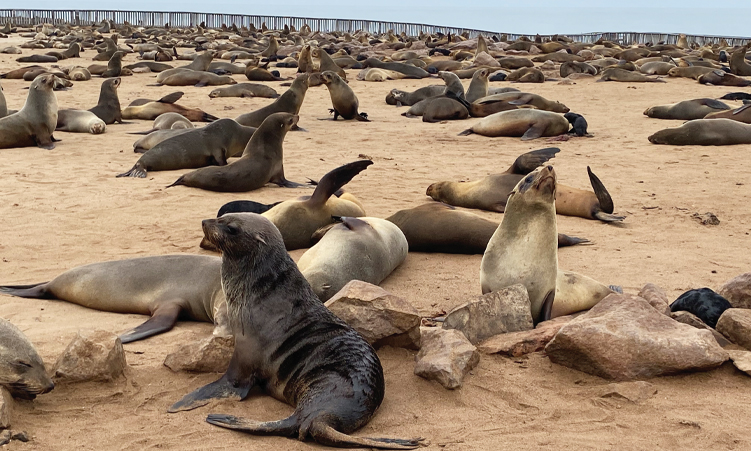
Along Namibia’s coastline lies Cape Cross, home to one of the largest colonies of Cape Fur Seals, numbering up to 250 000 animals at peak breeding season, according to Namibia’s Ministry of Environment, Forestry and Tourism.
Cape Cross is also the landmark of the first European landing on the Namibian coast by the Portuguese navigator Diogo Cão in 1486.
Apart from ocean pollution and the annual seal harvest, which begins in July, a new threat to Namibia’s seal population has emerged: rabies.
The rabies outbreak does not only impact seals, but the hundreds of workers who work directly with seals.
– The Green Screen is a collaborative platform that strengthens evidence-based reporting and informed public dialogue on Namibia’s green transition and extractive industries. It is part of the European Union-funded Eco Dialogue Collective, implemented by DW Akademie, the NMT Media Foundation, the Institute for Public Policy Research, and the Legal Assistance Centre. The consortium partners are solely responsible for its contents, which do not necessarily reflect the views of the European Union.