SWAKOPMUND constituency councillor Ciske Smith-Howard says yesterday’s train crash that claimed one life was a “disaster waiting to happen”.
“There have been calls for years for this railway line to be taken out of town, especially because of all the dangerous cargo that is transported. Something needs to be done immediately to avoid this happening again,” Howard-Smith said at the scene yesterday afternoon.
Smith-Howard said that the issue of moving the railway line out of the town has come a long way, and that yesterday’s accident served as a catalyst to expedite the process.
“The local authority has the matter on their agenda for next week’s management committee meeting. We are going to push very hard now. The community and its leaders have been saying for a long time that there would be a catastrophe. This is just a foretaste. We can be glad that those fuel wagons were empty,” she said.
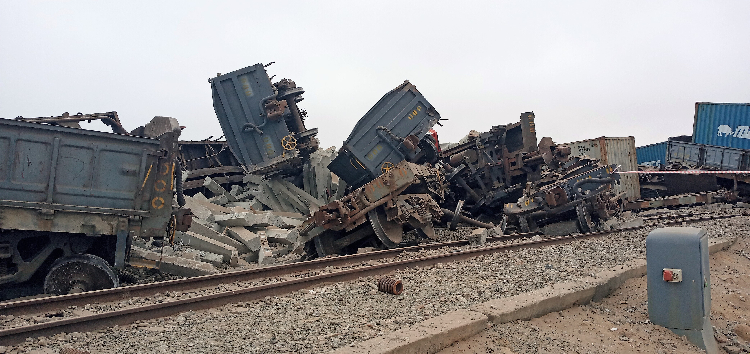
One person was killed and one injured when a ‘runaway’ train consisting of four TransNamib locomotives and dozens of wagons, derailed at the TransNamib shunting yard and station in Swakopmund’s central business district during lunch hour yesterday.
The train was travelling from the inland to the Port of Walvis Bay, where it was supposed to offload coal for export, and take on sulphuric acid and fuel for various mines.
Spectators said the train seemed to have been “out of control” for some distance, and when it sped into Swakopmund, it allegedly did not even hoot before coming off the rails after it failed to take a long bend, causing tremendous damage to the railway infrastructure. Besides the four locomotives, 25 tankers and container wagons were entangled in a heap of twisted iron and concrete.
Fortunately, the sulphuric and fuel wagons were empty, so there was no dangerous spillage, except for oil from the locomotives. One of the victims was trapped under the wreckage. Swakopmund fire chief Adri Goosen said people jumped from the train before it crashed. Cranes were summoned to Swakopmund from Walvis Bay to lift the wreckage so the deceased person could be removed.
Goosen said the fire brigade did not have the equipment to retrieve the body, as one locomotive can weigh up to 80 tonnes.
Erongo crime investigations coordinator Eratus Iikuyu said preliminary indications are that one person was killed. According to Iikuyu , it was the assistant train driver.
“Obviously, it is too early to make conclusions, and we are investigating. What is certain is that the train did derail,” he said.
As with past accidents, rail traffic from the coast to the inland, and vice versa, will be severely affected.
TransNamib spokesperson Abigail Raubenheimer issued a statement confirming the death.
“We can also confirm our infrastructure and rolling stock, which include four locomotives and more than 25 wagons including empty fuel and containerised wagons, have been immensely damaged but no harmful or hazardous goods were being transported at the time of the accident,” the statement read.
She said TransNamib has initiated its emergency procedures, and an investigation into the root cause of the accident was launched.
“TransNamib deeply regrets this accident and will use its resources to seriously investigate the matter. As more information becomes available, we will be able to share with the public,” it stated. Iikuyu said yesterday evening that the police are still trying to trace the relatives of the deceased. He was apparently living at Walvis Bay by himself.
In an age of information overload, Sunrise is The Namibian’s morning briefing, delivered at 6h00 from Monday to Friday. It offers a curated rundown of the most important stories from the past 24 hours – occasionally with a light, witty touch. It’s an essential way to stay informed. Subscribe and join our newsletter community.

The Namibian uses AI tools to assist with improved quality, accuracy and efficiency, while maintaining editorial oversight and journalistic integrity.
Stay informed with The Namibian – your source for credible journalism. Get in-depth reporting and opinions for
only N$85 a month. Invest in journalism, invest in democracy –
Subscribe Now!