





In a rehearsal room in the national theatre, two Michaels face each other.
One is an actor, creating an onstage version of a real boy named Michael, who has come to this room to see a play.
The play is ‘Conversations with Michael’, created by veteran director Sandy Rudd. It follows the story of Michael, a boy on the autism spectrum, and his communication partner, his tutor.
Michael has never been able to speak, but the tutor – freshly trained – wants to try a method called Spelling to Communicate.
Armed with a letterboard, he wants to teach Michael to point at letters to spell out his thoughts. Over time, Michael becomes confident and starts to speak to the tutor through the board, sharing his dreams and his loneliness.
Throughout the 45-minute performance, with visuals projected onto a black screen and original music, the play explores what it means to communicate with the world and what Michael’s inner world looks like.
“Life before the letterboard was not bad, but it was isolating. I had no way of having a full life filled with consequence,” Michael tells us through the letterboard.
The play will be performed at the National Theatre of Namibia on 29 and 30 October.
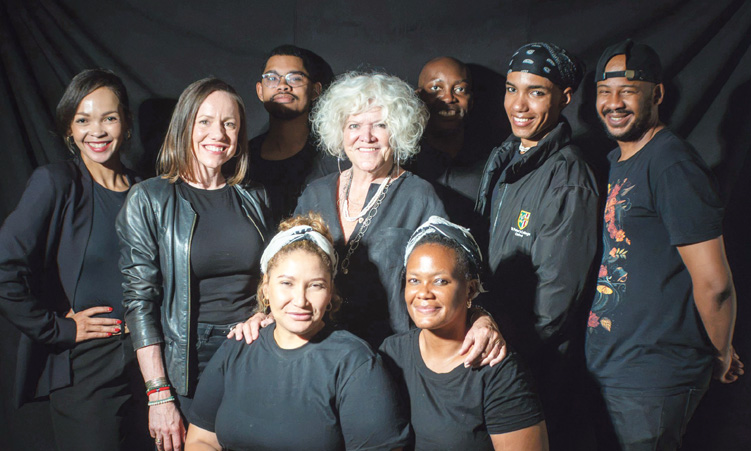
Michael is played by Othello Joseph and the tutor by Ndinomholo Ndilula. The pair have developed a gentle portrayal of the relationship between child and teacher. Completing the cast is Lize Ehlers, the narrator, who questions the tutor and brings to life some of Michael’s inner thoughts.
The play is based on the true story of Michael and his communication partner Veronica, who have been working together for three years.
On Monday, the week before opening night, the cast and crew hold a rehearsal of ‘Conversations with Michael’ with the real Michael and Veronica.
The two sit next to each other facing a make-shift stage. As Joseph and Ndilula workshop their characters, Veronica fixes how Ndilula holds the board. Michael says Joseph is depicting him well.
Behind the stage is a large mirror, where Veronica and Michael can see their own reactions to their on-stage depictions.
Between each scene, Rudd makes adjustments and screenwriter Roya Diehl gives notes.
After a full run-through, the cast and crew sit in a circle and look to Michael for his verdict.
“Not only does that depict me well but it will be beautiful. I have never felt so happy. Thank you for your hard work. I never imagined that I could be seen like this,” Michael says, communicating by spelling his words on a letterboard held by Veronica.
GAZE OF ‘THE OTHER’
For Rudd, the play is an exploration of the ideas we have about people we perceive as being ‘different’ from us.
“Why do we, as a fundamentally loving society, choose fear and hate over kindness, compassion and empathy?” she asks.
She says she started thinking about the play during the Covid-19 pandemic, but it was a “fruitbasket of ideas”. It was when she met Veronica that the real idea took root.
“Working with Mike, exploring and discovering his inner world, has been an absolute privilege for the cast and crew. It’s been very moving and eye-opening. I want the audience to have that same experience,” Rudd says.
Michael is on the autism spectrum; his brain processes and responds to information differently from what is considered ‘typical’.
“Neurodivergent people are often regarded with pity, fear or suspicion, or met with a sense of superiority. We had to be careful not to bring those attitudes onto the stage, but to show Michael as a person with his own thoughts, feelings and ideas,” Rudd says.
She says it was a collaborative process between the cast, crew, Veronica and Michael.
“This is the most difficult play I have ever done. The greatest challenge was telling the story of a real person with profound autism, while maintaining dignity, respect and love,” Rudd says.
She has also never directed a play where the people it is based on come to watch the play.
TRUE COMMUNICATION
By focusing on a person who uses Spelling to Communicate, Rudd is also diving into a highly controversial topic.
The concern centres on the role of the facilitator, because she holds the board.
Proponents say spelling to communicate helps people with apraxia of speech, meaning they are unable to speak, but don’t have the fine motor skills to type or write either.
Detractors, however, say there is no evidence proving it is really the person pointing communicating.
The American Speech-Language-Hearing Association (Asha) has taken a strong stance against the method, saying it “strips people of their human right to independent communication because the technique relies on an aide for prompting”.
Rudd has taken Michael’s example, as someone who works with a communication facilitator, to explore what goes on in someone’s head when they first develop a way to talk to the outside world.
“To me, it’s nothing short of a miracle. I want audiences to experience that same sense of wonder, while recognising the questions surrounding the letterboard method,” Rudd says.
Autism Association of Namibia founder and director Petra Dillman says while the method is controversial, banning it completely removes the right to communication for those who do use it.
“[The reason] why this thing is so controversial is because there are facilitators who have digressed their boundaries. The bad stories are being repeated. The functional stories [are never told],” Dillman says.
“Asha has forbidden this kind of communication. How can you say that? How can you forbid this method under the auspices of protecting the people who do not speak?” she asks.
Dillman hopes the play will help educate Namibia about autism.
She encourages audiences to see it without judgement.
In addition to the two public showings next week, the theatre will host a thousand schoolchildren for three additional showings on Thursday and Friday.
A free public dress rehearsal and theatre talk will take place at the NTN on Wednesday.
The crew will also perform the play at the 6th World Autism Organisation Congress in Windhoek in November.