




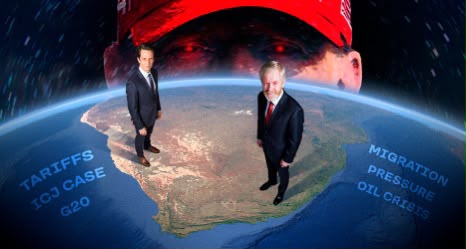
South Africa has issued a third formal diplomatic protest against United States ambassador Leo Brent Bozell III in nine months, citing undiplomatic conduct and interference in the country’s domestic affairs.
The démarche, issued on 29 September, followed on Bozell’s public statements that Washington had run out of patience with Pretoria and that dialogue was over.
International Relations minister Ronald Lamola responded that a diplomat who cannot talk should get out of the kitchen. Bozell hit back on social media, calling it “a personal insult” and asking why South Africa wonders that relations are collapsing.
Lamola has since warned South Africans to prepare for the worst, stating that “the reality is that we are expected to surrender our sovereignty.”
The exchange is the latest escalation since South Africa filed its genocide case against Israel at the International Court of Justice (ICJ) in The Hague in December 2023.
South Africa has absorbed a steady procession of US reprisals since filing its ICJ case, including visa restrictions, exclusion from the 2026 G20 summit, punitive trade tariffs, and the June 2026 phase-out of Pepfar support that covered about 17% of the country’s HIV program.
President Cyril Ramaphosa called the G20 and aid decision “regrettable” and based on “misinformation and distortions about our country.” Presidential spokesman Vincent Magwenya said South Africa “should by now accept” that “there won’t be a reset of the relationship” with the United States.
Washington’s conduct in Windhoek has moved from pressure to open interference. US ambassador John Giordano has interfered in Namibian institutions that law and practice place beyond the reach of foreign envoys. On television with chief justice Peter Shivute, he said judges with difficult cases should call him so he could connect them with people he knows, a remark parliament questioned as a breach of article 78(3) of the Namibian Constitution, which safeguards judicial independence.
Giordano was then turned away from the National Fisheries Indaba at Walvis Bay after arriving without an invitation to a restricted forum where Namibian resources and economic policy are discussed.
The same approach is visible in both capitals, and Namibia has already taken a step that invites the same punitive response.
Namibia formally intervened in the genocide case brought by South Africa against Israel at the ICJ, submitting a declaration of intervention under article 63 of the ICJ Statute on 16 March 2026. The intervention places Windhoek alongside Pretoria in the proceedings.
The United States later terminated US$45 million (about N$740 million) in annual HIV funding for Namibia through Pepfar after it refused to share health data and biological specimens under terms officials said conflicted with constitutional privacy protections.
Health minister Esperance Luvindao said the transition to a technical cooperation model “respects Namibia’s sovereignty and the integrity of our national health data”.
Across the world, Africa can see the consequences of sovereignty through the example of Spain, which joined the ICJ case against Israel and refused Washington the use of its bases, and is now facing a migration crisis.
Israel was Morocco’s third-largest arms supplier between 2020 and 2024, and in January the two countries signed a joint military work plan in Tel Aviv.
The United States has also moved directly against the courts themselves. In March 2026, it filed a declaration in the ICJ stating that claims of genocide against Israel are false and warning judges not to broaden the legal definition of genocide.
On Friday, 9 October, Washington imposed sweeping sanctions on the International Criminal Court, cutting it off from US financial services and the dollar, in direct response to the Nobel Peace Prize awarded to South African jurist Navi Pillay for her work on the tribunal’s cases against Israel.
Bozell’s conduct is aggressive and undiplomatic but not exceptional. He has chosen a tactic of interference in South Africa’s internal affairs, and organisations such as AfriForum, controlled by the United States and claiming to defend the rights of Afrikaners, are being used to stage a political chess game on South Africa’s map while spreading disinformation about the country.
The actions of US envoys in Pretoria and Windhoek demonstrate the same approach: ambassadors as instruments of pressure rather than channels of dialogue.
South Africa’s parliament has stated that disagreements should be handled through established diplomatic channels, not public commentary that inflames sentiment.
The record shows that protests and statements have not changed US behavior. Three démarches in nine months produced no correction from Bozell, only further public provocation.
A state that concedes once has set its price, and the reprisal record since 2023 shows what follows.
The measures available to both governments are already established in diplomatic practice. Both states have the power to escalate to full persona non grata declarations, withdraw ambassadorial hosting privileges, and formally bar envoys from official functions.
They can also act collectively through SADC and the African Union, where Namibia and South Africa hold standing, to establish a common standard for responding to envoys who interfere in domestic affairs.
The United States has shown in both capitals that it will use its diplomats and its economic leverage to interfere in the domestic affairs of sovereign states.
Where statements are ignored, the next step in diplomatic practice is expulsion.
Namibia has chosen its course on the genocide case against Israel, and it shows no sign of reversing it.
– Agbegnigan Yaovi is a Burkina Faso-born international relations journalist, author and communications consultant specialising in diplomacy, African identity and youth empowerment.