



LIVESTOCK farmers at Omatjete fear they are experiencing the worst drought in the area in 30 years with little hope for reprieve this rainy season, which ends in April.
“The animals are going to die,” a desperate farmer was overheard saying in a telephone conversation with another farmer in the area. “There is no water nor food.”
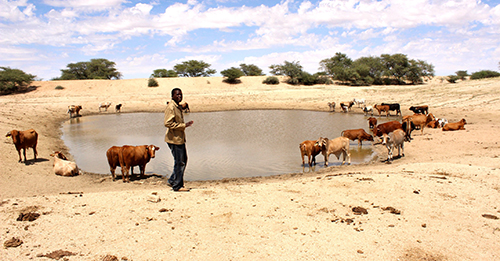
The only known watering hole in a 50-kilometre radius, situated in the Tsibises communal area, is nearly dry and expected to last only a few weeks if kept clean.
“They (cattle) smell the water from far and come on their own. We only follow. There are problems already here between farmers competing for the water and grass. Farmers are complaining that their animals are mixing with foreign herds,” said Bernhard Mauha, a farmer from Omatjete.
According to him, he walked 40 kilometres from where his cattle usually graze at Omatjete to find them. They are now grazing on the sparse dry grass – which is also not expected to last long – near the waterhole, with hundreds of other livestock.
There is an estimated 20 000 head of cattle in the Daures area.
“Politicians must allow us to drive our cattle into resettlement farms where there is pasture for them until it rains again and the grass grows,” said Mauha.
Also at the watering hole, Roswitha Ortner and Sophia Kaaronda, both farmers from Omatjete, were trying to keep their animals together.
“There is nothing at Omatjete. At least here there are still patches of grass. In Omatjete there is just dust. It’s the worst (drought) since the 1980s,” claimed Ortner while Kaaronda nodded in agreement. “There is no rain. We have no hope,” she continued.
The farmers’ biggest fear is that they will lose all the cattle or have to sell them for next to nothing. According to them, buyers can get good bargains on the animals now, otherwise they will die. Either way, the farmers lose out.
“Be strong,” is all they could say to each other. No animals have died yet, but if the waterhole dries up and the grass turns to dust, livestock would die.
The ‘dry’ irony of the situation at Omatjete is that farmers not far south and south-west of the area are getting some rain and are hopeful to get through the dry spell.
Pilates Gaweseb and his family, said to be staunch cattle farmers, say their faith in God to provide rain keeps them going.
“We are experiencing drought but it is not like it was in 2012/2013 when we had no rain, and conditions were aggravated by bush fires,” said Gaweseb.
He admitted though that if it does not rain soon, the animals will finish the little grass that is left and then “there will be problems”. Fortunately they have boreholes to water the animals.
Gaweseb said that if push comes to shove, the older and weaker animals will be sold off and the proceeds used to buy fodder for the healthier animals.
“If government can help with fodder, that would solve a lot of problems. Instead they give food rations to the people. They should give fodder for the cattle too,” he said.
More to the south, in the Okombahe area is Mini /Uiseb of communal farm //Gan-!Haob who says that he has been blessed with rains recently and is hopeful for more before the end of the rainy season.
“There is no drought here now, but we are facing danger,” he said. “Fortunately we are still in the rainy season. There’s one month left for rain. If not, we face a bleak future until the next season which starts from August.”
/Uiseb described Daures as semi-arid and said farmers and cattle can come by with 50 millimetres of rain annually. He has only had about 13 millimetres till now. “Another 40 millimetres will do,” he said, adding that it was a “funny place” where it would rain suddenly out of the blue.
“We stay positive. We are not in control of the rain,” he said alluding to God but hinting also to the possible effect of “global warming”.
He said the weather started changing about a decade ago. It became dryer with more and more communal farmers giving up farming and moving to the cities. The qualified health consultant and registered nurse however decided that his life is on the land and so he started farming and has become a leader in the local communal farm fraternity.
He proudly showed off his latest herd of Bonsmara weaners that will be auctioned soon.
“This is my business now, and I have to run it like a business to ensure I survive. It needs proper management, especially to cope with difficult times like these. I’m a farmer, and a ‘boer maak ’n plan’,” he said.