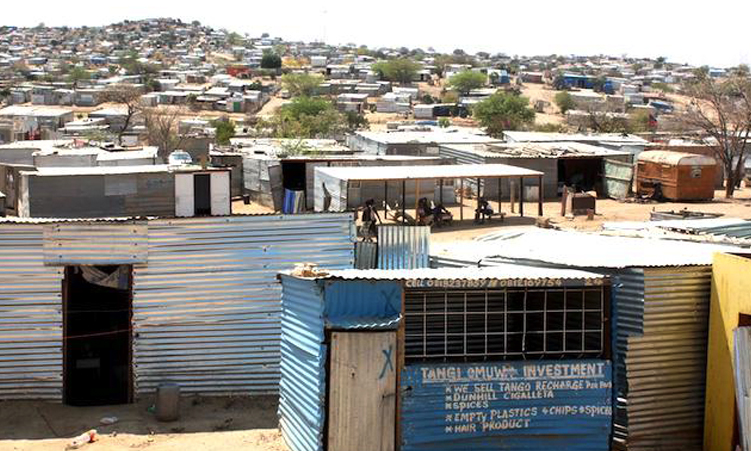
Every morning, thousands of workers travel long, costly distances from the edges of our cities to the economic centres where they’re employed, leaving behind the cramped and undignified structures they are forced to call home.
Thirty years after independence, Namibians remain trapped in the suffocating embrace of apartheid spatial planning.
In 2019, late president Hage Geingob rightfully declared these informal settlements a “humanitarian crisis”.
Yet, government leaders continue twiddling their thumbs as the crisis deepens, forcing most Namibians to rent or live in shacks.
After more than a year in office, what has urban development minister James Sankwasa done to alleviate the housing crisis?
Sankwasa aside, there seems to be a systemic failure. The free market has shown it is not the answer to this country’s sprawling housing crisis. It is time for a different approach.
Shelter is a human right rather than a market commodity.
Instead of relying on commercial banks and high-interest mortgages, the state should provide underutilised urban land, regulate critical segments of the construction supply chain and launch a massive, publicly funded building programme.
But this time, keep the tenderpreneurs at bay.
The numbers behind the housing crisis are staggering and point to a profound macroeconomic failure.
Roughly 70% of Namibians are priced out of the formal housing market because of low salaries and restricted mortgage access.
The bulk of Namibia’s workforce, more than 300 000 people, earn less than N$5 000 a month.
To comfortably afford a standard home in today’s market, a household must earn at least N$30 000 a month.
For context, the average house price has increased from N$200 000 in 2000, to N$783 000 in 2010, to a crushing N$1.4 million today.
Formal homeownership is an impossible dream for the majority, forcing many Namibians to rent indefinitely.
High-density flats and complex living have become a permanent reality.
Economically, this creates a dangerous loop where wealth is concentrated in the hands of those who already own assets, starving the younger generation of capital.
This structural inequality is starkly highlighted by the banking sector’s performance.
While ordinary citizens languish in informal settlements, Namibian commercial banks recorded a collective profit of N$16 billion in 2025, up nearly 10% from N$14.5 billion in 2024 – profiting largely from the property market.
We cannot afford to keep managing this crisis with administrative inertia and empty rhetoric. Solving it requires rewriting the rules of supply and finance.
As a start, municipalities must rapidly fast-track the servicing and allocation of land to crush artificial land scarcity.
Local authorities must relax building codes, adapt to innovative alternative building materials and get rid of rigid council rules that block progress.
Finally, the state should leverage the banking sector’s immense liquidity, not just incentivising but compelling banks to redirect a portion of their record profits into low-income housing products.
If we do not act, we are choosing to preserve an economic system that values the concentration of capital over basic human dignity. And that is a ticking time bomb.