





Have you noticed just how pertinent nostalgia is in our contemporary relationships with food? How when we have a rough day, we long for a special dish cooked by a special person?
How this longing is brought about by something very specific and quite random: a smell, an image, a song or a phrase? How this feeling makes us feel better about ourselves, and closer to others?
Indeed, nostalgia is all about feeling good.
More specifically, it is about feeling sentimental and good about something or someone from the past. It is our happy place, the space we seek when we require special comfort, or when we feel a little stressed or down. All it takes is a little time to reflect and remember and before we know it, we are covered in happy, warm and fuzzy feelings.
Even scientists agree: nostalgia is good for us. It can combat stress, promote optimism and promote social connectedness.
During our teen years and our 20s, nostalgia helps us cope with important life transitions and later on in life it helps us assess and understand our life’s achievements and the meaning of it all.
It is no surprise then that the food industry is tapping into the powerful emotive content of nostalgia when marketing their products to us, the consumer. They offer to take us to our happy place by means of a single mouthful, and sometimes quite literally, they claim they can take the place of the ultimate food icon of our times: our grandmothers.
Stressful circumstances and an inability to chew and eat solid food provided the perfect backdrop for a little personal experiment in food nostalgia. For most part, I’d be buying rather than making my own food. Also, I would focus on food with some nostalgic connotations. These included: soup, custard, jelly and soft drinks.
I am happy to share my finds with you:
• : Rubbish, rubbish, rubbish and more rubbish. Get your mom to make you some, or make your own. Never again.
• : Thick, way too yellow, too sweet and flavoured with artificial vanilla. But oh so good! This is a keeper.
• : This was my late father’s favourite dessert. They came in packets of three – green, red and orange – each with a dollop of thin custard on top. The jelly is almost flavourless, it was impossible to really tell them apart. The only thing this has going for it is convenience. You are definitely better off to make your own, but then only from scratch, not from the packet.
• : I bought the entire range of flavours by a soft drink company that claims to represent our good olde past: Homemade Ginger Beer, Olde Style Root Beer, Original Cream Soda, Cloudy Lemonade, Dandelion & Burdock and Cinnamon Cola. This, and I do mean it, honestly, is a nostalgic home run.
We did not grow up with tinned food, so maybe that is why I found the soup so appalling. I did not care too much for the jelly, cause it tasted of little that could inflict a decent bout of nostalgia. The store-bought custard brought me closer to home, because Mom still uses it today. On the occasional Sunday when she makes Malva pudding, we have our custard from a box. I am fine with it. In fact, this is a flavour profile that might be put to good use in future nostalgia-inspired food endeavours. But it was the soft drinks that hit me for an emotional six.
Back during the 1970s, a lot of people made their own ginger beer. So there is a lot to think about when tasting ginger beer. I also remember the original cream soda: it was colourless, not green as it is today. Dandelion was a leaf and Burdock a root and together they combined to define one of the iconic flavours of the 1970s.
But the flavour that really got its claws into me is root beer. For some time now, I’d been looking for that all too familiar, distinct, albeit slight artificial, the taste of the 1970s pink bubblegum. Yes. During the 1970s, all bubblegum was pink, no blue as it is today.
On those really hot summer afternoons in Keetmanshoop, we’d walk the few kilometers to the public swimming pool (yes, back then most small towns had a public swimming pool). We’d pay the five cents entry fee, and with 20 cents we could buy 40 pieces of pink root beer-flavoured bubblegum, each one neatly wrapped in white paper with a red and green symbol. That was a lot of bubblegum.
That distinct flavour was originally extracted from the roots of the sassafras tree. These days the original flavouring is no longer used; in fact it is a banned substance in both the USA and the EU where it is regarded as a carcinogen. These days the flavour is artificially produced and quite hard to come by.
If the taste of the root beer bubblegum took me straight back to the lazy days around the pool, the smell took me somewhere else: the testosterone drenched dressing room of my high school just before the start of another got-to-win-at-all-costs rugby match. You could see the urgency and taste the adrenalin in the air. And you could smell the wintergreen. It smelled just like the pink bubble gum. Only much later did I learn that wintergreen was a shared ingredient in what we put in our mouths and what we put on our youthful muscles. I do not think I’d ever forget that smell, and I would not forget the nervous faces.
Since I opened that bottle of root beer, I visited the swimming pool in my mind a few hundred times. I once more smelled the rubber of the blue diving mask that started to perish around the edges, and I relived the joy and sunstroke those five cents could bring.
I replayed numerous rugby matches. I smelled the distinct wintergreen-based gel combining with sweat to form a scrum. So, by myself, on my couch, I started calling out a few line-out codes, first softly, then as loud as my shredded mouth would allow. I felt good, much better than any time during the miserable few weeks before. And I felt close to people whom I had not seen for years, because we shared wintergreen gel and pink bubblegum.
I did hope to lay my hands on some of these nostalgic flavours for a recipe this week. Unfortunately, that did not happen. My apologies.
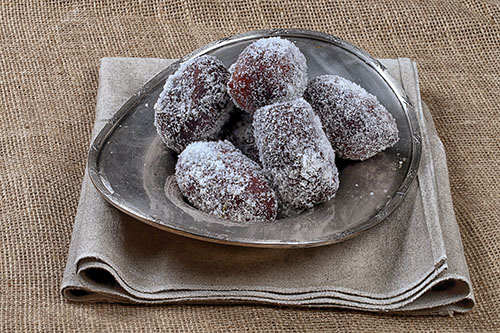
Instead, I included a recipe that has similar nostalgic tendencies. It is from my time learning to cook among the Cape Malay people: ‘koesisters’. Do not confuse it with koeksisters, it is not the same. Koesisters take me back to the Bo-Kaap and Woodstock, to the spice shops and the snoekverkopers. They say the koesister pays reference to the polite gossiping among spinsters, but to me it homage to a time filled with cinnamon and cardamom, aniseed and ginger, and Clarks and Cranfords.
Here’s to a life with meaningful moments.
• 125 grams butter
• 1 1⁄2 cups boiling water
• 1 cup milk