





Like Many Marine ecosystems worldwide, the Benguela Current along Namibia’s shores faces increasing pressure from industrial activity.
Long-established industries have left their mark on the ocean.
Collapsing fish stocks, noise and plastic pollution, as well as chemical contamination, are among the impacts that may be worsened by emerging industries.
The Namibian Cape fur seal is a key part of local biodiversity.
As top predators and bioindicators, they reflect the health of the marine ecosystem. Because they’re disproportionately affected by human industrial activities, they help reveal broader environmental changes and issues in the ocean.
The most visible threat to seals is entanglement in marine debris.
Ghost fishing gear, plastic waste and packaging cause serious injuries and death.
Far more invisible is the chemical pollution they are exposed to. As top predators, heavy metals accumulate in their bodies, weakening their immune and hormone control systems.
Studies show that elevated underwater noise from port expansion, increased marine traffic and other emerging industries affect the ability of seals to communicate.
SIGNIFICANT STEP
A new local study, launched in April, marks a significant step forward in local marine biology.
Led by researcher Arariky Shikongo from Ocean Conservation Namibia (OCN), with support from professor Johannes Iitembu of the University of Namibia (Unam) and French scientist Isabelle Charrier from Paris-Saclay Institute of Neuroscience, the project goes beyond simple population counts to assess the hidden physiological and behavioural costs of a changing ocean.
The study centres on three main objectives and will be conducted primarily at Pelican Point, with additional research at Cape Cross and potentially Wolf/Atlas Bay.
First, it investigates underwater acoustic communication in relation to the movement patterns of seals.
Second, it measures exposure to contaminants such as heavy metals, microplastics, and plastic entanglement.
Finally, it examines how these environmental stressors affect the seals’ physical health, immune system and hormone regulation.
So far, the research team has conducted non-invasive fieldwork that will continue in the coming years.
The team carried out a playback experiment, investigating how seals react to orca sounds as a potential predator.
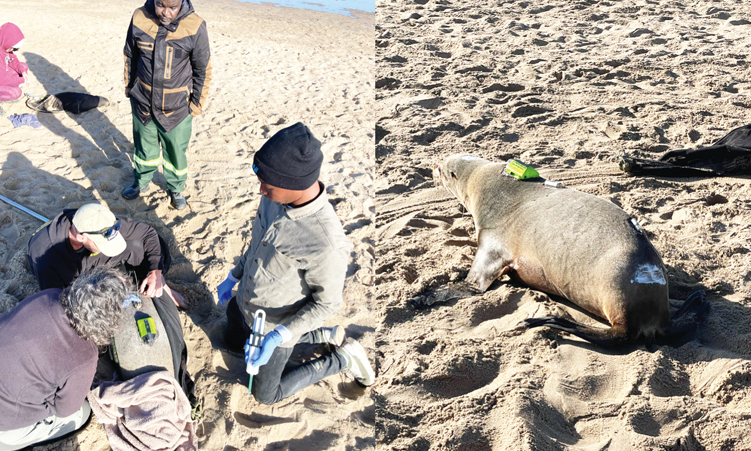
They also attached tags to females and pups to track their movements, underwater behaviour and interactions with other seals.
Some of these advanced tags record video and audio, paired with a depth sensor.
Working alongside the OCN seal rescue team, researchers record disentanglements and collect whisker, fur and faeces samples to assess contaminant and microplastic exposure.
In breeding colonies affected by the annual seal harvest, drone surveys monitor potential changes in harem structure and social dynamics.
The research is expected to fill critical knowledge gaps on how human activities affect Namibia’s ocean and wildlife.
By assessing seal health beyond population counts, studying underwater communication, and tracking young seals’ movements, the project will provide valuable new insights into seal ecology.
It will also measure responses to pollution and noise, helping to inform more effective conservation and management measures in the future.
NEW INSIGHTS
Given the environmental and economic sensitivity around Namibia’s seal populations, the research team emphasises transparency, ethical standards and full regulatory compliance.
All fieldwork is permitted and conducted under strict guidelines in close collaboration with relevant ministries, ensuring alignment with national conservation priorities and wildlife research standards.
This study is a big step in progressing marine mammal related research in Namibia.
It is the first combined assessment of acoustic, plastic and chemical impacts on Cape fur seals in our country.
Results are hoped to influence key environmental policy like the Marine Resources Act and Environmental Management Act, while the involvement of Namibian students is aimed at local capacity building in marine biology and conservation sciences.
- Damian Schreiber is a marine conservation communications, field and research officer at Ocean Conservation Namibia.
- He is involved in seal rescues, education outreach, and beach clean-ups.
- He has a master’s in ecology and society from Costa Rica’s University for Peace.