



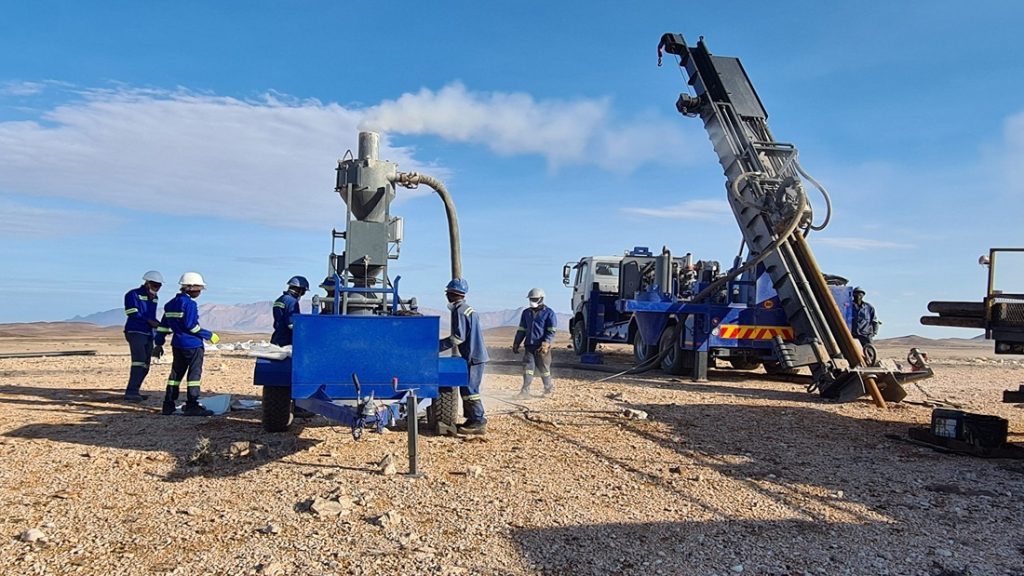
The European Union (EU) is funding critical raw material projects in Namibia that could open a path for critical mineral processing in Europe.
The union in May announced a partnership with Andrada, the London-listed mining company operating a tin mine in the Erongo region, through which it will fund a N$74-million project at Andrada’s Uis mine, called ProLith.
In an interview with The Namibian on Thursday, Andrada head of exploration Timothy Marais explained that it is a pilot project to prove that the kind of lithium found at Uis is suitable for making electric vehicle batteries.
The demand for lithium has exploded internationally as lithium is a key component of batteries. Historically, the lithium used in batteries has been produced from a mineral called spodumene.
Uis has a lithium-containing mineral called petalite.
“At the moment, petalite is not considered a lithium mineral for batteries, because currently it may not be economically viable,” Marais said.
The project at Uis, with technological support from the Finnish geological survey, is testing to see whether it is cost efficient to use petalite to extract the lithium for electric vehicle batteries by using an alkaline leeching process. Unlike spodumene, it is not necessary to roast petalite at high temperatures with this process, which will save a lot of energy.
“If this process works and we can show that it’s feasible, all other additional lithium such as petalite containing pegmatites start becoming attractive. And now Europe could start producing its own battery material from European mines, instead of shipping it all the way from the current producers,” Marais said.
This research project at Uis will not only provide the necessary information on whether lithium for batteries can actually be economically produced from petalite, but will also enable Namibia to sell processed lithium material, he said.
The project is at its early stages, but expanding Andrada’s current operations to produce petalite could increase the number of jobs at the mine by more than 10%.
“If a conversion facility is set up, you’re looking at many more job opportunities long-term. That being said, to reach this level of processing there’s a lot of skills transfer and development required. I mean, there are currently very few plants outside of China that can actually do this,” Marais said.
ZERO-WASTE MINING
The next phase of the partnership between Andrada and the EU would focus on using all the waste created by mining.
“The ProLith project has a follow-on hope, which is a base to the CircuMine project, where we’re looking at basically removing as much waste from Uis as possible,” Marais said.
The rock that is being mined there is very clean, he said. It contains several minerals which are currently being discarded by their operations and simply being put back into the ground. But many of those minerals are considered critical by the EU.
“It’s a question of: Can we produce the by-products economically? The next phase is looking at developing a process to separate all of these minerals economically,” Marais said.
Mining Finland chief executive Aleksi Salo says Finland, which is a partner of the project, is looking at reducing waste from mining.
“If you look at the material flow of metals and minerals, you are able to see that in the mining phase, specifically in open pit mining, you dump a lot of waste on the site, which is not usable. That’s why it’s called waste. Not necessarily harmful, but waste because we cannot use it.
Then in the processing phase, you dump a lot of things in the tailings, which is again something unusable,” he says.
Salo says Finland has for years been considering how to solve this problem by changing the design of mining.
“That’s why specifically this Andrada collaboration project is extremely important to solve global, not just local, mining waste issues to show that you can economically beneficiate battery materials from existing mining wastes,” he says.