





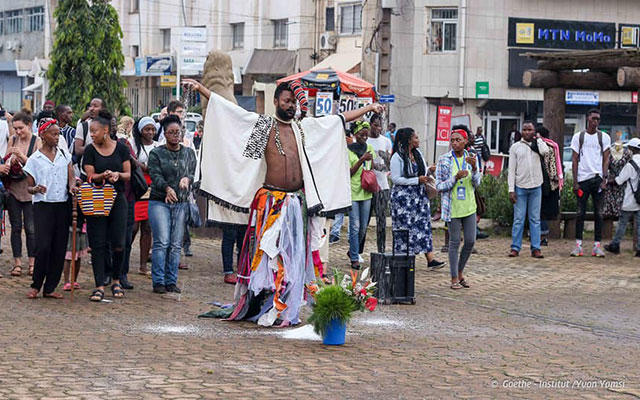
Ask citizens of Frankfurt, Munich, Yaoundé, Cape Town and Berlin if they’ve seen ‘The Dance of the Rubber Tree’ and some will nod with knowing. Nashilongweshipwe Mushaandja has been there.
Presenting the multifunctional performance art piece which has existed as a solo, as various site-specific interventions in museums, theatres, archives and heritage monuments as well as in collaboration with artists from Zimbabwe, Namibia, South Africa, Cameroon and Congo-Brazzaville, Mushaandja’s polymorphic offering now makes its way to Switzerland where audiences are invited to listen.
“Ondaanisa yo pOmudhime [Dance of the Rubber Tree] is more than just art. It researches and protests and heals,” says Mushaandja, who has created an 11-track sonic experience for a collective listening for the Zürcher Theater Spektakel.
“Many African communities make use of rubber shrubs – Omudhime in Oshiwambo – for a range of medicinal and spiritual functions. One of these functions is erasure of bad luck, cleansing and healing or even sorcery. The colonial archive is rooted in erasure and genocide of ‘other’ bodies and epistemologies. I became interested in erasure as a concept and Omudhime was one of the immediate things that I could reference as an African performance artist and researcher working in this clinical process.”
Harnessing the power of this tree as a central image in his work, which was born as the artist and researcher mined German colonial photography archives during a residency at the University of Hamburg, Mushaandja creates an aural antidote to erasure.
‘The Dance of the Rubber Tree’ as it will exist in Zurich opens with a sound of a journeying train and a call to action. An invitation to black people to gather their things, their land and look at the sun.
As the piece progresses, woven through with searing spoken word by South African theatremaker and performer Snelisiwe Yakeni, Mushaandja and Tschuku Tschuku’s reimagining of traditional Oshiwambo, Damara and Khoekhoegowab migration and healing as well as southern African struggle songs, the artist ultimately pays tribute to the departed, including those who never returned amidst the knot of colonial war and dispossession.
To build the soundscape, Mushaandja makes use of various sound archives. The ones in Khoekhoegowab found in the Basler Afrika Bibliographien were recorded by Ernest and Ruth Damman in 1953. Shona chants are derived from a demonstration by Zimbabweans in Windhoek when Robert Mugabe was overthrown in 2017.
“I like to think of sound in general as one way in which Africans made their archives. As ephemeral as it is, it touches and migrates. To play a sound is to allow it to travel,” says Mushaandja. “By revisiting sonic pieces of traditional and protest music, we encounter the past in unique ways. Sound enables us to imagine freedom by resonating and practising borderlessness, because sound is not confined to borders,” he says.
In its 45-minute running time, ‘Dance of the Rubber Tree’ calls to action, decries the museum’s collection culture as an extension of the colonial project, celebrates home, laments African leadership as the new oppressors and suggests fire as a decolonising intervention in museums. These ideas are interspersed with healing chants and appeals to the ancestors while advancing the body as an alternative archive to traditional and mainstream records.
“Africans need to return to the Rubber Tree. This potentially means a return to our bodies and land as sources of restorative justice and health,” says Mushaandja, who hopes his work will assist in inspiring collective consciousness, a sense of urgency, accountability and restorative justice as a global project.
“Ondaanisa yo pOmudhime makes claims about reconciling and centring knowledges such as the indigenous, African, feminist and queer that have been historically marginalised in nationalist and colonial archives. This also calls for restitution of art and human remains kept in private and public collections of museums and universities across the Euro-Americas,” he says.
‘Ondaanisa yo pOmudhime’ will be showing at the Zürcher Theater Spektakel on 23 August.

