




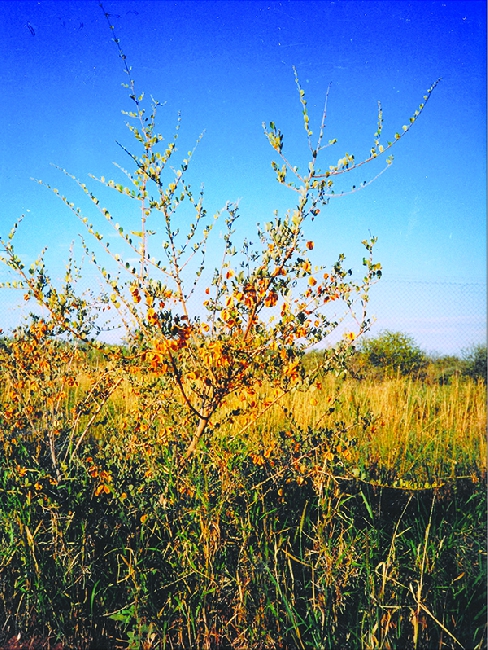
• LUISE HOFFMANNTHE most obvious characteristics of this shrub or small tree are the leaves, which are extremely variable. Measuring 10 – 48 x 5 – 25 mm, they are broadly elliptic to invertedly egg-shaped, leathery, grey- to yellow-green above, with a grey downy covering.
Below they are pale to yellowish green, covered with tiny scales, which at first glance seem to be hairs. The prominent veins on the leaf underside are very typical. The margins are entire and slightly turned under. Successive pairs are set at right angles to each other, sometimes they are spirally arranged. It is easiest to remember that they resemble mouse-ears, often notched or with a tiny bristly tip. The four-winged fruit of a strikingly beautiful russet colour also draw attention to this plant.
Names: E. russet bush willow, mouse-eared combretum; A. klapperkierrie / kierrieklapper; H. omutapati; Nd. Ky. omukadhikuku. The specific name hereroense refers to the Herero people.
The russet bush-willow occurs widespread in the north-eastern third of Namibia but not along the escarpment.
It is frequently found on calciferous or brackish soils, also common on disturbed road verges, along river banks and on sandy loam.
It is often a very untidy, gnarled and stunted shrub or small tree 3 – 5 m high, but may reach 10 m under very favourable conditions. The untidy appearance is probably due to the fact that it is much browsed by game and stock. During the rainy season the shrub is conspicuous because of long, straight new growth protruding from the gnarled old part of the shrub. The leaves on this new growth are set relatively far apart.
This phenomenon can also be noticed on other trees and shrubs that are heavily browsed, such as the shepherd’s tree (Boscia albitrunca) or its close relative the noenie- or stink-bush (Boscia foetida). Apparently, when these long new shoots are browsed, a more dense foliage develops on the remaining part.
Fragrant, white to creamy yellow flower spikes are borne in dense clusters on the end of the branches before or together with the new leaves from September – November.
Typical for Combretum species in Namibia, the fruit are four-winged. They measure about 20 x 20 mm and the central portion is a strikingly rich russet colour with golden wings. As the season proceeds the central portion turns brown while the wings remain golden.
The leaves are regarded as nutritious browse for game and stock. The wood is hard, heavy and close grained and may be used for tool handles and as fire wood.
According to Veronica Roodt in “Trees and Shrubs of the Okavango Delta” a tasty herbal tea can be brewed from the crushed leaves and fruits. A root decoction or infusion can be taken against chest ailments and will also cure a bad cold.
The leaves may be chewed for the same purpose or the dried leaves can be smoked. In the Tsumkwe area the branches, which are more pliable than those of most other plants, are used to make a musical instrument that is mainly played by tradition healers during healing ceremonies. In the Kunene region thin pliable branches are woven into a belt to be worn by young girls upon reaching puberty.