



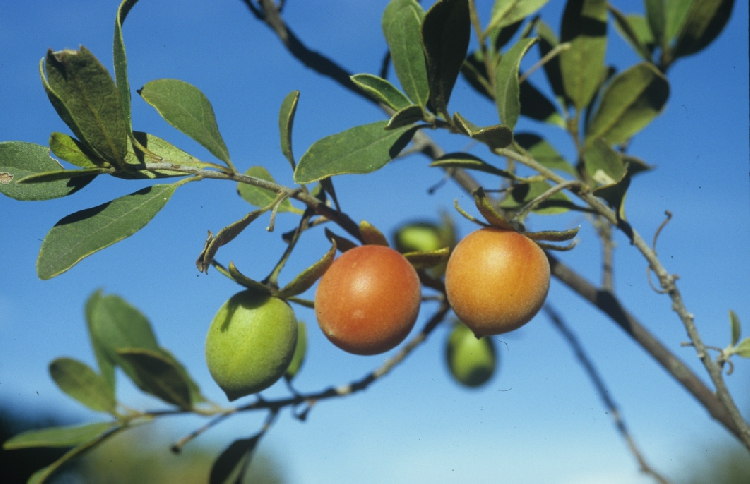
• Luise HoffmannWHEN in fruit, this shrub or shrubby tree is easy to identify.
The orange to red-brown berries have a diameter of up to 20 millimetres and their five persistent calyx leaves curve backwards similar to those of a tomato, while a scar of the fallen off flower remains visible on the opposite end of the fruit.
It occurs in many vegetation types and on various types of soil all over Namibia but is common mainly in the north-east.
Names: G. Schakalbeere, Zahnbürstenstrauch; A. bloubos; H. omukohatjinyo, omuzema. The botanical name Diospyros may be interpreted as meaning ‘divine fruit’ and may refer to the tasty fruit of many species of this genus.
As can be inferred from the ending ‘oides’ these plants have a certain similarity to those of the genus Lycium, known as honey-thorn in Namibia, a number of spiny, rather untidy shrubs of one to three metres high often found as undergrowth which will be described in one of the coming weeks.
The blue-bush may already bear fruit while still a small plant of only 30cm height. Usually it is a shrub of about three metres but may become a tree of five to eight metres when growing under favourable conditions. In the shrubby form it is often wider than tall and tends to form tickets, especially on the floodplains of north-eastern Namibia, where it is quite common.
A dark grey, fairly smooth bark covers the trunk. The narrow simple leaves are spirally arranged and clustered at the branch tips. A sparse to dense silvery down covers both sides of the olive coloured leaves, which keep their colour even when dry. The leaf margins are slightly turned under.
Small cream coloured to pale yellow flowers appear from October – April. The fruit is a berry and consists of a small amount of sweetish tasting edible flesh with several seeds. Eaten in greater numbers they are highly purgative. Birds and monkeys like to eat them.
They can be used to brew an alcoholic drink. The leaves are browsed by game and stock.
The wood is used in the construction of huts when thin branches are required.
Twigs or the cleaned root with its bark, locally known as “muthala”, are chewed and used as a toothbrush. Scientific research has verified that twigs and roots contain several substances protecting against tooth decay and oral infections and provided that they are used regularly over an extended period of time – they may even remove tartar, the hard, brownish substance that plaque turns into when teeth are not properly cared for.
Using the twigs and roots as a toothbrush is a widespread habit and also protects against colds, flu and coughs.
A decoction of the cleaned and chopped root is used as an effective eye-wash. Such a decoction can also be swirled around the mouth for some time to alleviate tooth pain. It can also be used as a gargle to treat a sore throat.
The root decoction and the raw fruit are considered to be effective against tuberculosis.
A yellowish brown dye is obtained from the roots and the bark is used for tanning skins, while the flowers provide nectar for bees.
The shrub also makes a pretty garden plant.
In an age of information overload, Sunrise is The Namibian’s morning briefing, delivered at 6h00 from Monday to Friday. It offers a curated rundown of the most important stories from the past 24 hours – occasionally with a light, witty touch. It’s an essential way to stay informed. Subscribe and join our newsletter community.

The Namibian uses AI tools to assist with improved quality, accuracy and efficiency, while maintaining editorial oversight and journalistic integrity.
Stay informed with The Namibian – your source for credible journalism. Get in-depth reporting and opinions for
only N$85 a month. Invest in journalism, invest in democracy –
Subscribe Now!