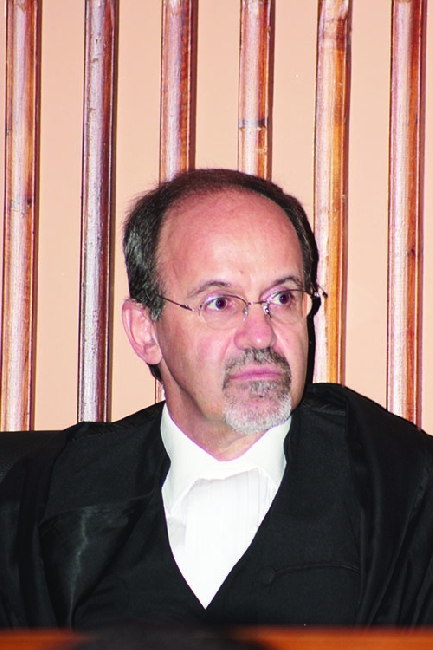
THE quality of output in magistrates’ courts has improved significantly.
This was the view of High Court Judge Dave Smuts when he addressed the annual general meeting of the Magistrates and Judges Association (MJA) held in the capital last weekend.
“When I spoke to you three years ago in Otjiwarongo, I strongly commended you on the quality of work which was evident from the reviews sent to the High Court. I had mentioned that I had previously acted in 1996, 1998 and briefly in 2006.”
During 2012, he noted “a dramatic improvement in the quality of proceedings when attending to review. That trend has continued, even though the graph has not been as dramatic,” Smuts said.
According to him, he has only written about two judgements over the past year in which he addressed one or two queries. “All other matters were confirmed.”
Smuts said that a colleague of his, Judge Elton Hoff, has also said that the output of the lower courts has improved. “That is crucial. Most members of the public have their interface with the justice in your courts. Delays are not only severely prejudicial to the administration of justice – it is so important for interested parties to have results emerging in court as quickly as possible – but it also costs money when there are delays.”
He emphasised that there are the direct and indirect costs of delays. “Getting people to court – often yourselves, when travel is needed – but also the time of witnesses, courts and your time could be better spent if matters were finalised promptly. It is important to remember that it is a service we are providing – the delivery of justice – and that we must use the scarce resources allocated to us effectively.”
According to Smuts, “there are also important lessons to be learned from the High Court.” Judicial case management was introduced in civil matters in 2011 at the initiative of the Judge President, he said. “Judges now control the process. It has been a tremendous success. There was an increase of 225% in the finalisation rate of cases within the first year alone.”
Smuts said that the rules have since then been more refined in the new court rules which were promulgated earlier this year. He said those rules were the product of extensive consultation with all relevant stakeholders. “They have served to strengthen and enhance judicial case management and brought about even more reforms. Most notable of these has been the introduction of court connected mediation. This has the potential of massively reducing the workload of the courts and confining judicial time to the more important cases.”
He said some senior magistrates had been involved in this process and are court connected mediators. According to him, their involvement has been important to the process.
Smuts further spoke about the in-service training of the judiciary. He said it was primarily aimed at judges. “But we also trained lawyers in judicial case management with the help and cooperation from [the] United States judiciary. Our training went even broader in respect of alternative dispute resolution.”
At the same occasion, Judge Smuts spoke about the recent constitutional amendments and “how they directly affect us as members of the judiciary”.
He said much of the attention was focused on the new positions created by the new constitutional provisions such as that of a vice president as well as the increased size of parliament. “The debate centred largely on those innovations. It is not for me to enter into that debate. Whether a country with a population of our size requires a vice president in addition to a Prime Minister, deputy Prime Minister, etc is not a matter for the judiciary to comment on. It is a political choice made by the elected political office-bearers in parliament.”
According to him, the most important component was not raised. “It concerns the independence of the judiciary. A new independent office for the administration of the courts outside the executive branch of government (the Ministry of Justice) is now established. Experience elsewhere has taught us and demonstrated that this is a crucial and necessary consequence of the independence of the judiciary – a principle emphatically enshrined in our Constitution.”
Smuts said: “This new institution will have massive implications for the administration of justice. A new office will be set up to run the courts. It will be difficult to bring about the entire changes necessary overnight. That is because the judiciary includes the magistracy, with its courts spread over the length and breadth of the country. The Mostert case and the legislation which came about following it, had made that very clear. It is indeed a big task. The Chief Justice and others within the Ministry and myself went to the US to see how it is done there. From budgeting to governance. My own special interest – apart from the fundamental constitutional imperative of independence – is training and the need to establish an institution which addresses training coherently and systematically at all levels of the judiciary – from the Supreme Court to the magistracy.”
He emphasised that this process will take time and money. “But it will no doubt start at the High Court and expand as soon as the magistracy is included within the new structure.”