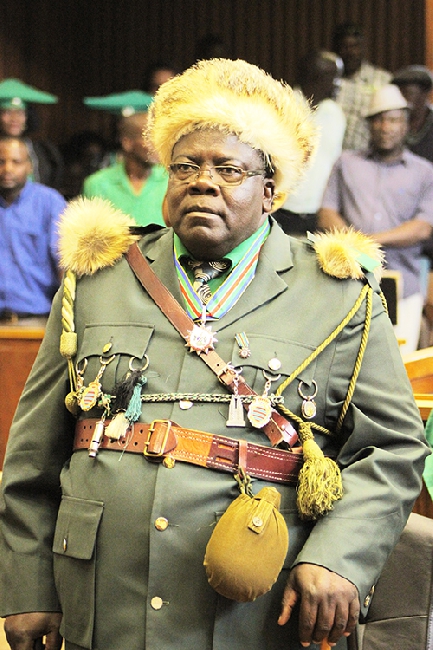
THE deputy Minister of Works and Transport, Kilus Nguvauva, must be officially designated as traditional chief of the Ovambanderu community, a judge ordered in the Windhoek High Court yesterday.
Nguvauva’s hopes of succeeding his late father, the late paramount chief Munjuku Nguvauva II, as traditional leader of the Ovambanderu community, received a significant boost with a judgement in which Acting Judge Collins Parker ordered the Minister of Regional and Local Government, Housing and Rural Development to approve Nguvauva’s designation as the Ovambanderu community’s traditional chief by 14 October.
Acting Judge Parker also declared that Nguvauva has been duly proposed to be designated as the traditional leader of Namibia’s Ovambanderu community in terms of the Traditional Authorities Act. The judge further made a finding that once the Minister of Regional and Local Government has received an application for the designation of a proposed traditional leader and that application complies with the requirements set out in the Act, the minister is compelled to approve the designation.
Supporters of Nguvauva, who filled the public gallery in the courtroom where Acting Judge Parker delivered his judgement, greeted the ruling with a celebration outside the court.
The judge reasoned that since the application for Nguvauva’s designation as traditional leader of the Ovambanderu – which was supported by the Ovambanderu Traditional Authority – is the only such application pending before the minister, following the death of Nguvauva’s half-brother and leadership rival, Keharanjo Nguvauva, the minister is compelled to approve Kilus Nguvauva’s proposed designation as traditional chief.
The judgement was given in a case in which Nguvauva was asking the High Court to order the minister to approve his designation as Ovambanderu chief. Nguvauva’s application was his response to legal action that the late Keharanjo Nguvauva launched in 2010, when the latter applied for a court order that would have set aside a decision by the minister to hold an election to choose a new Ovambanderu leader.
Kilus Nguvauva is the eldest son of his late father, whose death in January 2008 was followed by a leadership contest that split the Ovambanderu community into rival camps. Since Nguvauva was born out of wedlock, a committee which the Minister of Regional and Local Government appointed to investigate the conflicting Ovambanderu leadership claims concluded that his younger brother, Keharanjo Nguvauva, whose mother, Aletha Karikondua Nguvauva, was married to the late paramount chief, was the rightful successor of their late father.
The minister initially accepted the committee’s recommendation to designate Keharanjo Nguvauva as Ovambanderu leader. However, he later changed his position and by May 2010 decided that an election should be held in which the Ovambanderu community would choose a successor for the late paramount chief, Acting Judge Parker recounted.
Keharanjo Nguvauva thereafter took legal action against that decision. His case was still pending in the High Court when he took his own life in April 2011. After that event – which Acting Judge Parker described as “a sorrowful and unfortunate act of God” – the minister had only the proposed designation of Kilus Nguvauva as Ovambanderu chief still waiting for his official approval. The judge found that in terms of the law, the minister has no discretion but to approve the designation if the application for it met the requirements in the law.
Aletha Nguvauva, whom a faction of the Ovambanderu community enthroned as paramount chief or queen and successor of her late husband after the death of Keharanjo Nguvauva, tried to join the case about the traditional leadership of the community, but was finally ruled out of the case by the Supreme Court in June last year.
The court noted that according to the Ovambanderu constitution only someone who is a descendant of the Nguvauva clan is eligible to become the paramount chief, which is a hereditary position. The court also noted that there was no allegation before it that Aletha Nguvauva is a descendant of royal blood from the Nguvauva clan, or that she had a stronger claim to succeed her late husband than Kilus Nguvauva had.
Nixon Marcus represented the minister in the case heard by Acting Judge Parker. Natasha Bassingthwaighte and senior counsel Theo Frank, instructed by Saima Nambinga, represented Kilus Nguvauva and the Ovambanderu Traditional Authority.