






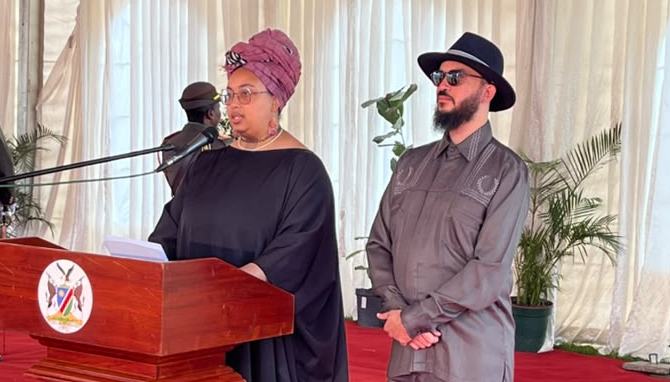
Tulimelila Shityuwete, daughter of liberation struggle veteran Helao Shityuwete, says Namibia’s independence should not be viewed as the end of the struggle, pointing to unemployment and poverty in the country.
Speaking at Shityuwete’a memorial service on Saturday, she said the employment and poverty crisis in the country are evidence that political freedom has not yet translated into economic freedom for all Namibians.
“We cannot look at a country where more than one third cannot find employment and say that the work of freedom is complete,” she said.
She said the freedom fought for by her father’s generation should grow into the freedom to feed one’s family, find meaningful work, receive an education, live in safe housing, access healthcare and build a future without poverty determining the limits of opportunity.
“I want to keep asking uncomfortable questions, to keep making room for people whose voices are too easily ignored, to keep fighting for dignity and equality,” she said.
Reflecting on her father’s death, Tulimelila said her father’s legacy extends beyond the freedom he fought for; it is also the values he instilled in his children.
She describes him as her “north star”, saying he taught his children to question power, challenge injustice and stand up for human dignity.
“For all my 39 years, you were our north star. You are part of our compass now and we will carry the torch from here,” she said.
While many know Shityuwete as a freedom fighter, political prisoner and liberation struggle leader, to his children he was a teacher who taught them to fight for what is right.
Tulimelila said her father believed in an independent Namibia long before the country existed, choosing to fight for a future he only imagined.
She said he and his comrades looked at a system backed by laws, the government, money, armies, prisons and weapons and refused to accept that it was the limit of what Namibia could become.
“They had something much more fragile. They had an idea. They looked at the world as it was and refused to accept that it represented the limits of what the world could become,” she said.
Shityuwete was arrested at the age of 31 and released just before his 50th birthday.
“For 16 years, he gave his time to an imagined future. It is youth, it is time, and it is one thing no liberation, independence and no grateful nation can ever give back,” she said.