



Most young girls are already familiar with the term ‘periods’. A right of passage for all young women, this monthly biological function starts at the age of puberty, signifying that a girl is not pregnant.
In societies where basic amenities are available, girls who are on their period usually receive tampons or pads from their parents or guardians. This makes the often uncomfortable process more bearable for many young ladies.
However, in many rural communities, young girls are not lucky enough to have access to tampons or pads on a regular basis. Because of this, they are forced to use various materials such as t-shirts, layered cloths or even toilet paper to soak up the menstrual blood.
Research has also shown that these girls miss school because they do not feel comfortable and confidant during the day, and so stay home instead.
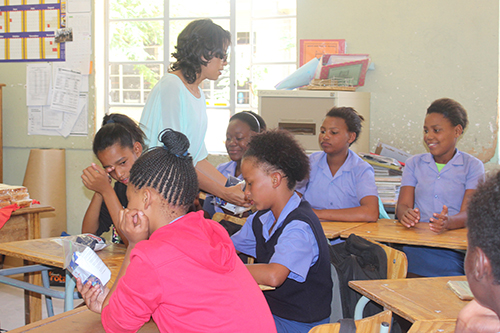
Various initiatives have been implemented to change this in Namibia, and one of these includes Sister Namibia’s excursion to Groot Aub, about 30 km from Windhoek, to hand out free washable sanitary pads to young women at Groot Aub Primary School recently.
The accompanied them on their journey.
The initiative of giving away sanitary pads to different impoverished communities is not a new one. Along with the First Lady Penehupifo Pohamba, diamond mining firm Namdeb chief executive Inge Zaamwani-Kamwe managed to obtain a sponsorship from Pick ‘n Pay stores and held a brief meeting on 8 July 2014 in Windhoek, emphasising the need to provide sanitary care to school children.
“We appeal to the general public to support this initiative,” First Lady Pohamba was quoted saying during the event. “A good number of Namibian girls missed about three days of school every month. In Kenya, over 850 000 girls missed six weeks of school every year. Why, we ask?
According to statistics in sub-Saharan Africa, the school attendance rate is among the lowest in the world.”
Instead of using everyday pads and tampons which most communities are not able to afford, washable sanitary pads, also known as cloth menstrual pads, have become a solution.
These are reusable, environmentally friendly, as well as cost-cutting materials used during menstruation. If you are worried about the pads leaking, don’t be. The material embedded inside is able to absorb fluid easily so that you do not have stains on your clothes, underwear or the chair that you may be sitting on.
Unfortunately, the material is made in the United States and has to be imported to the country, otherwise, qualified people would have been able to make these washable pads in local factories and distribute them where needed.
“As women and children, we need our parents to look after us,” Vida de Voss, director at Sister Namibia, said to the pupils of Groot Aub Primary School. “Children want cellphones, but because they are not able to get it, they choose to have sugar daddies. Sometimes it’s not that you wanted to, but you can’t tell them ‘no’. And because you can’t afford certain things, you also use your sugar daddy to buy you other things,” de Voss said. And one of these things are pads and tampons.
Hopefully, with these washable pads, this will not be the case any longer. “Sister Namibia is thinking of you. Take responsibility of yourself. Study, go to school and do your homework.”
“We want to see girls reach their full potential. Start saying to yourself my period doesn’t control me’.”
With that said, a demonstration was given to the pupils on how to use the pads. Each pupil was given two pads and five additional cloths to occasionally replace and wash. Some pupils opted to take extras for members of their families at home who needed help as well. During the next three months, those who have taken the pads will go through a trial period and report back to their teacher. How comfortable are the pads? Are there adjustments which need to be made?
These are the some of the questions that they are required to answer as Sister Namibia wants to do extensive research behind these products and improve on them at a later stage.
Lucia Goabas, a teacher at Groot Aub Primary School, extended her deepest gratitude for the gesture. “On behalf of the staff, we would like to thank Sister Namibia, the representatives and all the people who were involved.
I hope you will carry this over. We hope these pads will be of great help. Throughout the years, we have been struggling to get pads. At times, we were successful, at other times not. So I would really like to say thank you.”
• The products come in different shapes and sizes to cater for girls’ different body types.
• The cloth is all natural and environmental-friendly so the possibility for an allergic reaction is slim.
• It’s really simple. Soak, wash and dry in the sun (but not for too long).
• The pads are very easy to use. Just slip the menstrual pads in your underwear and you no longer have to worry.