CHARMAINE NGATJIHEUE and TERTTU NEWAKAFEWER pupils achieved the minimum requirements to proceed to higher learning institutions in 2020.
The number of high school pupils who made the grade dropped from 66,7% in 2018 to 61% this year, while the part-time candidates obtained 77,3% graded subjects, compared to 85,5% in 2018.
Speaking at the release of the 2019 Grade 10 Junior Secondary (JSC) part-time and Grade 12 Namibia Senior Secondary Certificate (NSSC) higher level results yesterday, deputy education, arts and culture minister Anna Nghipondoka said most institutions of higher learning insist on a Grade 3 or better in a National Senior Secondary Certificate (NSSC) higher level subject as a minimum requirement for admission.
Following the drop in graded subjects, Nghipondoka stressed that the NSSC higher level (NSSCH) results for 2019 did not meet the ministry’s expectations, but every year presents a new opportunity for pupils to work towards a better future.
“I call upon all the role players in the education fraternity to redouble their efforts to ensure that the ministry meets its set targets. Now more than before, with the transition from the old curriculum to the revised curriculum we need to move away from our comfort zones and from behind closed doors and try out new approaches geared towards achieving quality educate with above average performance.”
She partly blamed the poor performance on the fact that pupils do not receive the best guidance or advice on selecting the appropriate levels according to their potential and historic performance over the years.
Based on the ministry’s analysis, Nghipondoka said teachers can properly guide and advise these pupils on appropriate level selection.
“It is thus imperative that the teachers and learners determine the appropriate level of entry for the NSSC-Ordinary level and NSSC-Higher level examinations. Allowing learners to enter at higher level just to score a 4 grade, is in most cases the contributing factor to these poor performances at higher-level, not withstanding the fact that all role players are required to work hard to achieve good results.
“It has become a trend at some schools to enter most, if not all the candidates at higher-level in some subjects imagine a school with 200 candidates all entered at higher level all scoring only 4 or ungraded,” she stressed.
In 2019, over 20 605 pupils sat for the NSSC higher-level examinations, comprising of 18 649 full-time and 1 956 part-time candidates. The number of NSSC higher-level candidates in 2019 increased by 2 637, or 12,8 when compared to 2018.
Moreover, 91,4% of all full-time candidates who entered the NSSCH obtained a Grade 4 or better, in comparison to 94,2% in 2018.
“This means that 8,6% of the total entries were ungraded if compared to 5,8% in 2018. Based on the ungraded subject entries, this performance represents a drop of 2,8% compared to 2018,” said the deputy minister.
According to the results, higher-level female candidates outperformed their male counterparts with 92,6% of all female entries graded, while their male counterparts achieved 89,9% graded entries.
A total of 9 566 part time candidates registered for the JSC examinations this, a 1 656 drop when compared to 2018. This translates to a 14,8% drop.
“The part-time candidates who sat for JSC this year and improved their results should take note that they cannot continue with grade 11 on a full-time basis simply because the old curriculum has phased out and re-entering the full-time schooling system will mean that these candidates should start with the revised curriculum senior secondary phase in grade 10,” the deputy minister noted.
During the result release, the top performing candidates were given an opportunity to reveal their tips and tricks to achieving good grades.
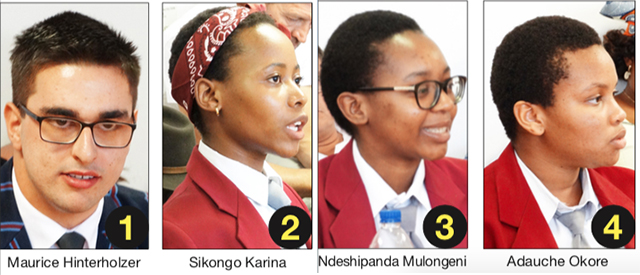
Top student in the country was Maurice Hinterholzer (18) from Walvis Bay Private High School.
He said one should look at the greater picture when studying.
“One must come to realise that one is not studying for studies’ sake. One is studying for the betterment of yourself, your family, your community – especially the community of Walvis Bay which I am certainly proud of and I am grateful for their support- and for this country,” said Hinterholzer, who plans to study medicine at the University of Pretoria in South Africa.
Karina Sikongo (18) from St. Boniface came second in the country.
She said the main thing that helped her through her studies was prayer.
“I give some of my success to the usual religious retreats and reflections that we have at our school that our principal encourages, also going to church and a lot of prayer. There is hard work and then there is prayer. Work hard and pray herder,” she said.
St. Boniface’s Ndeshipanda Mulongeni (17) was the third best performer, followed by 16-year-old Adauche Okore, also from St. Boniface.
In fifth place is Timotheus Bormann from Otjiwarongo Secondary School, with Ukarapo Kasaona from Windhoek High School and Louis Mouton from Edugate Academy in sixth and seventh places, respectively.
Nico Epler from Otjiwarongo Secondary School is in eighth position, while Windhoek Gymnasium’s Marne Rieckert came ninth in the country.
Michelle du Plessis of Walvis Bay Private High School was tenth.