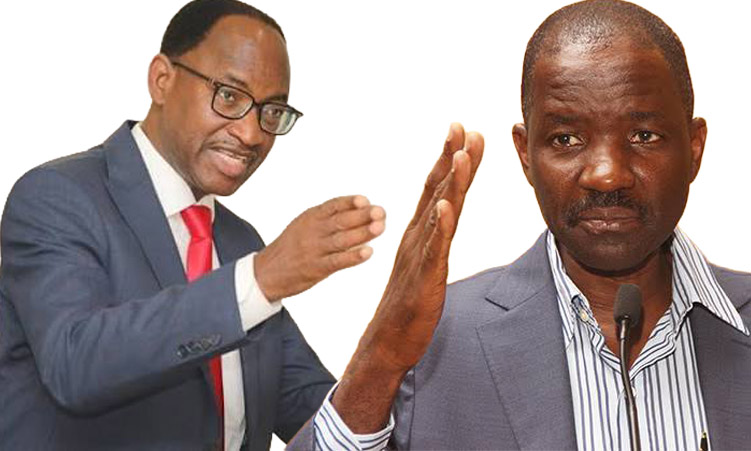
Former health minister Bernard Haufiku has questioned whether outgoing Anti-Corruption Commission director general Paulus Noa protected a person implicated in alleged corruption at the Ministry of Health in the so-called ‘healthrot’ scandal.
Haufiku made the allegation on Friday using the interview with The Namibian while responding to Noa’s defence of the ACC’s handling of corruption cases.
“The question is: Is the outgoing director general sitting on my case because one of the persons, a young man, implicated in this corruption at the Ministry of Health is a son of a friend to the outgoing director general?” Haufiku asks.
The former health minister did not name the son or Noa’s alleged friend.
He however says the matter had been outstanding for nearly a decade and questions whether Noa had failed to act because one of those implicated had a personal connection to him.
Haufiku says he had submitted what he described as facts and evidence of alleged fraudulent procurement at the Ministry of Health between 2016 and 2017, including a 51-page document, but claimed no action had been taken by Noa’s office.
“And up to now nothing has been done by the director general’s office. That is 10 years ago. And the nation is still waiting to hear from the outgoing director general,” Haufiku says.
“He must answer this question.”
The allegation comes as Noa has defended the ACC’s record, saying the commission cannot pursue people simply because there is public pressure for them to be prosecuted.
“When the ACC is not taking action against a particular person who is probably perceived to be on the wrong side of the law, it is simply because there is no evidence that justifies the ACC to take action against that person,” Noa said last Wednesday.
He says investigations must establish whether a matter can be referred to the prosecuting authority for a decision on whether charges should be brought.
Responding to Haufiku’s comment yesterday, Noa said the investigations into the allegation of corruption in the Ministry of Health and Social Services are still under investigation. He said he did not protect anyone.
“Haufiku knows me very well, he knows where he can contact me ….he could have asked me about it if he thinks that there is something suspicious that is being hidden whatsoever. What made him not to ask me?,” Noa says.
Noa says that he also informed the new director general Bryan Eiseb about the investigations into the ministry of health before he left as it is one of the outstanding notable cases.
SECOND CHANCE
Haufiku, however, says his complaint should not be characterised as simply a matter of public pressure.
“This is a serious case with evidence of wrong dealings provided,” he says.
“And if the outgoing DG has not seen the 51-page document I submitted in 2017 to his office, I can offer to avail a copy for him or his successor,” he says.
He says the alleged corruption case he has submitted to the ACC should not be trivialised to a so-called “what the public wants to be investigated”.
“This is a serious case with evidence of wrong dealings provided. It therefore deserves the full attention of the responsible person and the public commission which was setup to ensure processes, systems, institutions and anyone involved is operating above board. Without any fear or favour,” Haufiku says.
Last year Haufiku told The Namibian that medical supplies sold to the government during his tenure were overpriced by as much as 300%, raising suspicions of corruption and irregularities in the health ministry’s tender process.
The ACC also confirmed in July 2017 that it was investigating allegations involving irregular tender awards at the ministry.
In April this year, Noa said the commission was investigating multiple cases at the ministry and was trying to establish who was involved.
In October 2025, the ACC also confirmed that it was investigating allegations involving health ministry officials and suppliers over alleged manipulation of medical tenders and orders worth hundreds of millions of Namibia dollars.
Political commentator Ndumba Kamwanyah says the public should understand that the ACC cannot investigate every allegation simply because there is public pressure.
“Investigations should be based on credible information and evidence. However, this does not mean the ACC should ignore public concerns,” Kamwanyah says.