Why did it not act sooner?
Namibia’s veterinary officials allegedly warned the government months ago about cattle crossing from South Africa into Namibia as foot-and-mouth disease (FMD) spread in the region.
Sources say this raises questions about whether state officials acted too slowly to prevent the disease from entering the country.
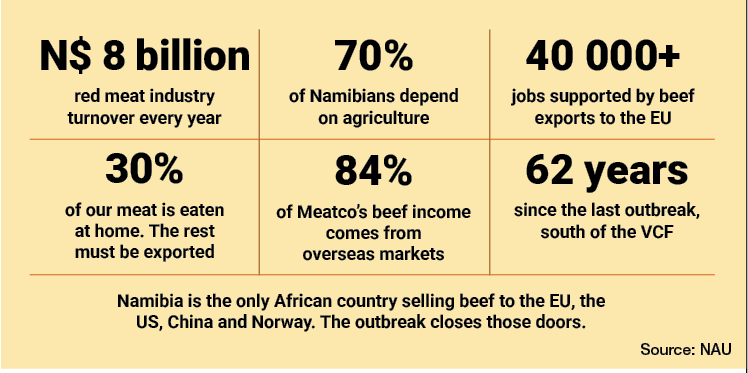
The outbreak, which was confirmed in the ||Kharas region, has left the N$8-billion agriculture sector at risk after the government announced strict restrictions on the movement of beef.
Now, some senior officials, who declined to be named because they were discussing confidential matters, are questioning why Namibia did not act sooner, given that the disease was already spreading in neighbouring South Africa and Botswana.
According to government sources, the Ministry of Agriculture, Fisheries, Water and Land Reform’s veterinary services were informed about unregistered livestock crossing the Orange River from South Africa, prompting the ministry to request the construction of a veterinary cordon fence to curb the risk of FMD entering Namibia.
The fence was never constructed.
The source say the government should have already sealed the borders and deployed the Namibian Defence Force (NDF) to prevent the disease from entering the country.
Agriculture ministry spokesperson Romeo Muyunda maintains that the government was alerted about cattle roaming along the border, prompting the ministry to take precautionary measures.
“With the FMD threat emerging from South Africa, given the reports of confirmed cases, we had already identified the potential risk from cattle roaming along our borders, particularly along the Orange River between South Africa and Namibia, as a competent authority.
“Based on this, the need to erect a cordon fence was identified as a preventative and precautionary measure,” he says.
He says the ministry had deployed staff members along the border to monitor the movement of roaming animals.
A senior government official who declined to be named told The Namibian yesterday that the ministry, through its veterinary services, had identified the risks already last year and had deployed about 50 staff members this year to guard the border to restrict the movement of livestock in the country from Botswana and South Africa.
The source said staff were deployed to the river line and points of entry, where disinfection operations were carried out, while restricted animals and animal products were checked to prevent illegal movements, particularly across borders and through points of entry.
A risk assessment had already been conducted last year, followed by increased awareness campaigns among farmers this year.
There was also collaboration with the private sector, with an FMD task force established this year and a plan put in place to prevent and control the disease in case it entered the country, the source said.
“Our staff had to take turns during the day and in the evening to control the livestock,” the source said.
The source said the ministry had also put up notices and imposed restrictions at the borders, first with Botswana and then with South Africa, to prevent animals from entering freely in the absence of the veterinary cordon fence.
This was before the first case was confirmed at an agricultural farm in the ||Kharas region, near the Orange River.
The Namibian understands that neighbouring farms are testing their animals this week to determine if the outbreak has spread.
The source says following the deployment of staff members, the government was also working on a plan to erect fences around those areas.
“Now after the outbreak, we decided to continue with the fencing and so far as we speak the guys are busy with the fencing,” the source said.
THE GENESIS
High Court documents seen by The Namibian also provide insight into how the government was dealing with a potential outbreak in the background.
According to the documents, Central Procurement Board of Namibia (CPBN) chairperson Mary Shiimi’s answering affidavit shows how the ministry was tracking outbreaks in South Africa as they moved closer to the Namibian border.
“In light of the rapidly developing outbreak and the increasing risk of the movement of infected livestock across the border, the ministry advised that any further delay in securing and constructing the veterinary cordon fence would materially undermine the very purpose for which the procurement was initiated,” Shiimi says in the court documents.
She says the ministry had advised that the FMD outbreak was approaching Namibia’s borders at a significantly faster rate than had initially been anticipated.
“The ministry further explained that the reduction in water levels in the Orange River had increased the risk of livestock crossing the border,” she says.
On 3 September, agriculture ministry acting chief director Petrus Nangolo wrote to the CPBN saying South Africa was experiencing serious outbreaks of FMD.
“Affected locations are reported within less than 100km from the Namibian border,” Nangolo wrote.
On 15 June the agriculture ministry, through Nangolo, approached the CPBN to do a competitive bidding process of a veterinary cordon fence along the border to curb the spread of the disease and restrict livestock movement across the border.
During this period, on 31 August the CPBN received further information from the ministry concerning the rapidly developing disease in neighbouring South Africa.
The Namibian had reported during the same period that agriculture minister Inge Zaamwani had rejected a quotation from August 26 Construction of N$179 million to construct a veterinary cordon fence, which would stretch 400 kilometres along the Namibia-South Africa border and prevent animals moving across borders and spreading FMD.
The project was sent to the CPBN on 14 July, which invited bids for 185km of veterinary cordon fencing in the ||Kharas region.
Twenty-three companies submitted bids, with China Jiangxi JV Homefin emerging as the successful bidder at about N$126 million.
However, the CPBN later cancelled the tender, citing procurement provisions, and awarded an emergency contract worth about N$122 million to Punchu JV China State Construction, which had ranked second.
This led to China Jiangxi JV Homefin dragging the government to court.
This followed Nangolo’s advice to the CPBN that on 3 September, the circumstances had become increasingly urgent and that, if the procurement process were to continue through the reconsideration and possible review processes, the disease would, by then, likely have reached Namibia.
The outbreak was announced to the public last Wednesday by acting agriculture minister Charles Mubita.
FMD is highly infectious and affects cattle, goats, sheep, pigs and other cloven-hoofed animals, including wildlife/other wild animals.
Mubita said veterinary officers doing routine inspections had tested 11 animals exhibiting symptoms of the disease in the ||Kharas region, 10 of which were positive.
According to chief veterinary officer Kenneth Shoombe, a total of 63 animals showed signs of the disease.