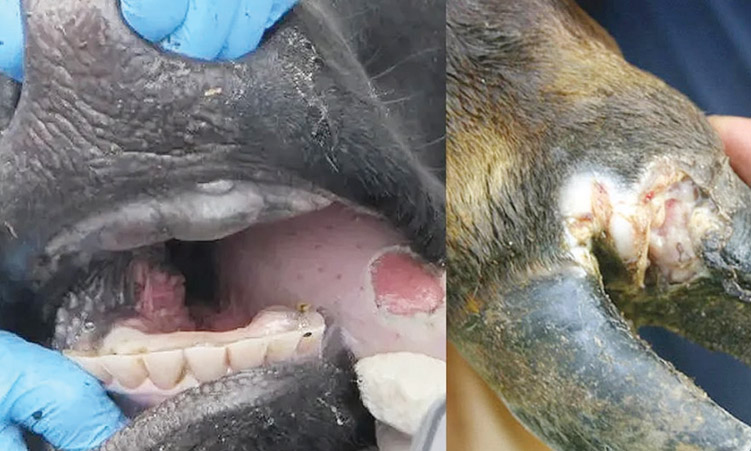
Nearly two weeks into Namibia’s foot-and-mouth disease (FMD) outbreak, butcheries and meat suppliers are running out of stock and placing workers on leave.
This comes as agriculture, fisheries, water and land reform minister Inge Zaamwani announced over the weekend that FMD cases in ||Kharas increased to 79, with the disease now confirmed on 11 farms.
Restrictions imposed to curb the spread of the virus, including no slaughtering in the red zone (||Kharas) and no movement of livestock across the country, have forced a family-run butchery in ||Kharas to rely on chicken and cooldrink sales.
Namgate Guesthouse, Butchery and Farmstead, located about 5km south of Grünau along the B1 highway, says the restrictions have had a major financial impact on the business.
Wilmarie van der Merwe of Namgate says the butchery has been unable to operate normally since the restrictions.
“It’s impacting us very badly because we are only allowed to sell chicken and cooldrinks,” she told The Namibian yesterday.
Van der Merwe said the business has also had to place about four workers on leave because there is no red meat-related work for them to do.
She said the workers will remain on leave depending on how long the restrictions last.
The FMD outbreak was first detected on 22 September during routine inspections at a farm in the Graswater area of the Karasburg State Veterinary District.
Tests have confirmed that the outbreak involves the SAT 1 type of FMD.
By 2 October, 531 samples had been sent for testing. Of these, 79 tested positive for FMD and 450 tested negative. One sample was still waiting for confirmation.
Zaamwani said all confirmed cases are currently within the Karasburg State Veterinary District.
Nuwerus Suppliers at Koës, also in the ||Kharas region, has temporarily closed its operations.
Nuwerus is a farm-to-table meat and dairy wholesaler, with an abattoir on its farm.
Owner Andries Johannes Dames says the restrictions have brought the meat side of the business to a standstill.
“We are closed, so we can do nothing. It will have a big financial impact,” he says.
Dames says the business employs about 20 people but has managed to keep them working by giving them other duties on the farm.
“The benefit for us is that we have an abattoir on the farm, so the workers go on with farm work. We still pay them,” he says.
He says Nuwerus decided against placing its workers on leave despite being unable to operate its meat business.
“We try to support our people. We must give them other jobs,” Dames says.
He says the FMD restrictions have affected the abattoir’s operations completely because the company cannot continue with its normal slaughtering and meat supply activities.
MINCE AND BOEREWORS TO RUN OUT SOON
Butcheries in ||Kharas warn that meat stock currently available in the shops will run out in the next two weeks, with mince and boerewors first.
Owner of Suidekoelkamers at Keetmanshoop, Christine Swiegers, says the impact of FMD will bring local livestock and meat-processing businesses to a standstill due to the restrictions.
“We will still have meat products available for the next two weeks. Trimming for certain products is starting to run out, and we might not have mince and boerewors on our shelves soon,” Swiegers says.
She says the situation is worrisome and that the outbreak must be contained as soon as possible, as local butcheries face severe stock shortages once their existing inventories run out.
She expresses concern about regulations that hamper the movement of meat products not affected by FMD, as it is reportedly unclear if they can or cannot be transported internally.
Swiegers is urging the government to allow approved businesses to supply clean meat from areas not affected by the outbreak.
She adds that the company is covered in terms of paying the workers. “I pray that we will not have to lay off anyone,”
Owner of Meat To Market at Keetmanshoop Johan Blaauw says farmers should be allowed to slaughter animals in accordance with FMD regulations and supply the inland market.
Being able to supply the inland market would provide some financial relief to the industry, Blaauw says.
He says they closed the feedlots and sent 13 employees on leave, while his trucks are no longer operating.
“Salaries alone that I have to pay this month amount to about N$60 000. We still have 350 cattle in the kraal, which costs N$23 000 per day to feed. My business is bleeding money,” Blaauw says.
He says his butchery has enough stock for about one week, after which he will have to close down.
Blaauw says as testing on animals continues, if animals on farms adjacent to the epicentre of the FMD outbreak test negative, authorities should close the area from Grünau to the Ariamsvlei and Noordoewer borders and allow meat suppliers to resume business inland.
Meanwhile, surveillance teams from the Directorate of Veterinary Service in the agriculture ministry have intensified FMD response activities at the Karasburg-Warmbad four-way, where ongoing operations include the inspection of all incoming and outgoing vehicles.
Teams are conducting thorough vehicle searches and inspections, while vehicles are also being disinfected to reduce the risk of FMD transmission.
In Windhoek, many large butcheries have remained operational. Some small businesses, however, have paused operations as they wait for clarity on the spread of the disease.
“[With the restrictions] I cannot take the risk of losing my business licence,” Zhazay Meat Suppliers owner Lee Davids tells The Namibian.
Davids’ business is small, with no other employees. He says several small operators like him have put everything on hold as they are unsure about the meat supply chain.
Simonis Storm estimates that FMD could cost Namibia about 12 000 job years in 2026 and 2027, particularly among casual and seasonal workers in rural areas.
VACCINATION AND CULLING
Zaamwani on Saturday said investigations are continuing to find out whether livestock movements may have carried FMD to other areas.
She said the government will now start vaccinating some livestock as part of efforts to stop the disease from spreading, adding that vaccination will be used together with the killing of infected animals, increased testing and restrictions on livestock movement.
The vaccination programme will start from the outside of the affected area and move towards the centre of the outbreak.
According to her, the government has deployed 13 teams to monitor the outbreak.
So far, 15 096 animals have been inspected.
Veterinary officials have also inspected 66 of the 81 farms they are targeting. The remaining 15 farms are expected to be inspected today.
FENCING IN THE VIRUS
Zaamwani said the government needs about N$190.2 million to fight the outbreak, noting that part of the money will be used to build a fence around the affected area.
About N$47 million has been set aside for approximately 290km of fencing from Ariamsvlei through Karasburg to Ai-Ais.
“The scale of our response to the current state of outbreak requires additional financial, logistical and institutional investment,” Zaamwani said.
The fence is expected to help separate the affected area from other areas and control the movement of livestock.
The outbreak has also affected Namibia’s ability to export livestock and meat products.
Namibia’s FMD-free status for the affected free zone has been suspended after the disease was detected there.
The government is also speaking to Namibia’s trading partners about meat and livestock products that were already on their way to other countries, had recently arrived or were being stored when the outbreak was announced.
Zaamwani has asked farmers, livestock traders, transporters, auctioneers and abattoirs to follow the restrictions and cooperate with veterinary officials.