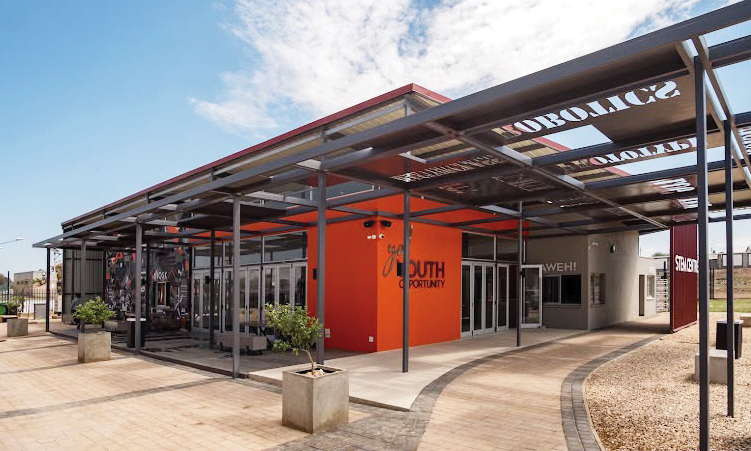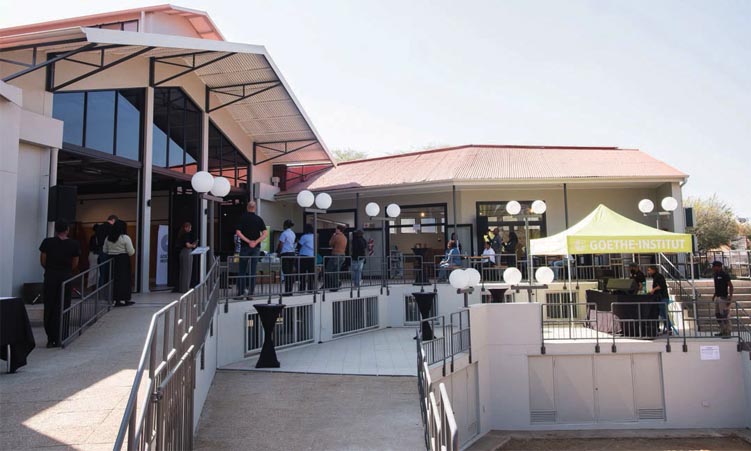
The Goethe-Institut Namibia’s new Windhoek premises are intended to serve as a shared space for cultural exchange, education and creative work, its director Dennis Schroeder said on Friday.
Schroeder said the building at the corner of Simon Shixungileni Street and Dr W Kulz Street, which is still being completed, would host activities ranging from German language examinations and literary events to theatre, music, film and book projects.
“You may have noticed that this place is not quite finished. The garden is still taking shape. We need more plants. The logo for the tower is being made as we speak. And the café is also getting there,” Schroeder says.
“In a way, that feels right. A cultural institution should never feel completely finished. It should keep changing with the people who enter it, the students who learn here, the questions they bring, and the work we create together,” he says.
The institute’s upcoming programme includes a literary event based on Rémy Ngamije’s ‘The Eternal Audience of One’, Ndayola Ulenga’s one-woman performance ‘KoKo: Patulula’, a Silent Book Club and a Language Café.
The venue will also host another edition of BookSprint Namibia, a 12-hour project bringing together Namibian writers, illustrators and designers to create children’s books. Musicians and producers from Namibia are expected to perform alongside a Berlin-based DJ, while the DOEK! Literary Festival and European cinema screenings are also scheduled.
Schroeder said the range of activities reflected the institute’s approach of bringing different forms of cultural engagement into one space.
“German exams, Namibian literature, theatre, music, film, and simply sitting quietly together to read. All at the same address. That gives you an idea of what we mean by ‘One Space. Many Stories’,” he said.
The Goethe-Institut previously operated from Fidel Castro Street, where it was known for cultural events, German-language learning and its library.
Schroeder said relocating the institute did not mean abandoning the relationships built at the former premises.
“We brought almost everything with us: the books, the equipment, the chairs and tables, the lamps. One thing we did not bring was the walls, and that turned out to be fine,” he said.
“Because none of what really mattered was ever in the walls. It was in the people who kept coming back, in the new people who walked through the doors for the first time, in our team, and in the relationships built over many years,” Schroeder said.
He linked the institute’s work to the broader relationship between Namibia and Germany, acknowledging the history of German colonial rule, violence and genocide.
“Namibia and Germany have an even longer shared history, and we know its darkest chapters: colonial domination, violence, and genocide. The crimes committed under German colonial rule cannot be undone or softened, and that is where any honest account has to begin,” he said.
Schroeder said cultural exchange could provide space for different perspectives on that history.
“A relationship must be able to do both: remember honestly and shape the future together,” he said.
The Goethe-Institut, which was founded in 1951, marks its 75th anniversary this year. Schroeder said its approach to cultural relations remained centred on dialogue, exchange and long-term engagement.
“This is where I see the potential of this place: not simply as a German house in Namibia, but as a Windhoek address where Namibian, German, and international perspectives can meet, and where something can emerge that none of us would have created on our own,” he said.
Schroeder said the building would ultimately depend on how people use it.
“A building is only a promise until people begin to use it,” he said.