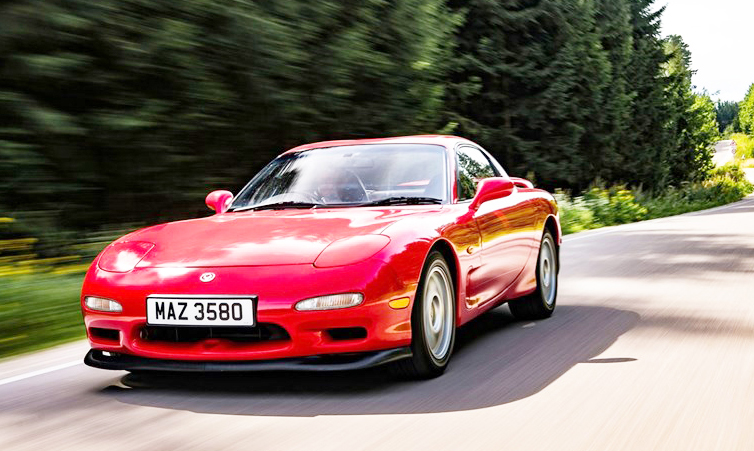
Mazda is the only current car manufacturer that’s been brave enough to stick with rotary engines with any commercially viable conviction – and, having recently spent some time chatting to the company’s executives, Car Magazine UK has learned the brand is getting quite serious about bringing them back.
The rotary was the engine of choice for Mazda’s flagship sport cars from the launch of the Cosmo in 1965, right up until the last RX-8 rolled off the production line in 2012.
They all made good power for their sizes, but their high fuel consumption and lofty emissions are what eventually forced the brand to kill them off. At least in its performance cars.
Mazda has already had a stab at bringing back the rotary in the MX-30 R-EV, but the engine had quite a boring job in that car as it was only being used to charge a battery pack.
And that’s not what Moritz Oswald, project manager for product planning and co-creation at Mazda Motor Europe, wants for the technology.
“The reason why people love the rotary is because of the revving, because of the sound, because of the vibration.
So, I think if we want to bring that to an audience, the easiest way is if you could let the customer experience how that engine revs,” he says.
What work has Mazda already done to revive the rotary?
Earlier this year, Mazda filed a patent for a rotary engine-specific exhaust gas recirculation (EGR) system that promises to make the technology cleaner and more efficient.
As an added benefit, it should also provide some extra performance as Mazda will be able to force more power through the engine without completely ruining its emissions or melting components.
The way Mazda’s patented EGR system works is quite complicated but, in simple terms, the rotary engine it would be attached to has two exhaust ports on the side of its housing.
The first one opens early in the combustion cycle to allow high-temperature exhaust gases to escape into a turbocharger. Which is what you want for making power.
The other one opens later, allowing colder spent gasses to be directed through an EGR cooler and back into the engine, dropping the temperatures inside the rotor housing and allowing Mazda to run a slightly leaner fuel-air mixture without worrying about turning its shiny new rotary engine into a knock-sensitive claymore.
This is a big shift. Older rotary engines were kept alive by firing more fuel at each combustion cycle – the extra helps to cool the housing and lower combustion temperatures – and enthusiasts turned a blind eye to the higher emissions and greater consumption. Mazda’s new patent could solve that issue.
And how will Mazda implement this in a car?
Mazda hasn’t publicly nailed this down yet but, judging from Oswald’s comments, we suspect it’ll be in tandem with some form of hybrid system.
One of the biggest hurdles Mazda needs to overcome with its rotary engine is emissions – and the toughest test is making sure it’s as clean as possible within the first 10 seconds of its runtime. But hybridisation might offer a route by which Mazda can game the system. – Car Magazine UK
– Luke Wilkinson is the deputy editor of Car Magazine’s sister site Parkers, but he spends time writing news, reviews and features for Car. He’s been a motoring journalist since 2018.
Read more on: https://www.carmagazine.co.uk/car-news/industry-news/mazda/rotary-engine-revival-plan/