






I recently had the pleasure of enjoying homely ‘northern’ Namibian hospitality when a friend invited me to drive with them to Rundu for a few days.
If you’ve ever driven that way, you know it’s not a quick dash and back. It takes a bit out of you. Rumor has it, it’s like driving across a few European countries all at once. I’ll leave you to guess which ones in relation to the distance.
The trip, largely uneventful, culminated with my buddy hosting me for a picnic luncheon at Rundu Beach, by the banks of the Kavango River.
I was tempted to go in for a dip, but the thought of a “snappy snappy” coming up and making me its lunch changed my mind real quick and my feet stood fixed on dry land. I later learnt about the incidents that usually happen during the festive season.
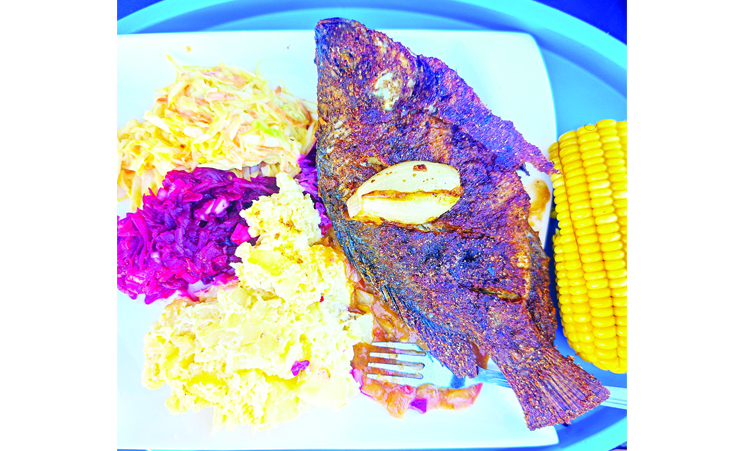
On the menu was fish and three types of salad/veggies and a corn on the cob.
As the title suggests, the focus this time around wasn’t how good everything looks on the plate, but how it all comes together in the mouth.
So I do apologise if you feel I failed on the “looks” front this week. It wasn’t a fancy getaway of sorts that needed you to pull out a picnic basket and blanket, along with the matching cutlery and all. It was two friends who decided to grab lunch from home, sit on a cooler box and the boot of the car, and just have at it.
Tilapia is one of those types of fish I don’t usually eat, but when I do, I tend to enjoy it a lot. And for some reason, I always eat it in this part of the country, except for that one time at Maun when a fishbone lodged painfully in my throat for quite a while.
Ordinarily, fish consumption as we discussed a few weeks ago is limited for the more central and coastal city folk. We love our hake fillets, our angel fish, kabeljou, kingclip, tuna. However, these are the more ocean-going type. The inland hero of the rivers, the soldier of the waters, such as tilapia and Zambezi bream, have been feeding families for years.
I again try not to depend on the frozen stuff, but being this far from freshwater means one might have to rely on the ice block fish and hope that it is somehow preserved in its freshest state.
My dish, therefore, was not aesthetically astute but was highly enjoyable. Apart from the labour of ripping the flesh from the bone (something which is easier and faster if you know and understand the anatomy of the fish), I really had no complaints.
The salads, though basic, were the perfect accompaniment to the star of the show. We were there to eat fish, not salads or starches.
Fried Freshwater Tilapia and Salad
Ingredients
n Tilapia (if frozen, thaw in the refrigerator and cook once thawed. Do not wait too long)
n 3 lemons
n 1 large onion, cut into rings
n 3 chopped garlic cloves
n 1 teaspoon curry powder
n 1 tsp onion powder
n 1 tsp paprika
n 1 tsp black pepper
n 1 tsp fish spice
n 1 bay leaf
n 2 tablespoons flour
n 1 tsp salt
n Oil
Method
- Wash and descale your fish, ensuring it is clean throughout. You may opt to de-fin it before you cook. It is, however, easier to pull them out once cooked.
- Place oil into a pan for frying, making sure the quantity of oil will cover half the fish when it is inside the pan.
- Slice lemons into medium thick rings and place inside the cavity of the fish, along with garlic, bay leaf and one cut medium thick onion ring. Set aside.
- Combine flour, together with all the dry spices and salt. Coat the entire fish and fry on medium heat until golden. This will take about 10 minutes or less on each side, depending on how big the fish is.
- Remove lemon on the inside and place fresh lemon slices on top, making sure to squeeze the juice out of a slice or two when eating. Serve and enjoy!