Rice farmers say a lack of machinery, irrigation equipment, fencing and market access is slowing the growth of rice production in Namibia.
They say these challenges are limiting production and making it harder to expand their businesses.
Omusati farmer Johannes Muzanima says access to equipment and reliable markets would allow more farmers to produce rice on a larger scale.
“Our journey into rice production started with a simple vision. We wanted to grow something unique rather than cultivating the same crops most farmers in our area produce,” he said during the University of Namibia (Unam) Ogongo campus’ annual Rice Harvest Festival on Monday.
Muzanima said Harvest Investment CC harvested 2.5 tonnes of rice in 2024 and five tonnes in 2025, and expects seven tonnes this year.
He said planting, harvesting and threshing are still done by hand.
“We are still planting rice manually, which is labour intensive and time consuming. Harvesting and threshing are also done manually, which makes the process slow and less efficient,” he said.
Muzanima said finding buyers remains another challenge.
Another rice farmer, Foetus Amunwe from the Onyaanya constituency, says hard work has helped him achieve his harvest.
“Rice farming is not easy. I never thought I would harvest anything, but this year I worked hard, and my harvest sold out,” he said.
Amunwe said livestock often destroy rice fields, since many gardens are not fenced off.
“Our gardens are not protected. The lack of fencing makes survival hard and our gardens are often vandalised by livestock,” he said.
He said another challenge is selling rice through formal retailers.
“Sometimes shops would like to have our rice, but that is difficult because our packaging has no barcode. We need a barcode so we can sell our rice in shops,” Amunwe said.
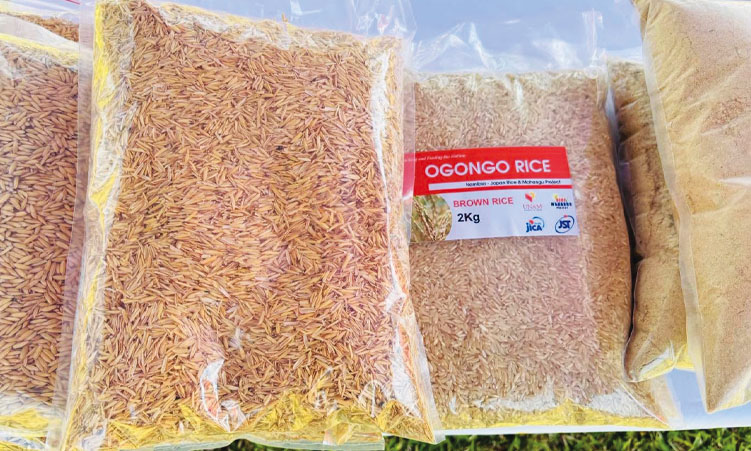
At the same event, Unam announced another increase in rice production at its Ogongo campus.
Unam vice chancellor Kenneth Matengu said the university expects to harvest more than 23 tonnes of rice this year from its 7.5-hectare field, compared to 21 tonnes harvested in 2025.
Matengu said rice has become part of Namibia’s efforts to strengthen food security and adapt to climate change.
He said the university is now placing greater emphasis on adding value to agricultural products.
Some 190 farmers in the Onyaanya constituency have been trained in rice production since 2025, bringing the total number trained under the Namibia-Japan rice and mahangu project to more than 4 000, he said.
Matengu appealed to the Namibian Defence Force to clear unexploded military ordnance from land earmarked for future rice production.
“We need this particular area designated for rice expansion to be demined. We need to make sure the people who will be cultivating there are not blown off by unexploded ordnances,” he said.
Debmarine Namibia chief executive Willy Mertens said Debmarine has invested about N$1 million in rice production and poultry farming at the Ogongo campus since 2022.
“The future of agriculture lies not only in increasing production but also in ensuring farmers derive greater value from what they produce,” he said.
Mertens said more agricultural machinery is needed to help farmers increase production.
“Mechanisation enables farmers to cultivate larger areas more efficiently, improve planting accuracy, reduce post-harvest losses and optimise the use of scarce resources,” he said.
The deputy head of mission at the embassy of Japan in Namibia, Noriaki Sadamoto, said Japan will continue supporting Namibia’s agriculture sector through research, training and climate-smart farming.