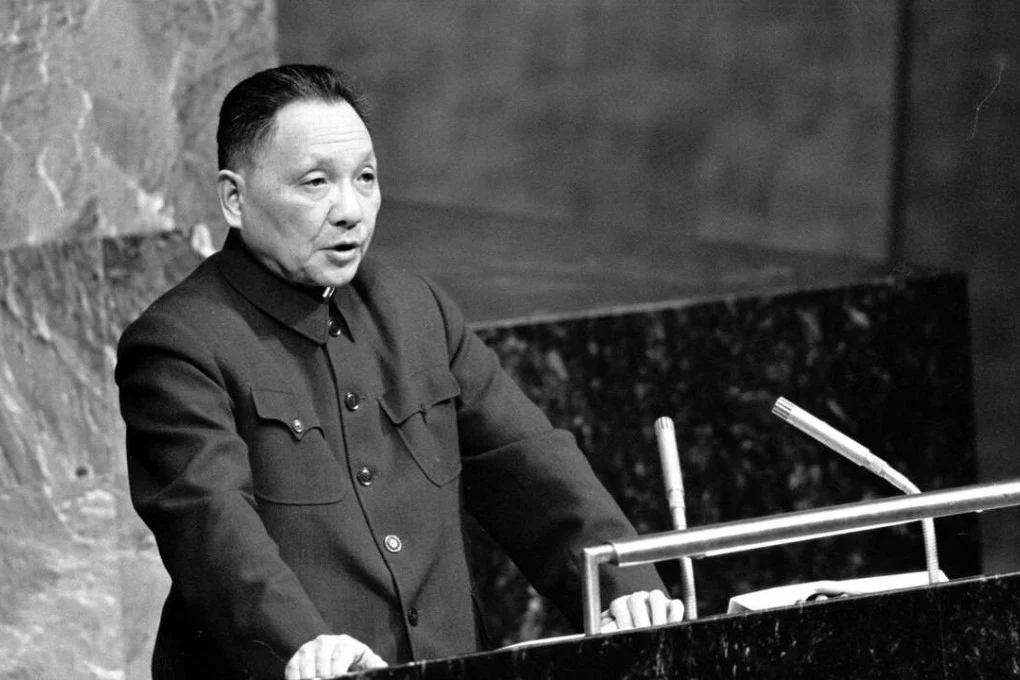
November 1978, Chinese leader Deng Xiaoping visited Singapore on a diplomatic mission.
Impressed by the prosperity he had seen, Deng concluded that Maoist economics did not work. On his return to China, he told his officials to study Singapore and to do better than them.
Deng subsequently opened up China to foreign investment.
Decades later, Lee Kuan Yew, Singapore’s then prime minister, would call Deng the greatest man he had met, praising him for admitting late in life that “Marxism, Leninism, Maoism, they are just not working and have to be abandoned”.
China has been one of Namibia’s key trading partners for decades, and there have been concerns that the terms often favour Beijing.
There is no doubt that China, like any powerful country, looks after its own interests.
Its footprint in other countries leaves much to be desired, including concerns around human rights abuses and debt traps in developing countries such as Pakistan and Sri Lanka.
This is why president Netumbo Nandi-Ndaitwah’s visit to China is a test of what progressive reforms Namibia can learn from Beijing.
The president is right that Namibia should learn from China in the fields of artificial intelligence, agriculture, energy, and other sectors that help grow economies.
However, failure to learn and implement will once again result in an overseas trip being branded as another joyride for politicians and technocrats.
From a practical perspective, one must critically question the usefulness of taking along a delegation of more than 200 Namibians.
A delegation of that size risks transforming a strategic diplomatic mission into mere tourism on a diplomatic passport.
Genuine bilateral progress for a developing nation is forged through precise, sector-specific negotiations aimed at national industrialisation, not by flooding foreign boardrooms and halls with scores of delegates seeking individual commercial profit.
China says it has directed capital towards targeted poverty alleviation programmes at the grassroots level and uplifting the working class.
Through their industrialisation drive, China built domestic factories and manufacturing capabilities.
Conversely, Namibia’s trade relationship with China remains rooted in an archaic, extractive paradigm.
Namibia exports raw materials like uranium and lithium to China and, in return, imports manufactured goods and machinery.
China currently dominates Namibia’s uranium market and has now entered the market to supply water through a desalination plant.
Thanks to mines minister Modestus Amutse, a Chinese company will also have a monopoly in the cement industry.
So, the Chinese companies know what they want.
Namibia’s overall export earnings increased to N$12.4 billion in May, a 25.9% increase compared to April 2026 and a 6.6% rise compared to May 2025.
Uranium was the largest contributor to Namibia’s export surplus, generating a N$2.8 billion surplus, followed by fish and non-monetary gold at N$1.3 billion each, and diamonds at N$1.2 billion.
However, Namibia continued to spend heavily on imported goods, with total imports reaching N$15.5 billion during the month.
A trade surplus built entirely on raw mineral extraction creates an illusion of prosperity.
There are already concerns that Namibians cannot eat trade statistics and that they need food bought with wages earned in value-adding industries. Until Namibia transforms, these massive delegations will remain superficial pageantry.