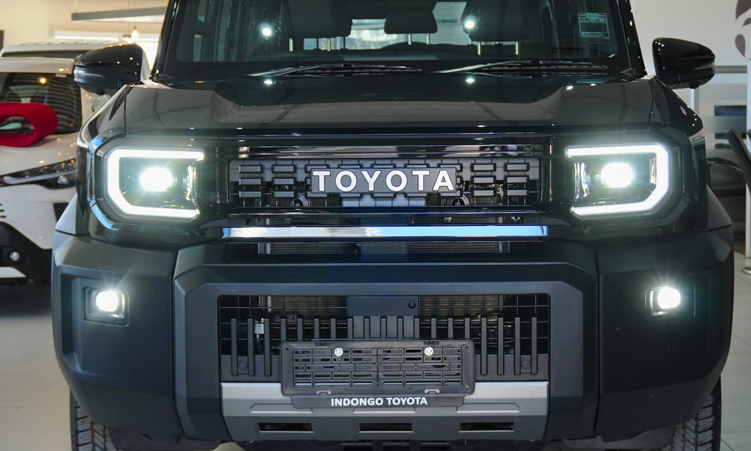
A Photograph may capture the look of a vehicle, but the new Toyota Land Cruiser FJ is one that is best appreciated in person.
The second-generation FJ returns with high expectations following the success of the iconic Toyota Land Cruiser FJ40, first introduced in 1960.
The original FJ built a loyal following but was also criticised for its limited rear passenger access because of its door design and its relatively high fuel consumption from the standard 4.0-litre V6 engine, available with either a five-speed automatic or six-speed manual transmission.
“Subtle, but aggressive,” is how Genivo Mouton of Indongo Toyota describes the latest model.
Standing next to it, the boxy design immediately signals its off-road intent.
Powered by a 2.7-litre petrol engine, the new FJ produces 122kW at 5 200rpm and 245Nm of torque at 4 000rpm.
Mouton says the smaller engine still delivers the capability expected of a Land Cruiser.
Fuel consumption is also lower than many would expect for a vehicle of this size, with a claimed combined figure of 11.7 litres/100km.
Combined with its 63-litre fuel tank, the FJ offers a useful touring range between fuel stops.
“The mere fact that the car leaves lasting impressions cannot be denied.
It is something I did not expect,” Mouton says.
The FJ is available in two derivatives: the 4×4 AT GX and the VX, with only minor differences between the two.
“The drive comfort is outstanding. Despite the smaller engine compared to the first generation, the gear ratios and power delivery complement each other,” he says.
The vehicle features a part-time four-wheel-drive system, double wishbone front suspension and a four-link rear suspension, designed to improve handling both on and off the road.
It rides on 265/65 R17 alloy wheels as standard, while the VX receives 18-inch alloy wheels.
A ground clearance of 245mm, together with a 29-degree approach angle and a 38-degree departure angle, further enhances its off-road ability, allowing it to tackle demanding terrain with ease.
One of the biggest changes is the move to a conventional four-door layout.
Unlike its predecessor, which had two main doors and two smaller rear-hinged doors, the new FJ offers easier access for rear passengers.
The side-hinged tailgate also makes loading luggage more convenient.
Mouton says the vehicle appeals to a broad market, from younger buyers to experienced off-road enthusiasts, adding that several FJs are already on Namibian roads and that customer orders indicate strong demand.
The FJ is equipped with a comprehensive range of driver assistance and safety systems, including anti-lock braking (ABS), blind-spot monitoring, brake assist, downhill assist control and traction control for improved stability on loose or slippery surfaces.
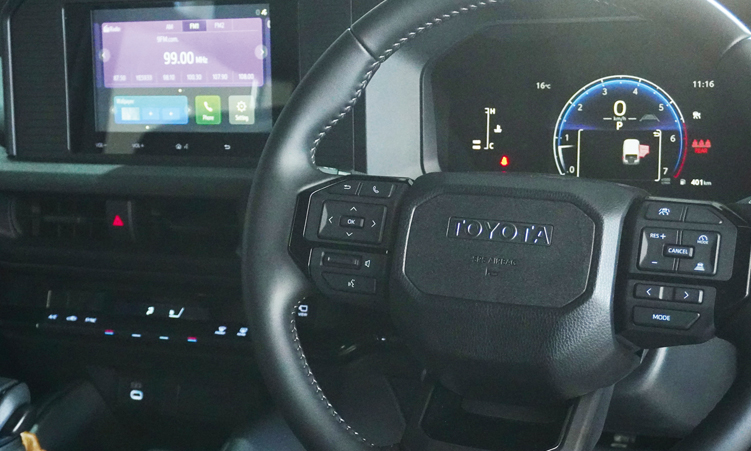
Standard comfort features include dual-zone automatic climate control, Android Auto and Apple CarPlay connectivity, an 8-inch infotainment display, cruise control, electric windows, reclining front seats with height adjustment, power steering, illuminated entry, a reversing camera, and a manually adjustable tilt-and-telescopic steering wheel.
Perhaps the biggest surprise is the price. The flagship VX is priced at under N$780 000, while the GX costs about N$50 000 less.
Before the FJ’s official arrival, speculation suggested it would carry a seven-figure price tag.
Instead, Toyota has positioned it well below that mark, making its return even more compelling.