FRANCIS XOAGUBSAN communities in the Omaheke region feel their classification as ‘marginalised’ is discriminatory, and could lead to further segregation and humiliation.
The group has, therefore, called for an end to the usage of the term ‘marginalised’ in reference to the San people, noting that it encourages the perpetuation of deeper poverty and suffering for them.
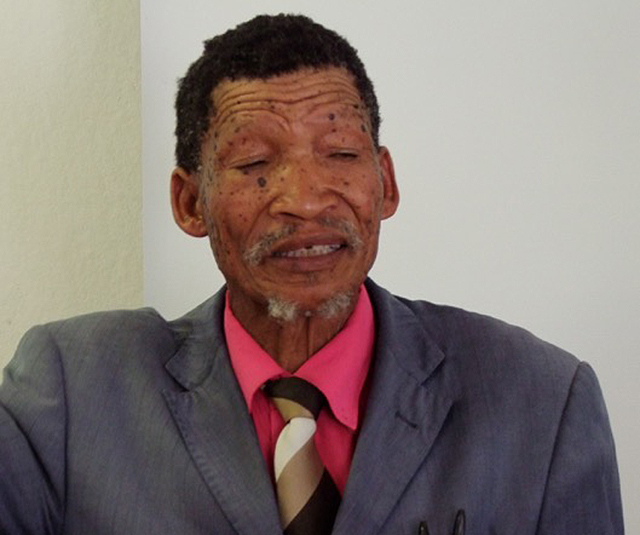
Chief Frederick Langman of the ≠Kao //Aesa Traditional Authority made the call during a recent workshop on improving the economic and social viability of the group’s resettlement farms.
“I have swallowed enough of these glowing coals, and want to get rid of what is in my heart because it burns me. Stop using this term,” he told the workshop, which was attended by representatives from group resettlement farms at Versailles, Ondera, Skoonheid, Meyerton and Kalahari Prag.
The San, along with the Ovatue, Ovatjimba and Ovazemba are classified as marginalised communities.
These are the community groups regarded as being disproportionately tormented by poverty, compared to other communities in Namibia.
The marginalised communities division was created in 2015 under the vice president’s office to improve the living conditions of these groups.
About 200 San were resettled on Farm Skoonheid in Omaheke in 1993, where the government built 72 houses for them on 2 120 hectares under the programme.
But unrelenting Langman said the term adds no value to his people, and should not be used in reference to the San people.
“To be called marginalised is equal to killing the San community, and making us suffer even more.”
He added: “Imagine staying without food for 11 months, and running around begging for food from other people while the so-called marginalised programme is there to supposedly help you.”
The chief claimed that the San were being intentionally sidelined when it came to developmental programmes, especially in the Omaheke region.
“Our children are dying at Skoonheid because they do not have enough food, and our livestock have been drastically decreased from the original 200 to a mere 20. That is outrageous,” he charged.
The chief also condemned the group’s resettlement programme, which he compared to the apartheid practice that was characterised by the ‘my baas’ syndrome”.
He said the resettled San communities now have very little or no access to land on their own account.
“We still believe we are the rightful inhabitants of this country, and should be treated as such. If they [other tribes] think we are from another country, send us back,” Langman stated.
He said the resettlement programme should also be revised as it was leaving the San, the youth, women and the downtrodden without farms, and was only benefiting those with money.
At the same occasion, community activist and workshop facilitator Uhuru Dempers said the San communities were still being subjected to the worst kinds of discrimination and oppression by their fellow countrymen, similar to what they endured during pre-independence Namibia.
“The San are disadvantaged by past discrimination as well as by current discrimination by us.We are responsible for the pain inflicted on these people, and we need to work on that,” he stated.
Contacted for comment, an official from the office of the vice president who preferred anonymity, confirmed that they are aware of the concerns raised by the communities, and they are attending to them.
“We are currently conducting consultations with the relevant communities and authorities. Most of the changes sought are well on their way to completion, and will be submitted soon through a white paper,” said the official.
The San in Namibia number between 27 000 and 34 000, and represent between 1,3% and 1,6% of the country’s population.
The San have different groups, and each group has its own language and distinct customs, traditions and history. The groups include the Khwe, Hai//om, Ju/’hoansi, !Xun, Naro and !Xoo.
The San were in the past mainly hunter-gatherers. But today, many have diversified livelihoods. Some are domestic or farm workers, others grow crops and raise livestock, do odd jobs in rural and urban areas, as well as engage in small-scale businesses and the provision of services.
More than 80% of the San have been dispossessed of their ancestral land and resources, and today they are some of the poorest people in the country. While the Namibian Constitution prohibits discrimination on the grounds of ethnic or tribal affiliation, it does not recognise the rights of indigenous peoples or minorities.
The Namibian government prefers the term “marginalised communities” rather than “indigenous peoples” to refer to these minority groups.