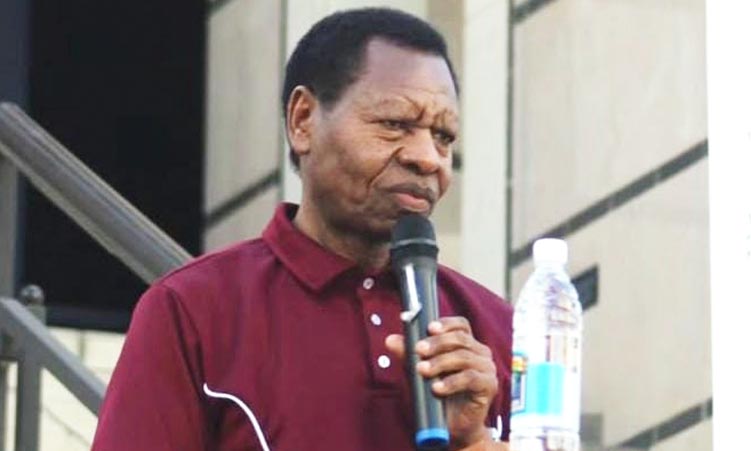
The professional demands encountered by judicial officers must not be met at the cost of their health, chief justice Peter Shivute says.
“The demands are real and, at present, they are considerable. What I do not accept is that they must be met at the cost of our health,” Shivute said in Windhoek on Saturday, at an event to mark the International Day for Judicial Well-being.
“A set of scales, however finely made, cannot weigh anything accurately once its balance is damaged. Neither can we,” Shivute added in remarks made at the Supreme Court.
The United Nations General Assembly in March last year proclaimed 25 July each year as the International Day for Judicial Well-being, following the adoption of a declaration on judicial well-being at a regional judicial conference in Nauru (Naoero) in the south-western Pacific Ocean in July 2024.
Those developments did not occur in a vacuum, but followed on international research that revealed high levels of occupational stress within judiciaries across the globe, together with comparatively low levels of acknowledgement and action in response to it, Shivute said.
The nature of judicial office has constrained judicial officers from speaking openly about the difficulties they face, the chief justice said.
He also said there is a close relationship between judicial well-being and the proper administration of justice.
That does not mean that judicial officers who experience stress lack competence or integrity, or that they are failing at their work if they feel strain, Shivute added.
“The Nauru Declaration states the position plainly: judicial stress is not a weakness and must not be stigmatised. Judicial work is demanding, and stress is a natural human response to those demands. That is important for us to acknowledge,” Shivute remarked.
“Judicial officers are required every day to make decisions affecting liberty, livelihoods, families and property,” he noted.
“They must absorb large volumes of information, manage demanding caseloads, confront difficult human circumstances and still approach each matter with patience, independence and impartiality.”
Judicial office demands composure, Shivute said as well.
“Whatever the complexity of the case, the pressure of the workload or the gravity of the decision to be made, the judicial officer is expected to remain calm, measured and in control. But what is visible above the surface tells us very little about what is happening beneath it,” he said.
Shivute further said the administration of justice is a collective endeavour, and judicial well-being is also a shared responsibility.
“Judicial officers must take active steps to maintain their own well-being, but courts, judicial leadership and court management must also create working conditions that are conducive to it,” he stated.
Shivute called on staff members of the Office of the Judiciary to look after themselves and also after one another, and to speak about their well-being.
“A judiciary able to speak honestly about its own humanity will be a stronger and more upright judiciary, not a weaker one,” he said.