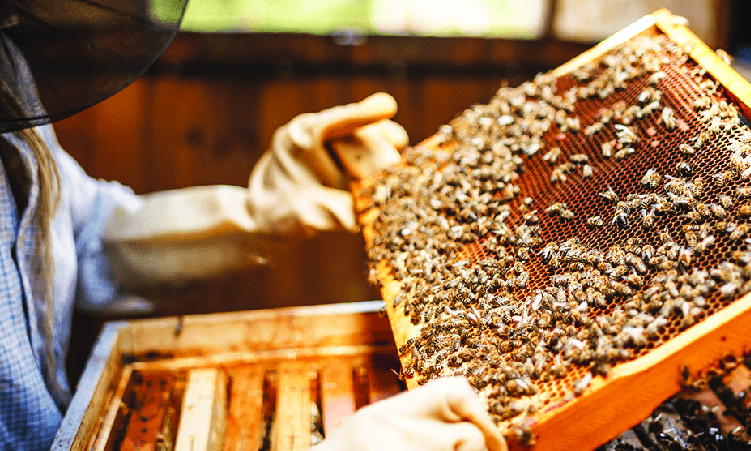
Namibia faces a gap in detecting and managing bee diseases because bees are not adequately covered by the country’s animal health system.
The issue was raised at the national apiculture role-player workshop held in Windhoek recently.
The workshop brought together government officials, beekeepers, farmers, researchers, honey traders, training institutions and other role-players who discussed challenges facing the sector.
The workshop aimed to review the laws and policies governing beekeeping, clarify the responsibilities of government institutions and identify gaps affecting the industry.
The discussions are expected to contribute towards a National Apiculture Framework.
Beekeeping Association of Namibia managing director Gretchen Burmeister says Namibia already has laws that could be used to regulate bee health, but gaps remain in their implementation.
“The main thing is we already have an act that looks at the things that are connected to world trade, and the world health that we are obliged to keep,” she says.
Burmeister says international bodies, including the Food and Agriculture Organisation (FAO), recognise bees as animals when dealing with animal health and disease.
“We are, since last year, obligated as a country to put bees under animals,” she says.
She says this means bee diseases should also be dealt with under Namibia’s animal health laws.
Burmeister says Namibia does not necessarily need a separate law for bees.
“We already have an act; it is the regulations and the implementation, so to have another act is not actually required, but rather certain bodies that should be more substantiated or supported, both in the government and with the private sector,” she says.
Burmeister adds that veterinarians and beekeepers need specialised training to improve the detection and management of bee diseases.
Environmental Lawyers Network of Namibia chairperson Des-Rose Englebrecht says the Animal Health Act already provides a legal foundation that could be used to deal with issues such as bee diseases, movement, biosecurity and food control.
“The problem, however, is that the act has not been properly operationalised for the agriculture sector, which is inclusive of various types of needs, and not just land communities, which is the main focus,” Englebrecht says.
She says Namibia should also make use of existing African Union guidelines on beekeeping instead of developing a system from scratch.
“The question is, why are we not using and implementing the framework that was specifically developed for the African conditions?” she questions
She says a national mechanism is needed to bring the different institutions and role-players together.
“The current fragmented approach is not producing any coherent outcomes for the sector,” Englebrecht says.
Director of forestry Johnson Ndokosho says the Forest Act mainly refers to honey-producing organisms, which creates uncertainty over the protection of bees and other pollinators.
“There are only two sections that are speaking about honey-producing organisms.
“So, when discussing bees and honey-producing organisms, it’s important to note that some bees do not produce honey. You know that. What about those bees? They are not protected,” he says.
Ndokosho says another problem is uncertainty over which government institution should handle different aspects of bee management.
“The other challenge that we do know about, certainly, is that of coordination and lack of clarity,” Ndokosho says.
He says forestry and agriculture authorities have previously discussed where responsibility for bee management should fall, given the role bees play in agriculture and food production.
Ndokosho says the discussions led to efforts to establish a task team to look at bee management across government institutions.