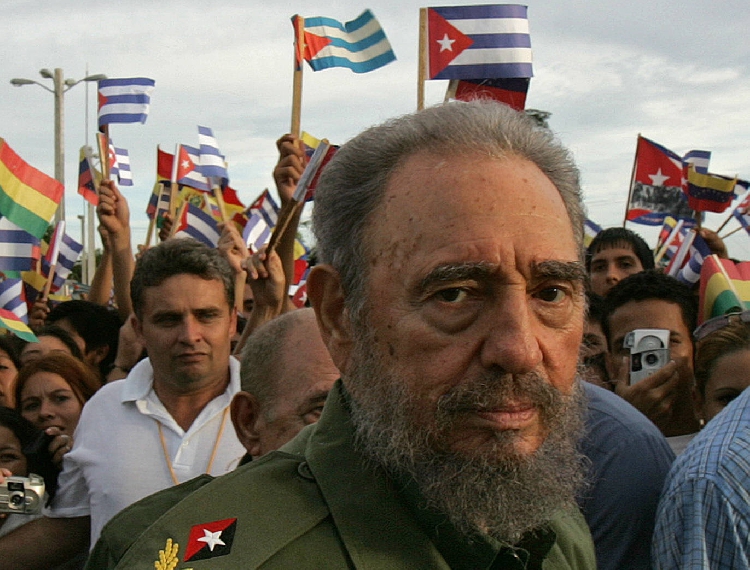
A NAMIBIAN who was taken to Cuba during the country’s war of liberation yesterday recalled how the late revolutionary leader Fidel Castro used to say lo poco que tenemos tiene que dividir (whatever little you have, you must share with others).
Reacting to the news of Castro’s death at the age of 90 on Friday in Havana, Beatrice Aikali (49), said she broke down and cried when she heard of it.
Aikali and journalist Maggie Thomas were among the many children who were airlifted to Cuba from Angola by Castro’s government, which offered them education and sanctuary.
Both yesterday related how Castro would visit them at the Island of Youth, where Cuba had set up two schools –the Hosea Kutako Primary School and the Hendrik Witbooi University – for Namibian children.
“I cannot begin to describe the way he assisted us from the time we arrived in Cuba,” Aikali said. “He always used to tell us lo poco que tenemos tiene que dividir,” she noted.
Aikali said she will remember Castro as a selfless man, who provided them with basic needs for nothing in return. Although she would like to attend Castro’s memorial, Aikali said she is unable to do so.
“Even though we are not there physically, we are with the Cuban people, and we are mourning together,” she said. Thomas was 12 when she left for Cuba in 1982. She also recalled Castro visiting them at school with Founding President Sam Nujoma, assuring them that they would be reunited with their parents.
“He would tell us about the war in Angola and Namibia. He gave us moral support, and told us to be serious with our studies so that we could come back to Namibia and develop the country,” said Thomas.
She said Cubans and Castro took them in like their own since most did not have families.
“I was just a small girl when I went to Cuba. But I came back a woman. Cuba took us where we are today,” Thomas added.
President Hage Geingob on Saturday hailed Castro, and described his death as a tragic loss to the world, not only of a revolutionary leader, but a father, uncle, brother and friend.
In his message of condolence, Geingob said Castro taught him and others not to compromise on one’s principles. He also said
Castro had no interest other than the liberation of the oppressed.
According to Geingob, Castro’s unwavering commitment to Namibia’s freedom led to the demise of apartheid in the country.
“Our own victories and losses in the struggle for our independence against apartheid South Africa are inextricably linked to the international solidarity of the Cuban people through diplomatic, military, and the people-to-people interface,” he said.
Nujoma, who last saw Castro in September during a visit to Cuba, said he celebrates his life dedicated to the generous service of his people and humanity at large, despite the loss.
According to Nujoma, Castro was a charismatic and visionary revolutionary leader who earned his place in modern history because of his strong stance against imperialism and his exceptional resilience against colonialism and oppression all over the world.
“We shall forever remain grateful for the all-round political, diplomatic and material support rendered to the struggling people of Namibia, including in the fields of education and health, by the people of Cuba under the wise and able leadership of Castro,” Nujoma stated.
Swapo secretary for information Helmut Angula said in a statement on Saturday that Castro provided Namibians with hope, inspiration and impeccable leadership during the difficult times of the struggle for independence.
“His selfless sacrifice inspired revolutionaries in all corners of the world to fight relentlessly for justice, freedom and human dignity,” he added.
Youth minister Jerry Ekandjo said the world has lost a revolutionary leader, peacemaker and freedom fighter.
“He is a hero of the Namibian revolution and of the Third World. It is the Cubans who fought during our struggle, and they were physically involved. There is no doubt that he contributed to our independence,” Ekandjo said.
Andrew Ndishishi said Castro’s Cuba did not only support the training and development of the People’s Liberation Army of Namibia to fight the South African war machinery, but also prepared young Namibians in terms of education and training in anticipation of the reconstruction and economic development of an independent Namibia.
“Today, many Namibian engineers, medical doctors and scientists, products of the Cuban revolution, are playing a critical role in the socioeconomic development of Namibia for the betterment of all. We are confident that the people of Cuba shall continue to uphold the revolutionary principles and spirit of Commandante Fidel,” he said.
In an age of information overload, Sunrise is The Namibian’s morning briefing, delivered at 6h00 from Monday to Friday. It offers a curated rundown of the most important stories from the past 24 hours – occasionally with a light, witty touch. It’s an essential way to stay informed. Subscribe and join our newsletter community.

The Namibian uses AI tools to assist with improved quality, accuracy and efficiency, while maintaining editorial oversight and journalistic integrity.
Stay informed with The Namibian – your source for credible journalism. Get in-depth reporting and opinions for
only N$85 a month. Invest in journalism, invest in democracy –
Subscribe Now!